Lesson 05 — A Circle Where Everyone Belongs
Learners recall a time they felt welcome, name what made it welcoming (a smile, a space, their name said, an invitation, a helping hand), and build a real "welcoming circle" — then practice making room so that no one is left outside and everyone belongs.
Objectives
Objectives
- D02.S3.02.01 Explain what makes a group feel welcoming and inclusive to everyone in it.
Essential question
What makes a group feel welcoming and inclusive to everyone in it?
Key vocabulary
Materials
Standard materials
- Chart paper and markers · 1 set For a class list of "what makes a group welcoming"
- A long ribbon or rope · 1 To hold a real circle together, with room for one more to join
Low-tech / no-cost
- Held hands and voices Form a real circle and practice inviting someone in; no props needed
- A doorway or open space Practice leaving a space in the circle and making room for a newcomer
Enriched / lab & device
- A class "welcoming circle" poster The class's own welcoming words and actions, displayed all year
- Camera or tablet · 1 per group Record the class saying each welcoming word in their home languages
Works in different contexts
- large-group Build the circle with the whole group, then practice making room so no one is left outside
- self-directed A learner writes or draws three things that make a group feel welcoming, then shares with a trusted person
- outdoor-only Draw a circle in the dirt or sand with a gap, and act out inviting someone in to close it
- multi-age Older learners demonstrate welcoming a newcomer; younger learners practice saying "welcome" and making a space
- level-grouped Learners ready to extend explain why belonging matters and what happens to a person left outside the circle
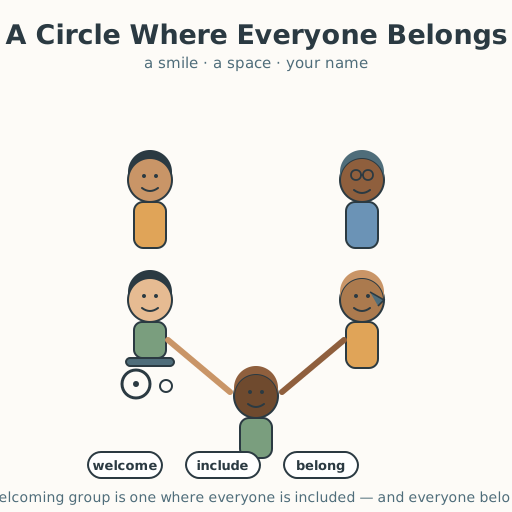
Lesson 5 — A Circle Where Everyone Belongs
Summary
Learners think back to a moment they felt truly welcome, name the small things that made it so — a smile, a space, their name said with care, an invitation, a helping hand — and build a real welcoming circle. Then they practice the harder part: making room, so that no one is left outside and everyone belongs. This gathers the year’s work on community and carries it into the celebration.
Objectives
- Explain what makes a group feel welcoming and inclusive to everyone in it. (D02.S3.02.01)
Connection
In every community, people make newcomers feel welcome in small, real ways: a bowl of food set out, a door held open, a name learned and said right, a space made in the circle. A group that feels welcoming is one where nobody has to squeeze in or be left out — there is a place for everyone. All year your class has been learning to be that kind of group. Today you name how you do it, so you can keep doing it on purpose.
Materials
- Chart paper and markers
- A long ribbon or rope (optional)
Preparation
- Set out chart paper to list “what makes a group welcoming.”
- Arrange space for a real circle, big enough for everyone plus one more.
- Have the class’s earlier “welcoming group” ideas ready to look back on (optional).
Facilitator note
This lesson is written to the learner (“you”). It spirals back to the “caring and working together” unit’s work on welcoming groups, now made real in the body. The commitment is everyone belongs — no one is left outside. Guide learners toward concrete, doable welcomes (a smile, a space, a name said right, an invitation, a helping hand, listening) rather than grand gestures. Be tender here: a learner may remember a time they were not welcomed; honor that gently and turn it into agency — “what would have helped you?” Make the circle wide enough for a wheelchair to enter, and accept a learner’s own way of joining (standing, sitting, signing “welcome,” patting the space beside them). The invitation is the lesson: belonging is something we do, and we can all do it.
Procedure
- Gather (5 min). Think of a time you felt welcome somewhere — a home, a playground, a class, a celebration. What did someone do that made you feel you belonged?
- Name what welcomes (10 min). Together, list what makes a group welcoming: a smile, a space made for you, your name said with care, an invitation to play, a helping hand, someone listening. Write them on the chart.
- Build the circle (10 min). Stand in a real circle, holding hands or a ribbon. Look around — this is your class community. Notice that everyone is inside.
- Practice making room (15 min). Now make a gap in the circle and choose one person to step outside. That person waits, just for a moment. Then, from inside, welcome them back the way your list says: smile, say their name, make a space, reach a hand. Watch the circle close around them — no one left out.
- Close (5 min). A welcoming group is not an accident; it is something people do on purpose, every day. Your class has become that group. At our celebration, make sure everyone has a space — because everyone belongs.
Differentiation
- Support: Act out one welcome at a time; give a simple script (“Welcome, [name]. Here is a space for you.”).
- Support (non-speaking): Welcome with a smile, a wave, a pat of the space beside you, or a sign for “welcome.”
- Support (blind/low-vision): Welcome with a spoken name and a held hand or arm, describing the space made.
- Support (mobility): Keep the circle wide and open so a wheelchair or walker can enter; invite a learner to pat the space beside them instead of standing.
- Extension: Explain in your own words what happens to a person left outside the circle, and one way you will make sure that does not happen at the celebration.
Assessment
- Formative (performance + observation): Can the learner name at least two things that make a group welcoming and do one of them (say a name, make a space, offer a hand) to include someone?
Home connection
At home, practice one welcoming thing — learning and saying a visitor’s name with care, or making a space at the table — and tell someone why it matters.
Resources
- CASEL SEL Framework (social awareness, relationship skills): https://casel.org/fundamentals-of-sel/