Lesson 06 — Many Hands, One Big Job
Learners take on a real task that no single person could finish alone — carrying a heavy or long thing, or building one big thing together. They plan who does what, do it, and reflect on how cooperation turns "too heavy for one" into "we lift it together."
Objectives
Objectives
- D02.S4.02.01 Cooperate with others to finish a task that no one could do alone.
Essential question
How do we cooperate to finish a task that no one could do alone?
Key vocabulary
Materials
Standard materials
- A real cooperative task (a long pole to carry, a heavy basket, a big puzzle, or a large picture to color together) · 1 Something too big or heavy for one learner, but right for many hands
- Chart paper and markers · 1 set For a "how we did it together" plan
Low-tech / no-cost
- Bodies and a found object Carry a heavy log or a full water jug together, or move a big stone as a team
- Voices Plan aloud who does what, then do it; no props needed
Enriched / lab & device
- A class building set or large floor puzzle · 1 set A structure or picture no one learner could finish alone in the time
- Camera or tablet · 1 per group Record the team lifting or finishing together, then watch it back
Works in different contexts
- large-group Split into small teams, each with its own one-person-cannot-do-it task, then share how they planned and did it
- self-directed A learner designs a job too big for one (a tower, a picture) and explains what part each helper would do
- outdoor-only Carry a heavy branch or stone together, or build one long wall of stones as a team
- multi-age Older and younger learners team up so the younger ones see a plan and a role modeled, then take a turn leading
- level-grouped Learners ready to extend write the plan first (who does what) and check it after, naming one thing they would change
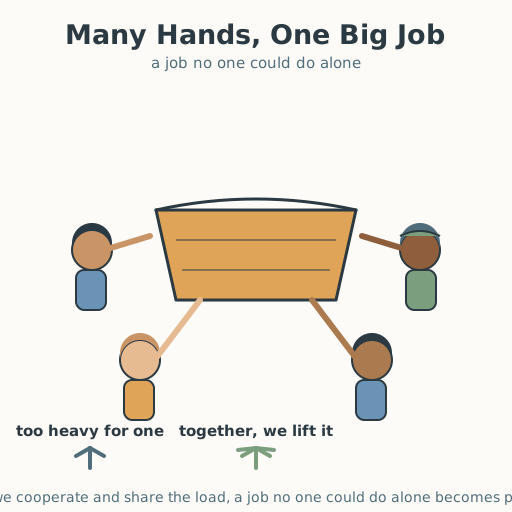
Lesson 6 — Many Hands, One Big Job
Summary
Learners face a real task that no one person could finish alone — a heavy or long thing to carry, or one big thing to build — and discover that cooperation is how it gets done. They plan who does what, do the job together, and reflect that each person’s part mattered. This gathers the year’s teamwork and prepares the class to make the celebration together.
Objectives
- Cooperate with others to finish a task that no one could do alone. (D02.S4.02.01)
Connection
Think of a thing one person cannot do alone: lifting a heavy basket of grain, pushing a boat into the water, building a house, carrying a harvest in from the field. All over the world, people do such jobs by working together — many hands, one job. A task that is “too heavy for one” becomes “just right for many,” when each person takes a part. Today your class becomes a team that can do what no single one of you could do.
Materials
- A real cooperative task (a long pole, a heavy basket, a big puzzle, or a large picture to make together)
- Chart paper and markers
Preparation
- Choose a task that is genuinely too big or heavy for one learner, but right for the group (carry a long bench or pole; move a heavy basket; finish a big floor puzzle; color one large picture).
- Set out chart paper for the plan.
- Arrange space to move and work together safely.
Facilitator note
This lesson is written to the learner (“you”). It makes cooperation real and physical, not a slogan. Choose a task that is truly a one-person-cannot-do-it — if a child could do it alone, the lesson loses its point. Safety first: pick tasks with no pinch points or falls, and guide the lift (bend knees, lift together, on a count). The egalitarian note is that every part matters and no part outranks another: the person holding the far end is as needed as the one holding the near end. A learner who uses a wheelchair or has limited strength can direct, count, clear the path, steady the load, or cheer the team — all real parts. Make sure every learner has a part to point to in the reflection (“that was my part”). The reflection, not the lifting, is where the learning lands.
Procedure
- Gather (5 min). Here is a job. Try it alone — you cannot finish it. That is not because you are not strong or smart; it is because some jobs need many hands.
- Plan together (10 min). Look at the job and plan as a team: who holds where, who guides, who clears the way, who counts “one, two, three, lift!” Write or say the plan. Every person needs a part.
- Do the job (15 min). Do it together, following the plan. Listen, adjust, and help. If one part wobbles, another person steps in — that is cooperation.
- Check your work (10 min). Did you finish what no one could do alone? Yes. Say each person’s part out loud: “You held the far end, I held the near end, you cleared the path.” Every part mattered.
- Close (10 min). A job too heavy for one is just right for many. Tomorrow, at our celebration, the whole class will make something together — and now you know exactly how that works.
Differentiation
- Support: Give each learner one clear, simple part and a partner to do it with.
- Support (mobility/strength): Offer non-lifting parts — directing, counting, steadying, clearing the path, cheering — and name them as real parts.
- Support (non-speaking): Use pointing, signing, or a pictured plan to choose and show a part.
- Extension: Write the plan before doing it, then after, name one thing you would change next time.
Assessment
- Formative (performance + observation): Did the learner take a part in a shared task that no one could do alone, and can they name their own part and one other person’s part?
Home connection
Find one job at home that is too big for one person and do it together, then tell someone how each person’s part mattered.
Resources
- CASEL SEL Framework (relationship skills): https://casel.org/fundamentals-of-sel/