Lesson 07 — Our Care, Our Celebration
The year closes with a portfolio celebration and a reflection on care: every learner's year of work is displayed equally, each child shares one remembered act of care, and the class reflects on why helping others helps everyone — including themselves — then looks ahead to Grade 3. A celebration, never a contest.
Objectives
Objectives
- D01.S2.02.01 Identify their personal strengths and one thing they are still learning to do.
- D02.S3.02.01 Explain what makes a group feel welcoming and inclusive to everyone in it.
- D02.S4.02.02 Explain why helping others helps everyone, including themselves.
Essential question
Why does helping others help everyone — including me — and how do we celebrate who we have become, together?
Key vocabulary
Materials
Standard materials
- Every learner's year work (writing, number work, predictions, made things) · per learner Chosen pieces to share at the celebration, plus this unit's pages
- A space to display the work · 1 A wall, floor, or table where every learner's work is shown equally
- A shared way to celebrate (song, clap, movement) · 1 Something the class makes up together
Low-tech / no-cost
- Work laid out or held up Lay pieces in a circle or hold each up in turn; no wall needed
- Voices, hands, and bodies Clap, sing, sign, or move together; no instruments or props needed
Enriched / lab & device
- A celebration space or outdoor gathering A decorated corner or a spot outdoors where the class gathers as a community
- A recording device · 1 Record the celebration, with permission, as a keepsake of the year
Works in different contexts
- large-group Walk the gallery as a whole group, then form one circle for the care-sharing and the shared celebration
- self-directed A learner reviews their own year of work, names one remembered act of care, and shares one reflection with a trusted person
- outdoor-only Hold the celebration outdoors — lay work in a circle, share care stories, and celebrate under the sky
- multi-age Older learners help set up the gallery and lead the shared celebration; younger learners join in their own way
- level-grouped Learners ready to extend say why helping others helps everyone, in their own words, and name one way they will care in Grade 3
Lesson 7 — Our Care, Our Celebration
Summary
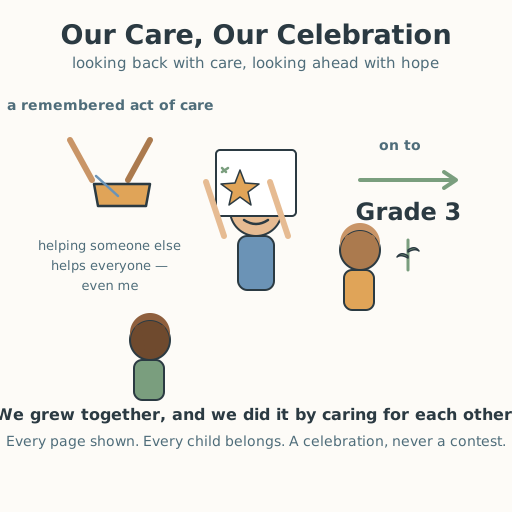
The year ends as it began — with who we are and who we are to each other. Learners display their year of work equally, share one remembered act of care, and think together about why helping others helps everyone, including themselves. Then they celebrate what they have grown into and look ahead to Grade 3. A celebration, never a contest.
Objectives
- Identify their personal strengths and one thing they are still learning to do. (D01.S2.02.01)
- Explain what makes a group feel welcoming and inclusive to everyone in it. (D02.S3.02.01)
- Explain why helping others helps everyone, including themselves. (D02.S4.02.02)
Connection
All over the world, people gather to celebrate — a harvest, a season, a graduation, a year’s work — and at the heart of every good celebration is care: someone cooked, someone set a place, someone helped a smaller one reach the table. When you help someone, you do not just fill their need — you grow warmer and more connected too. Helping helps everyone, including you. Today you remember the care you gave this year, and you celebrate it.
Materials
- Every learner’s year work (writing, number work, predictions, made things) plus this unit’s pages
- A space to display the work
- A shared way to celebrate (song, clap, movement)
Preparation
- Gather each learner’s chosen work and this unit’s pages (“My Strengths, My Growing” and the calm card).
- Set up the display so every learner’s work is shown equally — side by side, none higher or more special than another.
- Arrange a circle for the care-sharing and plan a simple shared celebration.
Facilitator note
This lesson is written to the learner (“you”). It is the year’s capstone, and its two commitments are celebration, not competition and care helps everyone, including the giver. No best-work awards, no winners, no ranking — every learner’s work is displayed equally, and every child belongs. Honor every family shape too: a child’s caring circle may be parents, one parent, grandparents, extended kin, guardians, foster or group care, or a trusted adult — and a learner may share their celebration with any of these, or pass. In the care-sharing circle, sharing is by choice; a learner may pass, and a pass is a full share. Let the question “why does helping help everyone?” stay open and personal — the answer is felt, not tested: helping connects us, warms us, and builds the group we want to live in. For a learner who is Deaf or hard of hearing, make the celebration visual — clapping, signing, a flag wave, a visual “bravo.” For a learner who is blind or has low vision, describe work aloud or offer a spoken or tactile tour. Keep the tone warm and generous: the class has grown together, and everyone belongs.
Procedure
- Gather (5 min). Today is a celebration of all of you — all of me, all of us. There are no winners and no rankings, just everyone, together.
- Set up the gallery (10 min). Lay out or hang every learner’s year of work, plus this unit’s pages. Every piece is shown equally — no one’s is higher or more special. If a learner chooses not to show a piece, that choice is honored.
- Remember an act of care (10 min). Think of one time this year you helped someone — a friend who was stuck, a smaller one who needed a hand, a job that needed many hands. Hold that memory. It is a real part of your year.
- Circle of care (15 min). Sit in a circle. Each learner may share their remembered act of care — or pass. Then think together: why does helping others help everyone, including you? Helping fills a need, and it also connects and warms the helper. When we help, the whole circle grows stronger — and so do we.
- Celebrate together (15 min). Make a shared celebration — a song, a clap, a movement the class creates together. You have grown all year, and you did it by caring for each other.
- Close (5 min). Look ahead: next year, in Grade 3, you will keep growing — more feelings, more strengths, more community, more care. You are all of you, and you are all of us.
Differentiation
- Support: Allow a learner to celebrate by pointing to their work or holding up a partner’s hand; a pass counts as sharing.
- Support (Deaf/hard-of-hearing): Make the celebration visual — clapping, signing, a flag wave, or a visual “bravo.”
- Support (blind/low-vision): Describe work aloud or offer a spoken or tactile tour of the gallery.
- Extension: Say in your own words why helping others helps everyone, and name one way you will care in Grade 3.
Assessment
- Summative (portfolio + performance): The learner shares their year of work (displaying it or passing) and names one remembered act of care, and can say — by word, drawing, sign, or a partner voicing — one reason helping others helps everyone, including themselves.
- Observation: Does the learner show, in their own way, that they see themselves as a whole person and their class as a caring community they belong to?
Home connection
Bring your year’s work to the people who care for you — your family, whatever shape it takes (parents, one parent, grandparents, aunts and uncles, kin, guardians, or any trusted adult) — and tell them one act of care you remember, and why helping helped you too.
Resources
- CASEL SEL Framework (social awareness, relationship skills): https://casel.org/fundamentals-of-sel/