Lesson 06 — Reading My Body's Signals
Learners bring the four body signals together into one "body-signal map." They mark where hunger, fullness, thirst, and tiredness each show up and write one helpful response for each, creating a portfolio artifact that is their own guide to reading and answering their body.
Objectives
Objectives
- D03.S1.03.02 Recognize early body signals of hunger, fullness, thirst, and tiredness and say one helpful response to each.
Essential question
How do I read all four of my body's signals — hunger, fullness, thirst, and tiredness — and answer each one?
Key vocabulary
Materials
Standard materials
- A body outline sheet · per learner A large simple body shape to draw each signal onto
- Crayons or markers · per learner To mark where each signal shows up and draw its response
- Signal cards · 1 set Reuse the hunger, fullness, thirst, and tiredness cards from Lessons 4–5
Low-tech / no-cost
- Paper and a pencil Trace or draw your own body shape and mark the four signals
- Your own body Point to where each signal lives — tummy, mouth, eyes, whole body
Enriched / lab & device
- A large paper body outline (child-size) · 1 per pair Trace a partner onto big paper and mark the four signals on the life-size map
- A camera or tablet · 1 per group Photograph each learner's body-signal map to keep a digital copy for the portfolio
Works in different contexts
- large-group Build one big class body map together first, then each learner makes their own smaller map
- self-directed A learner draws a body shape, marks all four signals and a response for each, and writes one sentence per signal
- outdoor-only Draw the body shape in the sand or with chalk on a path, and mark the four signals with stones or drawings
- multi-age Older learners scribe the responses while younger learners point to and color each signal spot, then they trade maps to check
Lesson 6 — Reading My Body’s Signals
Summary
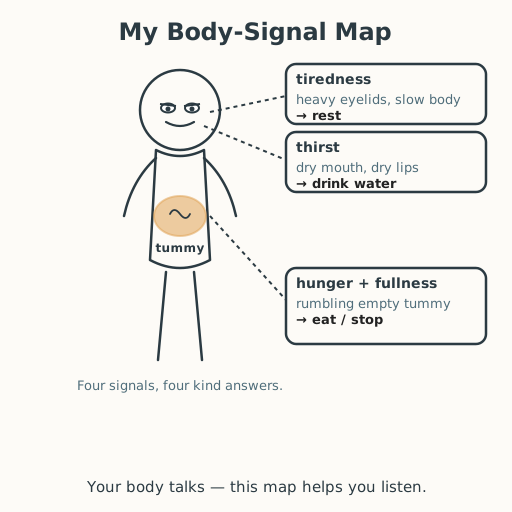
Learners gather all four body signals into one place: a “body-signal map.” On a body outline they mark where hunger, fullness, thirst, and tiredness each show up, and write one helpful response for each. The map is their own guide to reading and answering their body — and a portfolio artifact.
Objectives
- Recognize early body signals of hunger, fullness, thirst, and tiredness and say one helpful response to each. (D03.S1.03.02)
Connection
Your body has been sending you signals all along — a rumbling tummy, a dry mouth, heavy eyelids. Today you will draw them all on one map, the way a traveler marks the roads on a journey. When you know the map, you can read your body’s signals and answer them before they get loud.
Materials
- A body outline sheet
- Crayons or markers
- Signal cards (reused from Lessons 4–5)
Preparation
- Print or draw a simple body outline for each learner.
- Set out crayons and the four signal cards from Lessons 4–5.
- Prepare a space to share finished maps.
Facilitator note
This lesson is written to the learner (“you”) so it works in a classroom and for a self-directed learner. Prepare the body outlines and signal cards, then guide the mapping. This is the unit’s second portfolio artifact — the body-signal drawing named in the assessment plan — and it closes the body-signals strand of the unit. Keep every response gentle and non-judging: there is no “correct” amount to eat, drink, or sleep, and no body is praised or shamed. A learner’s map is a record of their noticing, never a grade. Some learners may show signals in different spots than the cards — that is fine; their own body is the authority. If a learner shares that their body feels hungry, thirsty, or tired right now, honor it: offer water, food, or a rest as the situation allows. Maps may be shared only if the learner chooses.
Procedure
- Gather (5 min). You have learned four signals in the last two lessons. Say them: hunger, fullness, thirst, tiredness. Today you will put them all on one map.
- Recall the signals (10 min). Look at the signal cards. For each one, say the signal, where it shows up, and its helpful response: hunger → empty rumbling tummy → eat; fullness → comfortable satisfied tummy → stop; thirst → dry mouth → drink water; tiredness → heavy eyelids and slow body → rest.
- Map the signals (15 min). On your body outline, mark each signal where it shows up: draw a rumbling tummy for hunger and fullness, a dry mouth for thirst, and heavy eyelids for tiredness. Label each spot.
- Add the responses (10 min). Beside each signal, draw or write one helpful response. Your map now shows four signals and four kind answers.
- Share and close (10 min). Share your map with a partner if you want. How are your maps alike? How are they different? Every body is a little different, and every map is right for its own body.
Differentiation
- Support: Map two signals at a time, or have a partner scribe while the learner points and colors.
- Extension: Ask learners to add a fifth signal their body sends them that the cards do not show (such as feeling cold, or needing to move), and its response.
Assessment
- Summative (portfolio/observation): Can the learner place all four signals on a body map and name one helpful response to each, in their own body’s way?
- Artifact (portfolio): The completed body-signal map, kept in the learner’s portfolio.
Resources
- World Health Organization — global health and wellbeing reference: https://www.who.int/
Home connection
Show your body-signal map to someone at home and read it to them — all four signals and their kind answers. Ask them if their body sends any signals in a different spot.