Lesson 08 — Moving with Balance
Learners explore balance. They discover the hidden sense of balance inside the ear, practice balance poses, then walk a straight "tightrope" line and build a short balance sequence — moving with control and steadiness in their own body's way.
Objectives
Objectives
- D03.S2.03.01 Perform a short movement sequence, such as a dance or obstacle course, with rhythm and balance.
Essential question
How does my body keep balance while it moves through a short sequence?
Key vocabulary
Materials
Standard materials
- A line on the floor · 1 set Chalk, tape, or a rope laid straight to walk along like a tightrope
- A clear floor space · 1 per group Enough room to balance and move safely
- Balance pose cards · 1 set Cards showing stand-on-one-foot, arms-wide, heel-toe, and slow-steps poses
Low-tech / no-cost
- A line drawn in sand or chalk Any straight mark on the ground becomes the balance line
- Your own body Balance on one foot, then the other, with arms wide for steady
Enriched / lab & device
- A low balance beam or a plank on the floor · 1 set A safe, low beam to walk along and practice balancing
- Soft cushions or a wobble board · 1 set To challenge balance gently on a soft or moving surface
Works in different contexts
- large-group Lay several parallel lines and have small groups walk them in turn, watching and cheering each other on
- self-directed A learner walks a line, holds balance poses, and builds a three-part balance sequence to perform alone
- outdoor-only Balance along a log, a low wall, or a line drawn in the dirt, using arms wide and slow steps
- multi-age Older learners spot (hold a hand near) younger ones as they balance, then everyone tries the sequence together
Lesson 8 — Moving with Balance
Summary
Learners meet balance. They learn that balance uses a hidden sense inside the ear plus their muscles, practice balance poses, then walk a straight “tightrope” line and build a short balance sequence. Moving with balance is moving with control and steadiness.
Objectives
- Perform a short movement sequence, such as a dance or obstacle course, with rhythm and balance. (D03.S2.03.01)
Connection
Think of walking along the edge of a curb, or balancing on one foot to put on a shoe. Your body is doing something amazing: it is staying steady by talking to itself. People everywhere balance — tightrope walkers at festivals (a skill with long traditions from Japan to India to Europe), farmers crossing a narrow log over a stream, a dancer holding a steady pose, a child on a low wall. Today you will practice the skill of staying steady.
Materials
- A straight line on the floor (chalk, tape, or rope)
- A clear floor space
- Balance pose cards
Preparation
- Lay one or more straight lines on the floor, wide enough apart to be safe.
- Clear the space around the lines.
- Prepare balance pose cards.
Facilitator note
This lesson is written to the learner (“you”) so it works in a classroom and for a self-directed learner. Prepare the lines and cards, then model each pose and the tightrope walk slowly before learners try (explicit modeling, then guided practice). This continues the movement strand from Lesson 7’s rhythm — now balance joins it, and the two come together in the capstone. The factual idea here — that balance uses a sense in the inner ear working with muscles and eyes — is well established (see Resources). Honor every body: balance can be practiced seated (holding a steady, upright core and lifting arms or a leg), with wheels, or with a hand lightly touching a wall or a partner’s shoulder for support — and every version counts fully. Never pressure a learner to balance without support; staying safe is the first skill. Keep it joyful and non-competitive: falling or wobbling is how balance grows, and it is never a failure.
Procedure
- Gather (5 min). Stand still for a moment. Feel your body keeping you upright. Balance is a sense you carry inside you. Today you will practice it.
- Meet the balance sense (5 min). Deep inside each ear is a tiny balance sensor that works with your muscles and eyes to keep you steady. You do not have to think about it — it just works, all day long.
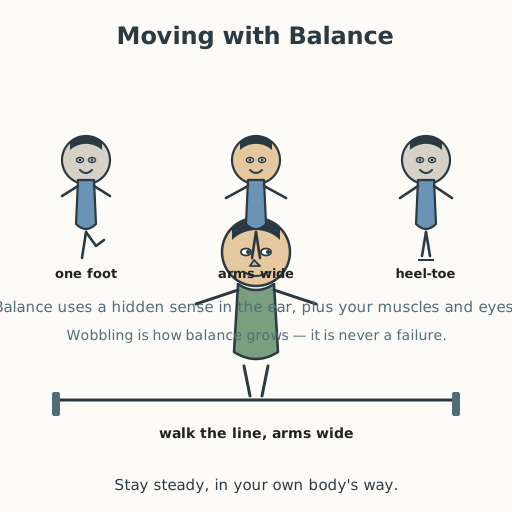
- Practice poses (15 min). Try the balance poses from the cards: stand on one foot, arms wide; stand heel-to-toe like a tightrope walker; take slow, steady steps. Hold each pose for a few slow breaths. Wobble? That is your body learning — try again.
- Walk the line (10 min). Walk along the line like a tightrope, arms wide, eyes ahead, slow steps. Walk it forward, then try it sideways. Use a wall or a friend’s hand for help if you want.
- Build a balance sequence (10 min). Put three moves in order — maybe balance on one foot, then slow-step the line, then a final wide-arms pose. Perform it with control, in your own body’s way.
- Close (5 min). Say it together: “my body can balance.” How did it feel to stay steady on your own?
Differentiation
- Support: Keep one hand on a wall or a partner for support; practice one pose at a time and a shorter line.
- Extension: Ask learners to balance with eyes closed for a moment (near a spotter), or to add a slow turn at the end of their line walk.
Assessment
- Formative (observation/performance): Can the learner hold a balance pose and move through a short balance sequence with growing control, in their own body’s way?
Resources
- World Health Organization — global health and wellbeing reference: https://www.who.int/
- U.S. National Institute on Deafness and Other Communication Disorders (NIDCD) — Balance Disorders (how the inner ear helps us balance): https://www.nidcd.nih.gov/health/balance-disorders
Home connection
At home, practice balancing on one foot or walking a line on the floor (a crack in the tiles, a line of tape) with someone — and teach them what you learned about the balance sense in your ear.