Lesson 06 — Rules That Help Us All
Learners explain how rules and routines — one turn each, wait in line, quiet at the library — help a community work fairly for everyone, and they practice proposing a fair rule of their own.
Objectives
Objectives
- D02.S3.03.02 Explain how rules and routines help a community work fairly for everyone.
Essential question
How do rules and routines help a community work fairly for everyone?
Key vocabulary
Materials
Standard materials
- Rules we know cards · 1 set Everyday rules — one turn each on the swing, wait in line, quiet at the library, wash hands before eating, look before crossing
- What does this rule help chart · 1 Two columns — "rule" and "how it helps everyone" — to fill together
- Paper and crayons · per learner To draw one fair rule in action
Low-tech / no-cost
- Voices and bodies Name rules aloud and act out "no rule" vs. "fair rule"; no cards needed
- Found objects A stone or stick can stand for the shared thing everyone wants
Enriched / lab & device
- A short film or photo set of a queue or shared space · 1 per group Real scenes where a routine keeps things fair — a water queue, a bus line, a library
- A class "fair rules" poster project · 1 Write and illustrate the class's own fair rules together
Works in different contexts
- large-group Sort the rules onto the big chart as a whole group, calling out how each one helps everyone
- self-directed A learner sorts the rule cards and writes or draws how each rule helps everyone, then checks it with a grown-up
- outdoor-only Use real outdoor rules — one turn on the swing, look before crossing the path — and act out how each keeps things fair
- multi-age Older learners explain "how it helps everyone" while younger learners act out the rule with a partner
- level-grouped Group by comfort with explaining; every group sorts the same rules, and confident speakers model the first answer
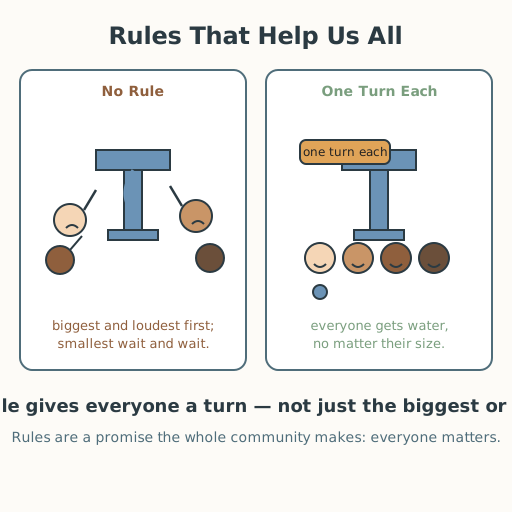
Lesson 6 — Rules That Help Us All
Summary
Learners look at the rules and routines they already live by — one turn each, wait in line, quiet at the library, look before crossing — and explain how each one helps a community work fairly for everyone. They discover that fair rules protect the smallest and quietest, not just the biggest and loudest, and they propose a fair rule of their own.
Objectives
- Explain how rules and routines help a community work fairly for everyone. (D02.S3.03.02)
Connection
Imagine a water pump with a crowd around it and no rule. The biggest and loudest get water first; the smallest wait and wait. Now imagine the same pump with one simple rule — one turn each, wait in line. Suddenly everyone gets water, no matter their size. A fair rule is a promise the whole community makes: everyone matters, and no one is skipped. Rules are not just about keeping order — they are how a community protects its fairest self.
Materials
- “Rules we know” cards
- “What does this rule help?” chart
- Paper and crayons
Preparation
- Prepare the rule cards (one turn each, wait in line, quiet at the library, wash hands before eating, look before crossing).
- Post the two-column chart: “rule” and “how it helps everyone.”
Facilitator note
This lesson is about fairness, not obedience. The goal is that a learner can explain how a rule helps everyone, not merely recite rules. Frame rules as agreements a community makes so that all its members — especially the small, the slow, the quiet — are protected (the ethics and egalitarian lenses). Invite learners to notice a rule that feels unfair and wonder together whether it helps everyone or only some; that critical question is the lesson’s deepest skill and should be welcomed, not shut down. Keep the examples small and everyday, and honor that different communities hold different rules (what is polite in one culture differs in another) — rules are made by people for their shared life, and they can be changed when they stop being fair. Read the procedure aloud; model one “how it helps everyone” answer before learners sort the rest (Kirschner, Sweller & Clark, 2006).
Procedure
- Gather (5 min). Think of a rule or routine you follow every day — in class, at the market, on the road. Why do you think it is there?
- Meet the rules (10 min). Look at the rule cards. Say each one and act it out. For the first card, ask together: who does this rule protect? how does it help everyone?
- Watch a worked example (10 min). Fill the first chart row together: rule — “wait in line”; how it helps everyone — “everyone gets a turn, not just the fastest or loudest, and no one is pushed.” Notice: the reason is about fairness, not just order.
- Sort and explain (15 min). Sort the rest of the cards onto the chart, saying how each one helps everyone. Then draw one fair rule in action — the water-pump line, the shared swing, the quiet library.
- Close (5 min). A fair rule is a promise: everyone matters. Rules help a community work fairly when they protect everyone — and they can be changed if they stop being fair.
Differentiation
- Support: Offer the rule cards with pictures and the starter “This rule helps everyone because…”. A non-speaking learner points to a picture and a helper says the reason.
- Extension: Invite learners to propose a new fair rule for the classroom and give the reason it helps everyone, then test it by asking who it leaves out.
Assessment
- Formative (observation): Can the learner explain how a rule or routine helps a community work fairly for everyone, naming who it protects and why?
- Artifact (portfolio): The “one fair rule in action” drawing, kept in the learner’s portfolio.
Home connection
At home, notice one rule or routine your family follows and ask together how it helps everyone — and whether there is a rule that could be fairer.
Resources
- CASEL SEL Framework (responsible decision-making competency): https://casel.org/fundamentals-of-sel/