Lesson 07 — Fair Share, Group Goal
Learners practice cooperation by choosing a real group goal, dividing its jobs fairly, and doing the work together — so everyone contributes, no one does everything, and no one does nothing.
Objectives
Objectives
- D02.S4.03.01 Practice cooperation by contributing fairly to a group goal.
Essential question
How do I contribute fairly to a group goal?
Key vocabulary
Materials
Standard materials
- Group goal sign · 1 One shared goal to work toward — build a block structure, tidy a shared space, or plan a class celebration
- Jobs chart · 1 A place to write each person's part so the work is shared fairly
- Building or cleaning supplies · 1 set Blocks, paper, or tidying tools for the real task
Low-tech / no-cost
- Bodies and found materials A shared task with no supplies — move stones to clear a path, stack leaves, or carry water together
- A found object A stick can be the "turn marker" for choosing jobs fairly
Enriched / lab & device
- A timer or music · 1 To mark the working time and celebrate the finish
- A camera or tablet · 1 per group Record the group goal from start to finish to reflect on fair contribution
Works in different contexts
- large-group Break into small groups, each with one shared goal and a jobs chart, so every learner has a real part
- self-directed A learner sets one personal-community goal (tidy a shelf, help a neighbor), divides its steps, and does them one by one
- outdoor-only Choose an outdoor goal — clear a path, gather kindling, water the garden — and share the jobs in the open air
- multi-age Older learners model dividing jobs; younger learners do one simple part and see how it joins the whole
- level-grouped Match each learner to a part that fits what they can do well, so everyone contributes and no one is left idle
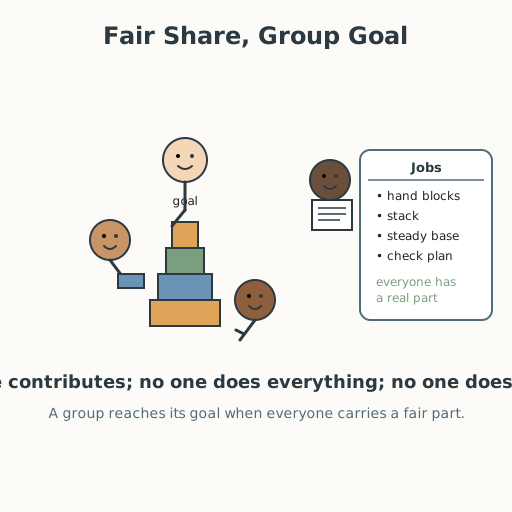
Lesson 7 — Fair Share, Group Goal
Summary
Learners practice cooperation by contributing fairly to a group goal. They choose one real shared goal, divide its jobs so everyone has a part, do the work together, and reflect on whether the contribution was fair — everyone contributes, no one does everything, and no one does nothing.
Objectives
- Practice cooperation by contributing fairly to a group goal. (D02.S4.03.01)
Connection
One person cannot lift a heavy beam, but four people can — if the work is shared. If one person does everything while the others watch, that is not cooperation; it is carrying someone else’s load. If everyone takes a part that fits what they can do, the job gets done and everyone is part of it. This is how a group reaches a goal fairly: everyone contributes. Everywhere people build, harvest, and celebrate together, this is the pattern.
Materials
- A “group goal” sign
- A “jobs” chart
- Building or cleaning supplies
Preparation
- Choose a real, reachable group goal (build a block structure, tidy a shared space, or plan a class celebration).
- Hang the jobs chart with a column for each person’s name and part.
Facilitator note
This lesson puts cooperation into practice — the skill CASEL places in relationship skills and the spirit the curriculum names as mutual aid over competition. The key principle to protect is fair contribution: everyone contributes, no one does everything, and no one does nothing. Match each learner to a part that fits what they can do well — a child who builds stacks, a child who plans and checks, a child who carries — so every body and every way of helping counts fully. Watch for the learner who quietly takes on too much and the learner who drifts to the edge; gently rebalance the jobs chart so the load is shared. The goal is the shared one; there is no “best helper” and no ranking. Reflect afterward on fairness, not speed or neatness — did everyone get to contribute? Read the procedure aloud and model dividing jobs once before groups do it themselves (Kirschner, Sweller & Clark, 2006).
Procedure
- Gather (5 min). Think of a job too big for one person. How does it get done? Many hands — each with a part.
- Choose the goal (5 min). Look at the group goal. Say what “done” looks like: “Our structure will stand taller than our knees,” or “Our shelf will be clear.”
- Divide the jobs fairly (10 min). On the jobs chart, give each person a part that fits what they do well. The rule: everyone contributes; no one does everything; no one does nothing.
- Do the work (15 min). Work together on the goal, each doing your part and helping when a part needs another pair of hands. Use kind words: “Need a hand?” “Nice job steadying that!”
- Reflect and close (10 min). Look at what you made or did together. Ask: did everyone get to contribute? Was the sharing fair? Remember: a group reaches its goal when everyone carries a fair part.
Differentiation
- Support: Assign parts ahead of time with picture labels; pair a learner who needs support with a patient peer who shares the part.
- Extension: Invite the group to plan a bigger shared goal (a class celebration) and divide its jobs across several days, checking each day that the sharing stays fair.
Assessment
- Formative (observation): Does the learner take a part, do it, and help others, so that the contribution across the group is fairly shared?
- Peer (check): After the work, does the group agree that everyone contributed and no one did everything or nothing?
Home connection
At home, pick one shared family job — setting the meal, tidying, watering plants — and divide its parts fairly with everyone, then notice how it feels when everyone carries a part.
Resources
- CASEL SEL Framework (relationship skills competency): https://casel.org/fundamentals-of-sel/