Lesson 08 — How We Help Each Other
Learners gather examples of how people in a community help one another — harvesting together, sharing food, watching children, rebuilding after a storm — and see that mutual aid, not competition, is how communities survive and thrive.
Objectives
Objectives
- D02.S4.03.02 Give an example of how people in a community help one another.
Essential question
How do people in a community help one another?
Key vocabulary
Materials
Standard materials
- Helping hands story cards · 1 set Real examples of community help — harvesting together, watching each other's children, sharing food, rebuilding after a storm
- Paper and crayons · per learner To draw or write one example of people helping one another
Low-tech / no-cost
- Voices and bodies Tell and act out the examples aloud; no cards needed
- Found objects A stone, leaf, or seed can stand for the food, water, or shelter people share
Enriched / lab & device
- A photo set or short film of mutual aid · 1 per group Real scenes — a barn-raising, a harvest crew, a neighborhood clean-up — to discuss
- A guest or recorded story from an elder · 1 Someone who remembers how the community helped one another in a hard season
Works in different contexts
- large-group Share examples whole-group onto a big "how we help" list, then let each learner add one they have seen
- self-directed A learner reads the examples, then writes or draws one example of help they have seen or given in their own community
- outdoor-only Walk the neighborhood or village and notice the ways people help — shared walls, shared tools, shared watch over children — and name them aloud
- multi-age Older learners tell a helping story from their own lives while younger learners act it out
- level-grouped Group by comfort with storytelling; every group shares one example, with confident speakers modeling first
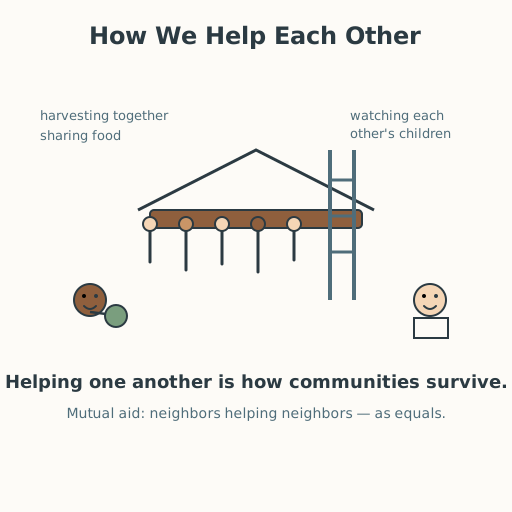
Lesson 8 — How We Help Each Other
Summary
Learners gather examples of how people in a community help one another — harvesting together, sharing food, watching each other’s children, rebuilding after a storm — and discover that this helping is not a favor from above but a pattern every community depends on: mutual aid.
Objectives
- Give an example of how people in a community help one another. (D02.S4.03.02)
Connection
A storm blows through and a neighbor’s roof is torn. The next morning, people gather — not because anyone paid them, but because they are neighbors. They lift the beam, pass the food, watch the children, and the roof rises. Or at harvest time, families help each other bring in the crop, and everyone eats. This is called mutual aid: people helping one another as equals, because caring for each other is how communities survive — in every place, in every time.
Materials
- “Helping hands” story cards
- Paper and crayons
Preparation
- Prepare the helping-hands cards (harvesting together, sharing food, watching children, rebuilding after a storm).
- Write the big idea large: “helping one another is how communities survive.”
Facilitator note
This lesson teaches mutual aid, the curriculum’s name for care that flows between equals rather than down from above. The distinction matters: mutual aid is not charity — it is neighbors helping neighbors as part of one shared life, and the one who helps today is helped tomorrow. Keep it concrete and close to the learner’s own world so the concept is real, not abstract. Invite every kind of helping and every kind of family and community shape; a single-parent home, an extended family, a chosen community, and a village council are all full ways of belonging. Be gentle: some learners have seen storms, scarcity, or hard seasons, and a helping story may touch real memory — honor it calmly, and connect it to hope and agency (“what did people do? what could we do?”). Read the procedure aloud; model one example fully before learners share their own (Kirschner, Sweller & Clark, 2006).
Procedure
- Gather (5 min). Think of a time someone helped you, or you helped someone. What happened? How did it feel?
- Meet the examples (10 min). Look at the helping-hands cards. For each, say what people did and why it mattered: harvesting together fills everyone’s table; sharing food keeps a neighbor from going hungry; watching children lets every parent work.
- Watch a worked example (10 min). The facilitator tells one full example — the storm and the roof — and names the pattern: neighbors helping neighbors, as equals.
- Gather your own (15 min). Think of your own community. What help have you seen or given? Draw or write one example — a shared harvest, a meal brought to a sick neighbor, children watched together, a road cleared after a storm.
- Close (5 min). Helping one another is not a rare kindness; it is how communities survive. And the one who helps today is helped tomorrow.
Differentiation
- Support: Offer picture cards to point at and the starter “People help by…”. A non-speaking learner draws one example.
- Extension: Invite learners to tell the same example from two sides — the one who helped and the one who was helped — and notice how both gain.
Assessment
- Formative (observation): Does the learner give a clear example of how people in a community help one another, and say why it matters?
- Artifact (portfolio): The “how we help each other” drawing or writing, kept in the learner’s portfolio.
Home connection
At home, ask about a time your family helped neighbors or was helped by them, and add that story to your picture or page.
Resources
- CASEL SEL Framework (social awareness and relationship skills competencies): https://casel.org/fundamentals-of-sel/