Lesson 13 — Everyday Phrases in Another Language
Learners learn and use simple everyday phrases in another language — a greeting, a number, and a color — practicing them by ear and in writing, with every script honored equally.
Objectives
Objectives
- D04.S4.03.01 Learn and use simple everyday phrases in another language, such as greetings, numbers, and colors.
Essential question
How do I learn and use simple everyday phrases in another language?
Key vocabulary
Materials
Standard materials
- Phrase cards · 1 set Simple phrases — a greeting, a number, a color — in the classroom's languages
- A phrase partner · 1 per pair A partner to practice the phrases with, speaking or signing
Low-tech / no-cost
- Voices and memory Learn the phrases by ear, repeating them aloud with a partner
- A phrase drawn or written in sand Write the phrase in the home script and the new script, side by side
Enriched / lab & device
- A recording of a fluent speaker · 1 Listen to the phrase spoken by someone who knows the language, and echo it
- A multilingual phrase poster · 1 The phrases displayed in several scripts, all equal in size
Works in different contexts
- large-group Learn one phrase together, everyone repeating it, then have partners practice in pairs while the facilitator listens
- self-directed A learner chooses a phrase, listens to it, repeats it, writes it, and practices until they can say or sign it from memory
- multi-age Older learners or those who know the language model the phrase; younger learners echo it, and the group practices together
- level-grouped Group by comfort with new languages, not age; those who know the phrase model it, and everyone practices at their own pace
- outdoor-only Practice phrases while walking or in a circle, saying or signing them to the rhythm of steps
Lesson 13 — Everyday Phrases in Another Language
Summary
Learners learn and use simple everyday phrases in another language — a greeting, a number, and a color — practicing them by ear and in writing. Every script is honored equally, and multilingualism is treated as wealth.
Objectives
- Learn and use simple everyday phrases in another language, such as greetings, numbers, and colors. (D04.S4.03.01)
Connection
Imagine arriving somewhere new and being able to say just three things: “hello,” a number, and a color. Suddenly you are not a stranger — you are a guest who tried. Everyday phrases are small keys that open real doors between people. And you already carry the biggest treasure: your home language, which no one has to lose in order to gain another. Multilingualism is wealth — each language adds, none takes away.
Materials
- Phrase cards (a greeting, a number, a color)
- A phrase partner
Preparation
- Prepare phrase cards in the classroom’s languages, each script equal in size.
- Pair learners for practice.
- If possible, invite or record a fluent speaker of the new language.
Facilitator note
This lesson is written to the learner (“you”) so it works in a classroom and for a self-directed learner. Learning phrases in another language is a skill: model each phrase clearly, have learners echo it, then guide practice in pairs (Kirschner, Sweller & Clark, 2006). The value to protect: there is no “correct” accent — an accent is a sign that a learner already speaks another language, and that is wealth, not a flaw. Honor the learner’s home language first; the goal is to add a language, never to replace one. UNESCO holds that valuing a child’s own language strengthens learning and dignity. Phrases may be spoken, signed, or both — a signed greeting is a greeting, and a sign language counts fully as a language. Script-agnostic: a phrase may be written in any script, or not written at all. Celebrate every attempt; mastery grows through patient repetition, not through ranking.
Procedure
- Gather (5 min). Think of a greeting, a number, and a color you know in your home language. You already carry a whole language — a treasure.
- Meet the phrases (10 min). Learn three everyday phrases in another language: a greeting, a number, and a color. Listen to each one, then say or sign it back. Try it a few times.
- Practice with a partner (15 min). With your partner, take turns: one says or signs a phrase, the other repeats it. Try the greeting, the number, and the color until they feel comfortable. Help each other gently.
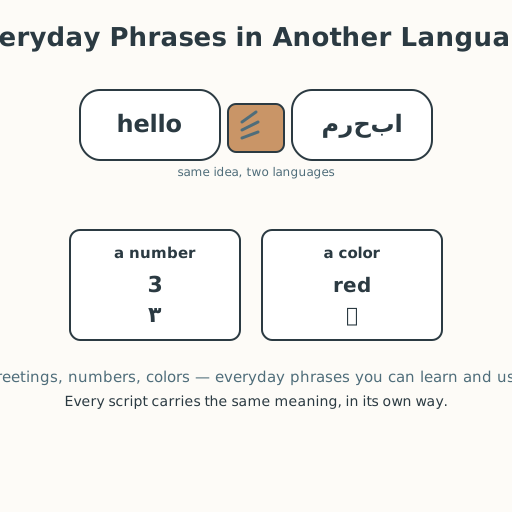
- Write or draw them (10 min). Write each phrase in the new script if you can, and next to it in your own. Or draw a picture for each. Notice: the same meaning, in two ways.
- Close (5 min). Three small keys — hello, a number, a color — and a door opens. You did not lose your language to gain another; you added a treasure.
Differentiation
- Support: Learn just one phrase well — the greeting — before adding the number and color; repetition and a patient partner are the tools.
- Support (non-speaking): Learn the phrases in sign or by pointing to the cards; a signed greeting counts fully.
- Extension: Learn one more everyday phrase — “please,” “thank you,” or “my name is…” — and teach it to a partner.
Assessment
- Formative (observation/performance): Can the learner say or sign a greeting, a number, and a color in another language, and use at least one of them in a simple exchange with a partner?
Home connection
Teach someone at home the greeting, number, and color you learned, and ask them to teach you one phrase from a language they know.
Resources
- UNESCO, multilingual and mother-tongue-based education: https://www.unesco.org/en/days/mother-language
- CASEL SEL Framework (social awareness and relationship skills): https://casel.org/fundamentals-of-sel/