Lesson 14 — One Idea, Many Languages
Learners take one everyday idea and discover it in many languages, comparing how each language says it in its own way, and recognizing that every language carries the same meaning with equal worth.
Objectives
Objectives
- D04.S4.03.02 Notice that the same idea can be said in many languages, and compare a few examples.
Essential question
How is the same idea said in many languages, and how do I compare them?
Key vocabulary
Materials
Standard materials
- A "one idea" card · 1 One everyday idea — "thank you," "water," "friend" — to find in many languages
- A languages chart · 1 A chart to record the idea in several languages, each entry equal in size
Low-tech / no-cost
- Voices and memory Collect the idea from the languages people in the room know, spoken aloud
- A sand or chalk line Write the idea in each language along one line, all equal
Enriched / lab & device
- Recordings or a translation tool · 1 Hear the idea spoken in several languages and listen for what is the same and what differs
- A multilingual word wall · 1 Display the idea in many scripts side by side, none above another
Works in different contexts
- large-group Gather the idea from every classroom language, write each on the chart, and read them together, noticing what is the same and what differs
- self-directed A learner collects one idea in several languages from books, people, or recordings, writes them side by side, and compares the sounds and shapes
- multi-age Older learners read each version aloud; younger learners echo it, so the whole group hears one idea in many voices
- level-grouped Each group collects the idea in the languages they know, then groups trade, so everyone ends with a rich chart
- outdoor-only Write the idea in the sand or soil in a row, one language after another, then walk the line and say each version aloud
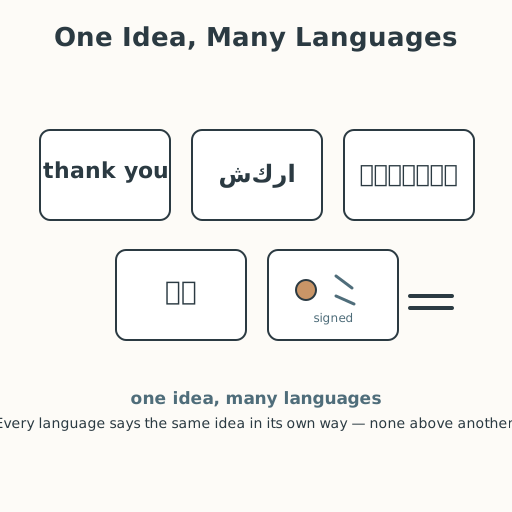
Lesson 14 — One Idea, Many Languages
Summary
Learners take one everyday idea — such as “thank you” or “water” — and discover it in many languages, comparing how each language says it in its own way. They see clearly that every language carries the same meaning with equal worth.
Objectives
- Notice that the same idea can be said in many languages, and compare a few examples. (D04.S4.03.02)
Connection
Think of water. It is the same wet, life-giving thing everywhere — yet every people has its own word for it, and each word grew from that people’s own long story. One idea, many languages. When you learn to say “thank you” in several languages, you are not learning several different ideas — you are learning one shared idea in many voices. That is the deep truth about people: we mean the same things, and we say them in many beautiful ways, none above another.
Materials
- A “one idea” card (thank you, water, friend)
- A languages chart
Preparation
- Choose one everyday idea to explore.
- Prepare the languages chart.
- Gather the languages spoken or signed in the room, and any other sources available.
Facilitator note
This lesson is written to the learner (“you”) so it works in a classroom and for a self-directed learner. Comparing languages is an act of noticing, not ranking: guide learners to hear and see that each language says the same idea in its own way, and that every version is equally good (UNESCO’s mother-language value holds that every language is a bearer of dignity). Keep it script-agnostic — the idea may be written in any script, spoken, or signed; a sign language version stands exactly as high as any spoken one. Model the compare: “this one sounds like…, this one looks like…, yet both mean the same thing.” Invite every learner’s home language into the chart, each entry equal in size, none above another. This is an egalitarian and ethical moment: no language is “better” or “more correct,” and no accent is wrong. A learner who is Deaf or hard of hearing contributes and compares in sign. Where a recording or a translation tool is used, notice what the tool does — it can bring many voices into the room — and what it cannot do: it cannot carry the warmth of the person who lives that language. A tool shows the words; the people in the circle carry the living voice. A tool is a helper, never a replacement.
Procedure
- Gather (5 min). Think of one everyday thing you know well — water, thanks, friend. You have a word for it in your home language. So does everyone else.
- Meet the idea (5 min). Choose one idea together — say, “thank you.” Say or sign it in your home language. That is one version of the idea.
- Collect the idea in many languages (15 min). Go around and gather the idea from every language in the room. Write or draw each one on the chart, all the same size. If you can, hear them from recordings or a translation tool too.
- Compare them (10 min). Look and listen. How are the versions the same — the meaning? How are they different — the sounds, the shapes, the signs? Notice: one idea, many beautiful ways.
- Close (5 min). One idea, many languages, none better than another. When we learn another language’s word, we hold a little more of the whole human family in our hands.
Differentiation
- Support: Focus on just two languages — the learner’s home language and one other — and notice one thing that is the same and one that differs.
- Support (non-speaking): Contribute the idea in sign and compare the sign with a spoken version, noticing how each carries the same meaning.
- Extension: Collect the same idea in five or more languages and sort them by how they sound or how they are written, noticing any that seem to share a family.
Assessment
- Formative (observation): Can the learner give one idea in at least two languages and say one way the versions are the same (the meaning) and one way they differ (the sound, shape, or sign)?
Home connection
At home, ask everyone to say “thank you” in every language they know, and write them down side by side — one idea, many languages.
Resources
- UNESCO, multilingual and mother-tongue-based education: https://www.unesco.org/en/days/mother-language
- CASEL SEL Framework (social awareness — recognizing shared humanity): https://casel.org/fundamentals-of-sel/