Lesson 12 — Editing for Spelling and Punctuation
Learners edit their revised paragraph for spelling and punctuation, using a simple checklist, so their writing is correct and ready to share — with support.
Objectives
Objectives
- D04.S3.03.02 Revise and edit their own writing for spelling, punctuation, and clarity, with support.
Essential question
How do I edit my writing for spelling and punctuation so it is ready to share?
Key vocabulary
Materials
Standard materials
- A revised paragraph · 1 The learner's own revised paragraph, ready for the final edit
- An editing checklist · 1 A short card — check spelling, check periods and question marks, check capitals
Low-tech / no-cost
- Paper and pencil Edit by hand, correcting spelling and adding punctuation
- A spoken edit Read the paragraph aloud, pause at each end mark, and fix what is missing
Enriched / lab & device
- A word processor with a spelling check · 1 Type the paragraph and use the spelling check as a helper — then double-check by reading
- Punctuation marks card set · 1 set Cards for period, question mark, and exclamation mark to place where needed
Works in different contexts
- large-group Edit one sentence together on the board — fix a misspelled word, add a period, add a capital — then have learners edit their own
- self-directed A learner reads their paragraph with the editing checklist, fixes spelling and punctuation, and reads once more to confirm it is ready
- multi-age Older learners model finding a misspelled word and a missing mark; younger learners then check their own with the same checklist
- level-grouped Group by writing comfort, not age; every group uses the same checklist, with confident editors modeling first
- outdoor-only Read the paragraph aloud, clap at each sentence end to hear where a mark is missing, then add the marks in writing
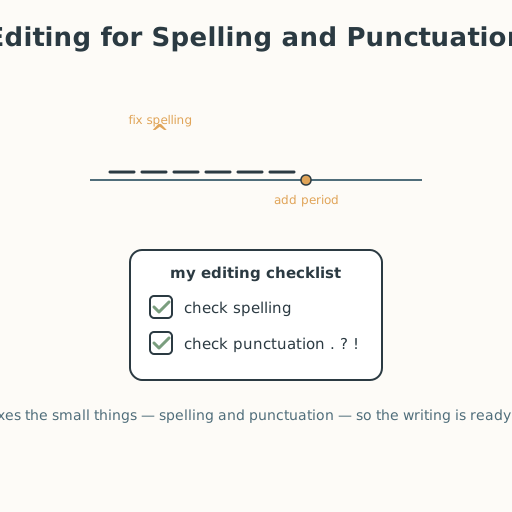
Lesson 12 — Editing for Spelling and Punctuation
Summary
Learners edit their revised paragraph for spelling and punctuation, using a simple checklist, so their writing is correct and ready to share. Editing is the last polish — the small things that help a reader follow the words.
Objectives
- Revise and edit their own writing for spelling, punctuation, and clarity, with support. (D04.S3.03.02)
Connection
Think of getting ready to meet people: you wash your face and smooth your clothes — the small last touches that show care. Editing is the small last touch for writing. You have already made the meaning clear; now you fix the spelling and the punctuation so the reader can follow without stumbling. A period says “one thought ends here.” A question mark says “someone is asking.” These small marks carry big meaning, in every writing system.
Materials
- A revised paragraph (from Lesson 11)
- An editing checklist (check spelling, check periods and question marks, check capitals)
Preparation
- Have learners bring their revised paragraphs.
- Prepare the editing checklist.
- Have pencils ready.
Facilitator note
This lesson is written to the learner (“you”) so it works in a classroom and for a self-directed learner. Editing is a taught skill: model it explicitly with a worked example — fix a misspelled word, add a missing period, add a capital — then guide practice (Kirschner, Sweller & Clark, 2006). Keep editing distinct from revising: revising makes meaning clearer; editing makes the marks correct. The punctuation marks to teach at this level are the period, question mark, and exclamation mark, plus a capital to start a sentence — in whatever writing system the learner uses, since some scripts have no capitals and different end marks. Script-agnostic: honor the learner’s own system’s conventions. A learner who is Deaf or hard of hearing edits in writing or sign the same way. A learner who is blind or has low vision edits by dictation, on a braille writer, or by listening to the text read back and naming the fixes. Never make editing a hunt for “wrongness” to shame; it is care for the reader, and it is celebrated. Where a spelling check is used, notice what it does — it catches some slips and saves time — and what it cannot do: it does not always know which word you meant, so the writer’s own eyes and care finish the job. A tool is a helper, never a judge.
Procedure
- Gather (5 min). Remember: revising made your meaning clear. Now for the small last touches — editing — so the reader can follow without stumbling.
- Meet the checklist (5 min). Learn the editing checklist: one, check spelling — is each word spelled right? two, check punctuation — does each sentence end with a period, question mark, or exclamation mark? three, check capitals — does each sentence start with a capital (where your writing system uses them)?
- Watch a worked example (10 min). The facilitator writes a sentence with a misspelled word and no end mark, then edits it: fixes the spelling, adds the period, adds the capital. Watch the sentence become ready to share.
- Edit your paragraph (15 min). Read your paragraph slowly with the checklist. Fix the spelling. Add the missing end marks. Check the capitals. Read it once more to be sure.
- Read it ready (5 min). Read your edited paragraph aloud. Is it ready to share? If a small thing is still off, fix it now.
- Close (5 min). Editing is care for the reader. Spelling and punctuation are the small marks that let your words travel, in any language, to any reader.
Differentiation
- Support: Edit a single sentence first, using one checklist item at a time; a partner may point to a missing mark.
- Support (non-speaking): Edit by pointing, signing, or using a device; the corrections may be recorded by a scribe.
- Support (blind/low vision): Edit by dictation or on a braille writer, listening back to catch what needs a fix.
- Extension: Trade paragraphs with a partner and gently find one spelling or punctuation fix for each other, then check it together.
Assessment
- Formative (observation/self): Can the learner edit their own paragraph for spelling and punctuation, using the checklist, so the writing is correct and ready to share?
Home connection
At home, take one message you wrote — a note, a text, a list — and check it with the checklist: spelling, punctuation, capitals. Fix what needs it.
Resources
- CASEL SEL Framework (self-management and responsibility for one’s own work): https://casel.org/fundamentals-of-sel/