Lesson 15 — Reading, Writing & Many Languages
Learners close the unit with a celebration and review: they share their retellings, questions, revised and edited paragraphs, and language treasures, and see reading, writing, and many languages as one connected whole in their lives.
Objectives
Objectives
- D04.S1.03.01 Retell a spoken story or explanation in sequence, including key details.
- D04.S1.03.02 Ask and answer questions to understand a speaker's meaning, and explain one idea to a small group.
- D04.S2.03.01 Read grade-level texts with accuracy and fluency, self-correcting when meaning breaks down.
- D04.S2.03.02 Identify the main idea and supporting details of a short informational or narrative text.
- D04.S3.03.01 Write a paragraph with a topic sentence, at least two supporting details, and a closing sentence.
- D04.S3.03.02 Revise and edit their own writing for spelling, punctuation, and clarity, with support.
- D04.S4.03.01 Learn and use simple everyday phrases in another language, such as greetings, numbers, and colors.
- D04.S4.03.02 Notice that the same idea can be said in many languages, and compare a few examples.
Essential question
How do reading, writing, and many languages all work together in my life?
Key vocabulary
Materials
Standard materials
- The unit's collected work · 1 portfolio per learner Retellings, questions, paragraphs (revised and edited), and language treasures gathered across the unit
- A multilingual celebration chart · 1 Greetings and everyday phrases in the classroom's languages, each equal in size
Low-tech / no-cost
- Voices and memory Share retellings, paragraphs, and greetings aloud, with no printed chart needed
- A chalk or sand word wall Write each greeting and phrase in sand, soil, or chalk, one beside another, all equal
Enriched / lab & device
- A class multilingual word wall · 1 Greetings and phrases from every classroom language, displayed together
- A recording of the celebration · 1 Capture the sharing as a portfolio artifact for the class
Works in different contexts
- large-group Build a shared word wall of every classroom language, then read, share, and greet together so all voices sound as one
- self-directed A learner gathers their portfolio, reads their paragraph aloud, reflects on what they learned, and writes one line about why many languages are a treasure
- multi-age Older learners read a paragraph or greeting; younger learners echo it, so the whole group celebrates reading, writing, and many languages together
- level-grouped Each group prepares one sharing — a retell, a paragraph, or a greeting — to bring to the whole circle, so every group contributes and every voice is honored
- outdoor-only Write greetings and phrases in the sand or soil in a wide circle, walk around it, and say each one aloud — reading, writing, and many languages under the open sky
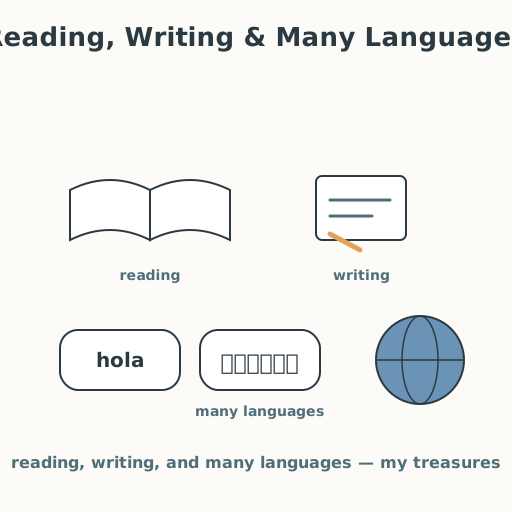
Lesson 15 — Reading, Writing & Many Languages
Summary
Learners close the unit with a celebration and review: they share their retellings, their questions, their revised and edited paragraphs, and their language treasures — and see reading, writing, and many languages as one connected whole in their lives. This is the unit capstone.
Objectives
- Review and celebrate the whole unit: retelling in sequence, asking and answering questions, reading accurately and fluently with self-correction, finding the main idea and details, writing a complete paragraph, revising and editing, and learning phrases in another language. (D04.S1.03.01, D04.S1.03.02, D04.S2.03.01, D04.S2.03.02, D04.S3.03.01, D04.S3.03.02, D04.S4.03.01, D04.S4.03.02)
Connection
Think of three tools that work together: a lamp to see, a hand to write, and a voice to speak. Reading, writing, and many languages are your tools like that — they do not live apart; they work as one. You read to understand, you write to be understood, and you reach across languages to meet other people. The whole human family has always done this, in every land, in every script. Today we gather it all and see the treasure we now hold.
Materials
- The unit’s collected work (each learner’s portfolio)
- A multilingual celebration chart or word wall
Preparation
- Gather learners’ portfolios and arrange a sharing space.
- Prepare the celebration chart or word wall in the classroom’s languages, each greeting the same size, none above another.
Facilitator note
This lesson is written to the learner (“you”) so it works in a classroom and for a self-directed learner. The capstone celebrates, reviews, and cements the unit’s deepest value: reading and writing are tools, and multilingualism is wealth — no language, spoken or signed, is better than another (UNESCO holds that valuing every child’s language strengthens learning and dignity). Keep it a celebration, never a contest: no ranking, no “best” paragraph, no high-stakes test. Review is light and joyful — a glance back at the portfolio, one paragraph read aloud, one greeting said in many languages — not an exam. Every voice, accent, and way of speaking is honored equally. A learner who is Deaf or hard of hearing shares in sign, and a signed greeting stands on the wall exactly as high as any spoken one. Growth is seen against each learner’s own beginning, never against a peer.
Procedure
- Gather (5 min). Look back at your portfolio from this unit. You have retold, questioned, read, written, revised, edited, and learned new phrases. Today we celebrate it all.
- Share your reading and writing (15 min). Read your revised and edited paragraph aloud to the group, or retell a story in sequence with its key details. Listen with full attention; this is each learner’s own work, in their own language.
- Greet in many languages (10 min). Around the circle, each person says or signs a greeting or an everyday phrase they learned. Everyone says it back. Notice: the greetings sit side by side, all the same size, none above another.
- Remember the journey (10 min). Together, name what we learned: retell in sequence with key details; ask the five questions; read accurately and fluently and self-correct; find the main idea and its details; write a paragraph; revise and edit; learn phrases in another language. Point to each in your own work.
- Close (5 min). Reading, writing, and many languages — your treasures, all working together. Many languages, one circle, none better.
Differentiation
- Support: A learner may share by pointing to their paragraph and having the group read it together, or by sharing one greeting; passing is always allowed.
- Support (sign language): Share a signed greeting or paragraph; the whole circle signs it back, honoring it exactly as a spoken one.
- Extension: Write one sentence about what reading, writing, or many languages means to you, and add it to the class word wall.
Assessment
- Formative (portfolio/performance): Can the learner share one piece of the unit’s work — a retell, a paragraph, or a greeting — and say in their own words one thing they learned about reading, writing, or many languages?
Home connection
Teach someone at home one greeting you learned this unit, and tell them the big idea: reading, writing, and many languages are treasures that work together.
Resources
- UNESCO, multilingual and mother-tongue-based education: https://www.unesco.org/en/days/mother-language
- CASEL SEL Framework (social awareness and relationship skills): https://casel.org/fundamentals-of-sel/