Lesson 06 — Patterns in Tables & Number Grids
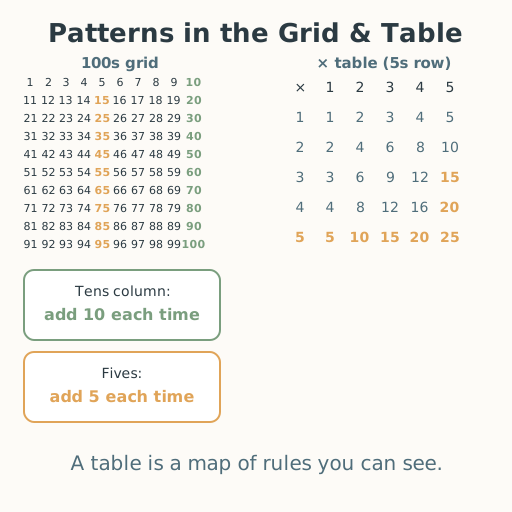
Learners hunt for arithmetic patterns in a 100s number grid and a multiplication table — skip counting down columns, across rows, and along diagonals — and state the rule of each pattern in words. A table becomes a map of rules you can see.
Objectives
Objectives
- D05.S2.03.01 Identify arithmetic patterns in tables and number grids and explain them using the properties of operations.
Essential question
What arithmetic patterns can I find in a number grid and a multiplication table?
Key vocabulary
Materials
Standard materials
- A 100s number grid and a multiplication table · 1 each per learner To hunt for and color patterns
- Colored drawing tools · 3 per learner To mark different patterns in the grid and table
- Paper or slate and a drawing tool · per learner To record rules in words
Low-tech / no-cost
- A ground grid and stones Scratch or chalk a number grid in the dirt and mark the patterns with stones or leaves
- Voice and body Count the pattern aloud, stepping or clapping on each number in the rule
Enriched / lab & device
- A transparent overlay grid · 1 per pair To lay over a number grid and slide along to reveal a pattern
- A large wall number grid · 1 To mark patterns together for all to see
Works in different contexts
- large-group Mark patterns on a large wall or floor grid together, chanting the rule as a group
- self-directed A learner colors patterns in a number grid, writes the rule for each, and checks with a table
- outdoor-only Mark a number grid on the ground and place a stone on each number in the pattern
- multi-age Older learners write the rule in words while younger learners color and read each number in the pattern
- level-grouped Learners who see patterns easily find and describe diagonal patterns; others color rows and skip count with support
Lesson 6 — Patterns in Tables & Number Grids
Summary
Learners hunt for arithmetic patterns in a 100s number grid and a multiplication table — skip counting down columns, across rows, and along diagonals — and state the rule of each pattern in words. A table becomes a map of rules you can see.
Objectives
- Identify arithmetic patterns in tables and number grids and explain them using the properties of operations. (D05.S2.03.01)
Connection
Look at a calendar, a tiled wall, a woven cloth, or a flight of stairs: the same step repeats, and you can predict what comes next without counting every square. Weavers and beadworkers in many traditions have built repeating patterns into cloth and jewelry for thousands of years — a pattern is a rule you can see (Zaslavsky, 1999). A number grid hides the same treasure: read down a column and the numbers grow by the same amount each time. Finding the rule is how you read the grid like a map.
Materials
- A 100s number grid and a multiplication table (per learner)
- Colored drawing tools (three colors)
- Paper or slate and a drawing tool
Preparation
- Give each learner a 100s grid and a multiplication table.
- Prepare (or plan to draw) a quick example of a skip-counting pattern and its rule.
- Clear space to color and count aloud.
Facilitator note
This lesson is written to the learner (“you”). It opens the Patterns & Relationships strand — the new skill is naming the rule of an arithmetic pattern found in a grid or table. Teach with a worked example (philosophy §13): color the tens column on a 100s grid, read 10, 20, 30 … and state “add ten each time”; then show the same rule in a multiplication table row. The key move is generalizing — saying what the pattern always does, not just what it did (Clements & Sarama, 2014). Every learner finds patterns at their own pace; seeing a pattern quickly is not a measure of smartness, and a pattern is a fact about numbers, never about a person. Patterns are a human and cross-cultural treasure — weaving, beading, and lattice grids carry arithmetic patterns in many traditions (Zaslavsky, 1999). Count in the home language. For learners who are Deaf or hard of hearing, tap each number in the pattern; for learners who are blind or low-vision, place stones on a tactile grid so the hands read the pattern. Learners with limited movement direct a partner to mark the grid. Mastery arrives at its own pace.
Procedure
- Gather — patterns around you (5 min). Name a pattern you have seen — stripes on a cloth, steps on a stair, marks on a wall. What repeats? A pattern has a rule.
- Worked example — the tens column (8 min). Watch and help: on the 100s grid, color every number in the last column: 10, 20, 30 … 100. Read them. What is the rule? Add ten each time. Now find the same rule in the multiplication table — the 10s row.
- Hunt for more (15 min). With your colors, find and mark three patterns: skip counting by fives (5, 10, 15 …), by twos, and one pattern of your own. For each, say the rule in words: “add five each time,” “add two each time.”
- Read the diagonals (8 min). Look at the grid diagonally. What do the numbers do? In the multiplication table, the diagonal 1, 4, 9, 16, 25 … has a rule too. Wonder about it — what is it counting?
- Check with a friend (5 min). Trade grids and read each other’s patterns. Do you agree on the rule? Count it together, kindly.
- Close (4 min). Remember: a table is a map of rules. Skip count, find the rule, and you can predict the next number without counting everything.
Differentiation
- Support: Find one pattern (counting by tens) today; add more patterns another day.
- Support (blind/low-vision): Use a tactile grid with stones; read the pattern by touching each marked square.
- Extension: Find the diagonal pattern 1, 4, 9, 16, 25 in the multiplication table and describe its rule (“counting by odd steps: +3, +5, +7 …”).
Assessment
- Formative (observation): Can the learner mark a skip-counting pattern in a grid or table and state its rule in words?
- Self: Can the learner predict the next number in a pattern they found, and tell how they know?
Home connection
At home, find a pattern in a calendar, a tile wall, or a piece of cloth, name its rule, and predict what comes next — then tell a grown-up.
Resources
- Zaslavsky, C. (1999). Africa Counts: Number and Pattern in African Cultures (3rd ed.). Lawrence Hill Books. (Arithmetic patterns embedded in weaving, beading, and other cultural designs.)
- Clements, D. H., & Sarama, J. (2014). Learning and Teaching Early Math: The Learning Trajectories Approach (2nd ed.). Routledge. (Generalizing a pattern by stating its rule.)