Lesson 07 — Properties Explain Patterns
Learners use arrays to see why patterns in the multiplication table repeat: changing the order does not change the product (commutative), regrouping does not change the sum (associative), and a hard fact can be split into two easy ones (distributive). A pattern is not magic — a property explains it.
Objectives
Objectives
- D05.S2.03.01 Identify arithmetic patterns in tables and number grids and explain them using the properties of operations.
Essential question
How do the properties of operations — order, grouping, and splitting — explain the patterns I see in tables?
Key vocabulary
Materials
Standard materials
- Square tiles or small objects · about 100 per learner or pair To build arrays that show the properties
- A multiplication table · 1 per learner To find patterns and explain them with properties
- Paper or slate and a drawing tool · per learner To record explanations
Low-tech / no-cost
- Found objects and the ground Build arrays with stones and split or reorder them on the ground to see the property
- Voice and body Learners stand in rows, then re-group and re-order themselves to feel the property with their bodies
Enriched / lab & device
- A set of property cards (commutative, associative, distributive) · 1 set per pair Cards naming each property with a picture example
- A "why does this work?" poster · 1 per pair To write a property explanation for one table pattern
Works in different contexts
- large-group Act out the properties with learners standing in arrays, re-ordering and re-grouping as a whole class
- self-directed A learner builds an array, tests a property, and writes the explanation in their own words
- outdoor-only Build and split arrays of stones outdoors and explain each property aloud
- multi-age Older learners name the property while younger learners build and count the array before and after
- level-grouped Learners who explain easily connect each property to a table pattern and write why it works; others build and count the array with support
Lesson 7 — Properties Explain Patterns
Summary
Learners use arrays to see why patterns in the multiplication table repeat: changing the order does not change the product (commutative), regrouping does not change the sum (associative), and a hard fact can be split into two easy ones (distributive). A pattern is not magic — a property explains it.
Objectives
- Identify arithmetic patterns in tables and number grids and explain them using the properties of operations. (D05.S2.03.01)
Connection
Why does 3 × 4 look the same as 4 × 3 on the table? Why is 7 × 6 easier as 5 × 6 plus 2 × 6? Mathematicians in many places — from the counting boards of ancient traders to the bamboo counting rods of East Asia — noticed the same rules and gave them names, because the rules explain what you see. When a pattern in a table puzzles you, ask: what rule makes it so? Today you find the rules behind the pattern, and that turns a trick into understanding.
Materials
- About 100 square tiles or small objects
- A multiplication table
- Paper or slate and a drawing tool
Preparation
- Give each learner or pair about 100 objects and a multiplication table.
- Clear space to build, turn, and split arrays.
- Plan a quick example of the distributive property (7 × 6 = 5 × 6 + 2 × 6).
Facilitator note
This lesson is written to the learner (“you”). It deepens yesterday’s pattern work by adding the properties of operations as explanations — the new skill is connecting a pattern to the property that causes it. Teach with worked examples (philosophy §13): build 3 × 4, turn it to 4 × 3 (commutative); build 7 × 6, split it into 5 × 6 and 2 × 6 (distributive); group (2 + 3) + 4 and 2 + (3 + 4) (associative). The goal is the why, not the vocabulary — children can say “turn it” and “split it” and still be doing real mathematics (Van de Walle et al., 2019). Understanding a property is not a race; a child who can show it with objects but not name it has understood it. These properties are human discoveries shared across traditions; no single people owns them. Count in the home language. For learners who are Deaf or hard of hearing, show the turn and split with signs and arrays; for learners who are blind or low-vision, turn and split tactile arrays in the hands. Learners with limited movement direct a partner. Mastery arrives at its own pace.
Procedure
- Gather — patterns that repeat (5 min). Yesterday you found patterns in tables. Today we ask why they happen. A property is a rule that explains a pattern.
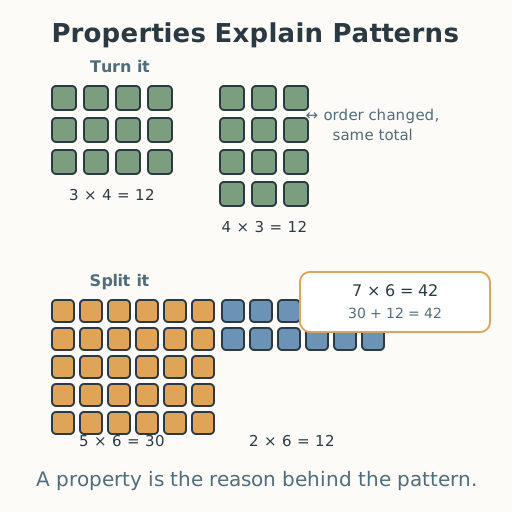
- Worked example — turn it (8 min). Build 3 rows of 4. Count: 12. Turn your array one quarter turn: now it is 4 rows of 3 — still 12. Changing the order does not change the product. That is why 3 × 4 and 4 × 3 sit in the same family on the table.
- Worked example — split it (8 min). Build 7 rows of 6. Hard? Split it into 5 rows of 6 and 2 rows of 6. You know 5 × 6 = 30 and 2 × 6 = 12. Together, 30 + 12 = 42 — so 7 × 6 = 42. Splitting a fact into two easy facts keeps the total the same.
- Guided practice — show and explain (15 min). Pick three facts from the table. For each, build the array, test a property (turn it, split it, or regroup it), and write or say the explanation: “I split 7 × 6 into 5 × 6 and 2 × 6 because …”
- Check with a friend (8 min). Trade arrays and explanations. Do you agree that the property holds? Build it again together, kindly.
- Close (6 min). Remember: a pattern is a clue, and a property is the reason. Turn it, split it, regroup it — and the table begins to make sense.
Differentiation
- Support: Work only on the commutative property (turning the array) today; add splitting another day.
- Support (blind/low-vision): Turn and split tactile arrays by hand; say each count aloud.
- Extension: Use the distributive property to find 9 × 7 as (10 × 7) − (1 × 7) and explain why subtracting works too.
Assessment
- Formative (observation): Can the learner show a property with an array and explain in their own words why a table pattern repeats?
- Self: Can the learner name one pattern they explained today and the property that caused it?
Home connection
At home, split a hard multiplication fact into two easy ones (for example, 8 × 6 as 5 × 6 plus 3 × 6) and show a grown-up why the total stays the same.
Resources
- Van de Walle, J. A., Karp, K. S., & Bay-Williams, J. M. (2019). Elementary and Middle School Mathematics: Teaching Developmentally (10th ed.). Pearson. (The commutative, associative, and distributive properties as explanations of multiplication patterns, taught through arrays before vocabulary.)