Lesson 08 — Two-Step Word Problems
Learners solve two-step word problems by acting them out, drawing a bar diagram, and recording the first step and then the second — using any of the four operations. A two-step problem is just two one-step problems in a row.
Objectives
Objectives
- D05.S2.03.02 Solve two-step word problems using the four operations and explain the relationship between addition and subtraction or multiplication and division.
Essential question
How do I solve a two-step word problem using the four operations?
Key vocabulary
Materials
Standard materials
- Small objects · about 60 per learner or pair To act out the problems
- A set of two-step story cards · 1 set per pair Short problems with two steps, drawn from real life
- Paper or slate and a drawing tool · per learner To draw a bar diagram and write the two steps
Low-tech / no-cost
- Found objects and the ground Act out the story with stones or seeds on the ground, one step at a time
- Voice and body Learners act out the story with their bodies, doing the first step then the second
Enriched / lab & device
- A "first step, then step" organizer sheet · 1 per learner Two boxes to record the first and second steps with their number sentences
- Blank story templates · 1 per pair To write a two-step problem for a friend to solve
Works in different contexts
- large-group Read one two-step problem aloud, act it out as a group, and record both steps together
- self-directed A learner reads a story card, acts it out with objects, draws it, and writes both number sentences
- outdoor-only Act out the story with stones or sticks outdoors, doing the first step then the second
- multi-age Older learners write the number sentences while younger learners act out each step with objects
- level-grouped Learners who solve easily write their own two-step problem for a partner; others act out each step with support
Lesson 8 — Two-Step Word Problems
Summary
Learners solve two-step word problems by acting them out, drawing a bar diagram, and recording the first step and then the second — using any of the four operations. They discover that a two-step problem is just two one-step problems in a row.
Objectives
- Solve two-step word problems using the four operations and explain the relationship between addition and subtraction or multiplication and division. (D05.S2.03.02)
Connection
A market seller starts the day with 45 mangoes, sells 18 in the morning, then gets 12 more; how many now? A family rides a bus 6 kilometers, then walks 3 more, then comes home the long way; how far in all? Real life does not come in one neat step — it comes in a story, and you solve the story by taking it one step at a time. That is a two-step problem, and people solve them in every market, kitchen, and journey on Earth.
Materials
- About 60 small objects
- A set of two-step story cards
- Paper or slate and a drawing tool
Preparation
- Give each learner or pair about 60 objects and a set of story cards.
- Clear space to act out stories.
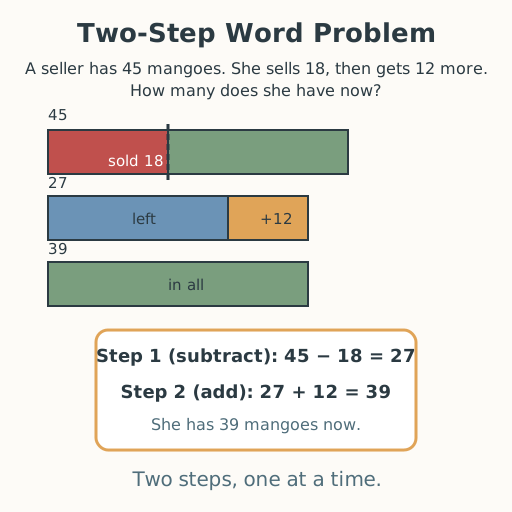
- Prepare a worked example (for example: “A seller has 45 mangoes, sells 18, then gets 12 more. How many now?”).
Facilitator note
This lesson is written to the learner (“you”). It is the learner’s first formal two-step problem — the new skill is decomposing a story into a first step and a then-step, choosing the right operation for each. Teach with a worked example (philosophy §13): read the story, act it out with objects, draw a bar diagram, then record step 1 and step 2 before learners try their own. Children make sense of word problems by acting them out and drawing them, long before symbols (Carpenter et al., 2015). The story, the drawing, and the numbers are three ways to the same meaning. No one’s speed at solving measures their smartness; a child who acts it out and tells the story has understood it even before writing numbers. Choose stories from many real lives — market, farm, sea, kitchen, bus — so no single world is the default. Count in the home language. For learners who are Deaf or hard of hearing, act the story in sign and pictures; for learners who are blind or low-vision, move objects in two steps the hands can follow. Learners with limited movement direct a partner. Mastery arrives at its own pace.
Procedure
- Gather — a story, not a sum (5 min). Today our numbers come inside a story. When a story has two parts, we solve it two steps.
- Worked example — the fruit seller (10 min). Listen: “A seller has 45 mangoes. She sells 18 in the morning. Then a farmer brings her 12 more. How many does she have now?” Act it out with objects. Step 1: take away 18 — 45 − 18 = 27. Step 2: add 12 — 27 + 12 = 39. She has 39 mangoes. Draw a bar diagram of it.
- Guided practice — act, draw, write (20 min). Choose story cards. For each: read the story, act it out, draw the bar, then write step 1 and step 2 as number sentences. Underline the answer in a sentence: “She has 39 mangoes.”
- Check with a friend (8 min). Trade stories and answers. Do you agree on both steps? Act it out again together, kindly, if you differ.
- Close (7 min). Remember: a two-step problem is two one-step problems in a row. Read, act, draw — then write the first step and the second.
Differentiation
- Support: Use two-step stories that use only addition and subtraction today; add multiplication and division another day.
- Support (blind/low-vision): Act out both steps with objects in cups; say each number sentence aloud.
- Extension: Write your own two-step story, solve it, and read it for a friend to try.
Assessment
- Formative (observation): Can the learner decompose a two-step story, choose the right operation for each step, and record both number sentences?
- Artifact (portfolio): The learner’s bar diagram and two-step solution, kept as a record of reasoning.
Home connection
At home, make up a two-step story from your day (“we had 10 cups, used 3, washed 2 more — how many now?”) and solve it with a grown-up.
Resources
- Carpenter, T. P., Fennema, E., Franke, M. L., Levi, L., & Empson, S. B. (2015). Children’s Mathematics: Cognitively Guided Instruction (2nd ed.). Heinemann. (Children solving word problems by acting out and drawing before writing symbols.)