Lesson 09 — Related Operations
Learners discover that addition and subtraction undo each other, and so do multiplication and division — one fact family gives four related sentences, and a missing number is found by doing the opposite operation. Understanding the relationship is the key to checking and solving.
Objectives
Objectives
- D05.S2.03.02 Solve two-step word problems using the four operations and explain the relationship between addition and subtraction or multiplication and division.
Essential question
How are addition and subtraction related, and how are multiplication and division related?
Key vocabulary
Materials
Standard materials
- Small objects · about 60 per learner or pair To act out related operations and missing numbers
- Fact-family cards (add/subtract and multiply/divide) · 1 set per pair Four related sentences to sort and match
- Paper or slate and a drawing tool · per learner To write fact families and find missing numbers
Low-tech / no-cost
- Found objects and the ground Act out joining and separating with stones; join to add, separate to subtract, and undo each move
- Voice and body Learners step together to add and step back to subtract, feeling the opposite moves
Enriched / lab & device
- A "fact family house" sheet · 1 per learner A four-room house to write each family of related facts
- A "find the unknown" number-balance set · 1 per pair A simple balance or number strip to find the missing number by doing the opposite
Works in different contexts
- large-group Build one fact family together on the board, then have learners hold up the missing number as you reveal each sentence
- self-directed A learner writes a fact family for given numbers and finds missing numbers by doing the opposite operation
- outdoor-only Join and separate stones outdoors, writing each related sentence in the dirt
- multi-age Older learners explain "do the opposite" for missing numbers; younger learners join and separate objects
- level-grouped Learners who see the relationship easily find the missing number in multiplication and division; others act it out with support
Lesson 9 — Related Operations
Summary
Learners discover that addition and subtraction undo each other, and so do multiplication and division — one fact family gives four related sentences, and a missing number is found by doing the opposite operation. Understanding the relationship is the key to checking your own work and solving for what is unknown.
Objectives
- Solve two-step word problems using the four operations and explain the relationship between addition and subtraction or multiplication and division. (D05.S2.03.02)
Connection
If you add three stones to a pile and then take three away, you are back where you started — the moves undo each other. If you make four rows of three and then share the twelve back into four groups, you are back to three again. This pairing — join and separate, group and share — is the oldest and most useful idea in arithmetic: every move has an opposite move. People use it to check a sum, to find a missing number, and to be sure an answer is fair.
Materials
- About 60 small objects
- Fact-family cards (add/subtract and multiply/divide)
- Paper or slate and a drawing tool
Preparation
- Give each learner or pair about 60 objects and a set of fact-family cards.
- Clear space to join, separate, group, and share.
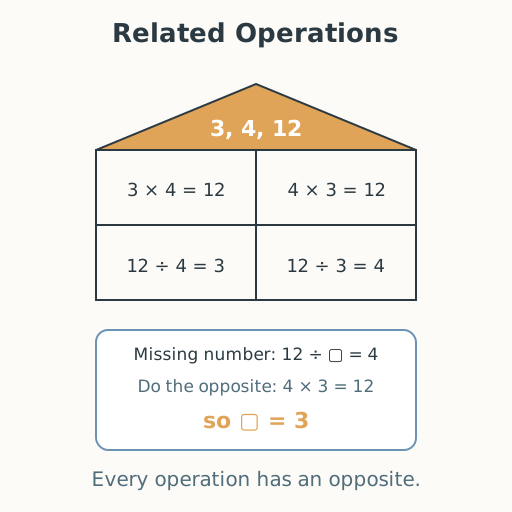
- Plan a worked example (3, 4, and 12 as a fact family).
Facilitator note
This lesson is written to the learner (“you”). It completes the relationship half of the word-problem standard — the new skill is seeing the inverse pairs: add/subtract and multiply/divide. Teach with a worked example (philosophy §13): build the fact family for 3, 4, and 12 (3 × 4 = 12, 4 × 3 = 12, 12 ÷ 4 = 3, 12 ÷ 3 = 4) and show that a missing number (12 ÷ ? = 4) is found by doing the opposite. The relationship is the point, not the vocabulary “inverse” — children can say “the opposite” and still own the idea (Van de Walle et al., 2019). No one’s speed at finding a missing number measures their smartness; understanding the opposite move is worth more than racing. The pair of opposite operations is a human discovery shared across all counting peoples. Count in the home language. For learners who are Deaf or hard of hearing, show join-and-separate with signs and objects; for learners who are blind or low-vision, feel the pile grow and shrink in the hands. Learners with limited movement direct a partner. Mastery arrives at its own pace.
Procedure
- Gather — opposite moves (5 min). Add three stones to a pile, then take three away. Where are you? Back at the start. Every arithmetic move has an opposite.
- Worked example — a fact family (10 min). Watch and help: build 3 rows of 4. Write the four related sentences: 3 × 4 = 12, 4 × 3 = 12, 12 ÷ 4 = 3, 12 ÷ 3 = 4. They are one fact family — the same three numbers, four ways.
- Find the missing number (10 min). Look at 12 ÷ ? = 4. What is the missing number? Do the opposite: 4 × 3 = 12, so the missing number is 3. Try 45 − ? = 27: the opposite is addition — 27 + 18 = 45, so the missing number is 18.
- Guided practice — build families (12 min). Pick a fact-family card. Build it with objects, write all four sentences, and find one missing-number sentence by doing the opposite.
- Check with a friend (8 min). Trade cards and read each other’s families and missing numbers. Do the opposite together, kindly, to check.
- Close (5 min). Remember: addition and subtraction are opposites; multiplication and division are opposites. One fact family is four sentences, and the opposite move finds the missing number.
Differentiation
- Support: Work only on add/subtract families today; add multiply/divide another day.
- Support (blind/low-vision): Build families with objects in cups; say each sentence aloud and feel the opposite move.
- Extension: Write a missing-number sentence for a friend using numbers within 100, and check their answer by doing the opposite.
Assessment
- Formative (observation): Can the learner write a fact family and find a missing number by doing the opposite operation?
- Self: Can the learner explain, in their own words, why 12 ÷ 3 = 4 and 3 × 4 = 12 are the same fact seen two ways?
Home connection
At home, write a fact family for any three numbers you choose (like 6, 7, and 42) and ask a grown-up to find a missing number in it.
Resources
- Van de Walle, J. A., Karp, K. S., & Bay-Williams, J. M. (2019). Elementary and Middle School Mathematics: Teaching Developmentally (10th ed.). Pearson. (The inverse relationship between addition and subtraction and between multiplication and division, developed through fact families.)