Lesson 10 — Area of Rectangles
Learners cover rectangles with unit squares and discover that area is the number of squares that fill a shape — and that counting the rows and columns and multiplying gives the same answer as counting every square. Area becomes "how much surface is covered."
Objectives
Objectives
- D05.S3.03.01 Understand the area and perimeter of rectangles and solve problems using them in real contexts.
Essential question
How do I measure the area of a rectangle, and why does rows times columns work?
Key vocabulary
Materials
Standard materials
- Square tiles or unit squares · about 60 per learner or pair To tile rectangles and count the area
- Paper or slate and a drawing tool · per learner To draw rectangles and record areas
- Rectangular objects to measure · 3 per pair A book cover, a card, a mat, a tray, or a floor tile
Low-tech / no-cost
- Found squares and the ground Cut paper or leaf squares of the same size and cover a rectangle on the ground, counting the squares
- Voice and body Learners stand in a rectangle, count the people per row and the rows, and multiply to find the "area" in people
Enriched / lab & device
- Grid paper · 1 per learner To draw rectangles and count unit squares quickly
- A "rows times columns" area chart · 1 per pair A recording sheet to compare tiling, counting, and multiplying
Works in different contexts
- large-group Tile one large rectangle on the floor together, count rows and columns, and record the area
- self-directed A learner tiles rectangles with unit squares, counts, then checks rows-times-columns for each
- outdoor-only Cover a marked rectangle with leaf or paper squares outdoors and count them; then count rows and columns
- multi-age Older learners record the multiplication while younger learners place tiles and count the squares
- level-grouped Learners who already see rows-times-columns find area by multiplying and explain why; others tile and count with support
Lesson 10 — Area of Rectangles
Summary
Learners cover rectangles with unit squares and discover that area is the number of squares that fill a shape — and that counting the rows and columns and multiplying gives the same answer as counting every square. Area becomes “how much surface is covered.”
Objectives
- Understand the area and perimeter of rectangles and solve problems using them in real contexts. (D05.S3.03.01)
Connection
A farmer needs to know how much ground to plant; a tiler needs to know how many tiles to cover a floor; a weaver needs to know how much cloth to cut for a mat. In every case the question is the same: how much flat space does this shape cover? The answer is its area, and people have measured area since the first fields were planted — counting how many equal squares fit. Today you measure area the same way.
Materials
- About 60 square tiles or unit squares
- Paper or slate and a drawing tool
- Three rectangular objects (book cover, card, mat, tray, floor tile)
Preparation
- Give each learner or pair about 60 unit squares.
- Gather rectangular objects to tile.
- Plan a worked example (a 4-by-6 rectangle).
Facilitator note
This lesson is written to the learner (“you”). It introduces area — the new skill is tiling a rectangle with unit squares and seeing that rows × columns equals the count of squares. Teach with a worked example (philosophy §13): tile a 4-by-6 rectangle, count 24 squares, then count 6 per row and 4 rows and multiply — same 24. The key move is connecting covering (tiling) to structure (rows × columns), the bridge from measurement to multiplication (Van de Walle et al., 2019). Keep it concrete: cover first, multiply after. No one’s speed at tiling measures their smartness; a child who counts every square and a child who multiplies have both found the area. Area is a real human need — the word “area” came to us from the measuring of threshing floors and fields. Count in the home language. For learners who are Deaf or hard of hearing, count squares with signs and taps; for learners who are blind or low-vision, tile a tray with tactile squares and count by touch. Learners with limited movement direct a partner to place squares. Mastery arrives at its own pace.
Procedure
- Gather — covering space (5 min). Look at a book cover. How much flat space does it take up? That question — “how much surface?” — is the question of area.
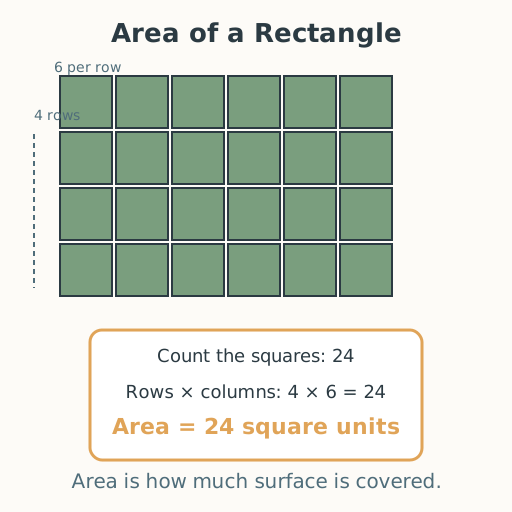
- Worked example — tile a rectangle (10 min). Watch and help: cover a 4-by-6 rectangle with unit squares, leaving no gaps and no overlaps. Count them: 24. The area is 24 square units. Now count the columns: 6 in each row. Count the rows: 4. Multiply: 4 × 6 = 24. Same answer!
- Guided practice — cover and count (15 min). Tile your own rectangles with unit squares. For each: count the squares, then count rows and columns, and multiply. Write the area both ways and check they match.
- Measure real things (8 min). Tile a book cover or a card with your squares. About how many squares cover it? Record the area. This is how you measure a real surface.
- Check with a friend (5 min). Trade rectangles and compare areas. Do you agree? Re-tile together, kindly, if you differ.
- Close (2 min). Remember: area is how much surface a shape covers, measured in unit squares — and rows times columns is a shortcut to the same count.
Differentiation
- Support: Tile and count only today; try rows-times-columns another day.
- Support (blind/low-vision): Tile a tray with tactile squares and count by touch, saying each square’s number.
- Extension: Find the area of a rectangle drawn on grid paper without tiling it — count rows and columns and multiply — and explain why it works.
Assessment
- Formative (observation): Can the learner tile a rectangle with no gaps or overlaps, count the unit squares, and explain that rows × columns gives the same area?
- Artifact (portfolio): The learner’s tiled rectangle with its area written, kept as a record of measurement.
Home connection
At home, measure the area of a small mat, tray, or book cover by covering it with equal squares (paper squares, crackers, or coasters) and tell a grown-up how many fit.
Resources
- Van de Walle, J. A., Karp, K. S., & Bay-Williams, J. M. (2019). Elementary and Middle School Mathematics: Teaching Developmentally (10th ed.). Pearson. (Area as tiling with unit squares, connecting counting to rows × columns.)