Lesson 11 — Perimeter of Rectangles
Learners measure the distance around rectangles with string and steps, and discover that perimeter is the sum of the side lengths — the fence, not the field. They distinguish perimeter (around) from area (inside).
Objectives
Objectives
- D05.S3.03.01 Understand the area and perimeter of rectangles and solve problems using them in real contexts.
Essential question
How do I measure the perimeter of a rectangle, and how is perimeter different from area?
Key vocabulary
Materials
Standard materials
- String or yarn and a measuring tool · 1 per pair To lay around the outside of rectangles and measure the distance
- Rectangular objects · 3 per pair A book, a card, a mat, a tray, or a marked floor space
- Paper or slate and a drawing tool · per learner To draw rectangles and record perimeters
Low-tech / no-cost
- String, sticks, and the ground Lay a length of string or a line of sticks around a rectangle and measure it with steps or a hand span
- Voice and body Learners walk the outside edge of a rectangle, counting their steps all the way around
Enriched / lab & device
- Grid paper and rulers · 1 each per learner To draw rectangles and add the side lengths
- A "perimeter walk" recording sheet · 1 per pair To record the distance around several rectangles and compare with area
Works in different contexts
- large-group Walk the perimeter of a large floor rectangle together, counting steps, then add the four sides
- self-directed A learner lays string around rectangles, measures it, and adds the side lengths to check
- outdoor-only Mark a rectangle on the ground, walk its edge, and measure the distance around with steps or string
- multi-age Older learners add the side lengths while younger learners walk the edge and count
- level-grouped Learners who see it easily find perimeter by adding side lengths and explain why; others walk and measure with support
Lesson 11 — Perimeter of Rectangles
Summary
Learners measure the distance around rectangles with string and steps, and discover that perimeter is the sum of the side lengths — the fence, not the field. They learn to tell perimeter (around) from area (inside).
Objectives
- Understand the area and perimeter of rectangles and solve problems using them in real contexts. (D05.S3.03.01)
Connection
A farmer needs to know how much fence to put around a field; a builder needs to know how much trim to run around a room; a gardener needs to know how much edging to circle a plot. Each asks the same question: how long is the way around? That is the perimeter — and it is different from the area, which is the space inside. The fence is the perimeter; the field it holds is the area. People have fenced and bordered and edged for as long as they have grown and built.
Materials
- String or yarn and a measuring tool
- Three rectangular objects (book, card, mat, tray, marked floor space)
- Paper or slate and a drawing tool
Preparation
- Give each pair string, a measuring tool, and rectangular objects.
- Clear space to walk and measure.
- Plan a worked example (a rectangle 7 by 3).
Facilitator note
This lesson is written to the learner (“you”). It introduces perimeter and the crucial distinction perimeter vs. area — the new skill is measuring around and adding the side lengths. Teach with a worked example (philosophy §13): lay string around a 7-by-3 rectangle, measure 20 units, then add 7 + 3 + 7 + 3 = 20. Emphasize the contrast: the string traces the edge (perimeter), while the tiles from yesterday covered the inside (area). Confusing the two is common and normal, so return to the fence-and-field picture often (Van de Walle et al., 2019). No one’s speed at measuring measures their smartness; walking the edge and adding the sides are both valid. The words “perimeter” and “area” come to us from the Greek and Latin words for “around” and “open ground” — real measuring needs, not school inventions. Count in the home language. For learners who are Deaf or hard of hearing, trace the edge with signs and count steps; for learners who are blind or low-vision, run a finger along string around the shape and feel the whole way around. Learners with limited movement direct a partner to walk or trace. Mastery arrives at its own pace.
Procedure
- Gather — the way around (5 min). Look at a mat or a book. If you ran your finger all the way around its edge, how long a trip would it be? That is the question of perimeter.
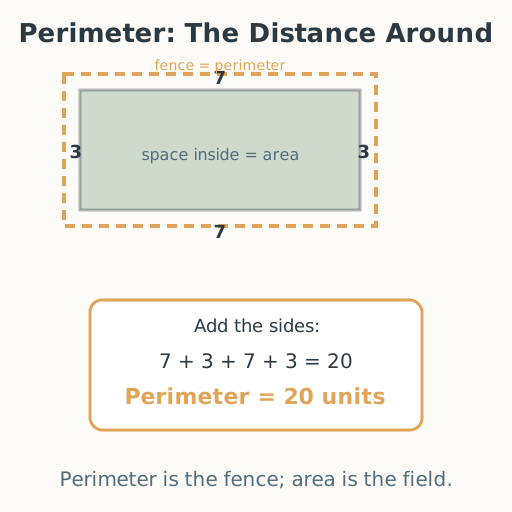
- Worked example — string around (10 min). Watch and help: lay string all the way around a 7-by-3 rectangle, meeting where you started. Measure the string: 20 units. Now add the four sides: 7 + 3 + 7 + 3 = 20. Same answer! The perimeter is 20 units.
- Perimeter or area? (8 min). Hold up the string (the edge) and a tile (the inside). Which one is the fence, which is the field? Say it: perimeter is the fence; area is the field.
- Guided practice — measure around (15 min). For each rectangle: lay string around it, measure, then add the side lengths. Write the perimeter both ways and check they match. Walk the edge of a floor rectangle and count your steps.
- Check with a friend (5 min). Trade rectangles and compare perimeters. Do you agree? Trace around again together, kindly, if you differ.
- Close (2 min). Remember: perimeter is the distance around — the fence. Area is the space inside — the field. Two questions, two answers, same shape.
Differentiation
- Support: Measure the perimeter with string only today; add side lengths another day.
- Support (blind/low-vision): Feel the string all the way around a shape and count hand spans along it.
- Extension: Find a rectangle whose perimeter is 20 units but whose area is different from a 7-by-3 rectangle (like 6-by-4), and compare the two.
Assessment
- Formative (observation): Can the learner measure the distance around a rectangle and add the side lengths to find the perimeter?
- Self: Can the learner say, in their own words, the difference between perimeter and area?
Home connection
At home, measure the way around a rug, a table, or a bed with your steps or a piece of string, and tell a grown-up the perimeter — then point to the area inside.
Resources
- Van de Walle, J. A., Karp, K. S., & Bay-Williams, J. M. (2019). Elementary and Middle School Mathematics: Teaching Developmentally (10th ed.). Pearson. (Distinguishing perimeter — the distance around — from area — the space inside.)