Lesson 12 — Sorting Shapes by Their Attributes
Learners sort shapes into categories by their attributes — number of sides, number of angles, straight or curved edges — and name the rule of each category. They discover that a category is a shared attribute, and a shape can belong by many names at once.
Objectives
Objectives
- D05.S3.03.02 Sort shapes into categories by their attributes and recognize that shapes in a category share common properties.
Essential question
How do I sort shapes into categories by their attributes?
Key vocabulary
Materials
Standard materials
- A set of shape cards or cut-out shapes · 1 set per pair Triangles, quadrilaterals, pentagons, hexagons, and shapes with curved edges
- Sorting rings, strings, or drawn circles · 3 per pair To make categories on the table or floor
- Paper or slate and a drawing tool · per learner To record the categories and their rules
Low-tech / no-cost
- Found objects and the ground Collect leaves, stones, and twigs of different shapes and sort them into circles drawn in the dirt
- Voice and body Learners sort themselves into groups by an attribute — "everyone with four sides this way"
Enriched / lab & device
- A shape-sorting chart with labels · 1 per pair Columns for each attribute (number of sides, number of angles, straight or curved)
- A "what is my rule?" mystery-sort game set · 1 set per pair One learner sorts by a secret rule; the other guesses the rule
Works in different contexts
- large-group Sort a large set of shapes on the floor as a whole class, naming each category and its rule together
- self-directed A learner sorts a shape set, names the rule of each category, and draws the sort
- outdoor-only Sort leaves, stones, and twigs by shape outdoors, drawing rings in the dirt for each category
- multi-age Older learners write the category rules while younger learners place each shape and name its sides
- level-grouped Learners who sort easily invent a secret rule and have a partner guess it; others sort by one attribute with support
Lesson 12 — Sorting Shapes by Their Attributes
Summary
Learners sort shapes into categories by their attributes — number of sides, number of angles, straight or curved edges — and name the rule of each category. They discover that a category is a shared attribute, and that one shape can be described by more than one attribute at once.
Objectives
- Sort shapes into categories by their attributes and recognize that shapes in a category share common properties. (D05.S3.03.02)
Connection
A cook sorts beans by color before cooking; a seed-keeper sorts seeds by size; a caretaker sorts tools by their job. Sorting is how people bring order to a big mixed pile — and shapes are no different. Every shape has attributes: how many sides, how many corners, whether its edges are straight or curved. When you sort by an attribute, you make a category with a rule. Builders, weavers, and tile-makers in every culture have sorted shapes this way to fit them together.
Materials
- A set of shape cards or cut-out shapes (triangles, quadrilaterals, pentagons, hexagons, and shapes with curved edges)
- Three sorting rings, strings, or drawn circles
- Paper or slate and a drawing tool
Preparation
- Give each pair a shape set and three sorting rings.
- Clear space to sort on tables or the floor.
- Plan a worked example (sorting by number of sides).
Facilitator note
This lesson is written to the learner (“you”). It opens the shape attributes strand — the new skill is classifying shapes by an attribute and naming the rule. Teach with a worked example (philosophy §13): sort a mixed set into “three sides,” “four sides,” and “five or more sides,” and state each rule aloud before learners sort their own. The key move is seeing that a category is a shared attribute — the same shape can be sorted by sides, by angles, or by straight-vs-curved, and belong in different piles depending on the rule (Van de Walle et al., 2019). No one’s speed at sorting measures their smartness; two children can sort by different rules and both be right. Sorting is a universal human act — every culture sorts its plants, stones, and tools. Count in the home language. For learners who are Deaf or hard of hearing, sign each attribute and point to the sides; for learners who are blind or low-vision, use cut-out shapes the hands can feel and sort by touch. Learners with limited movement direct a partner to place each shape. Mastery arrives at its own pace.
Procedure
- Gather — a mixed pile (5 min). Look at the pile of shapes. How could you bring order to it? What is the same about some shapes? That sameness is an attribute.
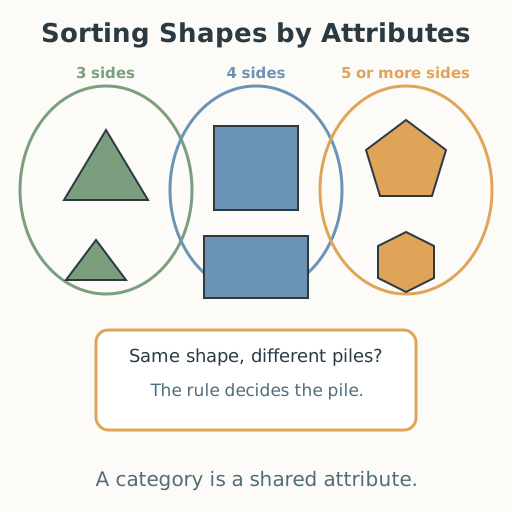
- Worked example — sort by sides (10 min). Watch and help: make three rings. Put every shape with three sides in one ring, every shape with four sides in the next, and the rest in the third. Say each rule: “this ring is three-sided shapes.”
- Sort another way (10 min). Now sort the same shapes by a different attribute: straight edges or curved edges? How many corners? A square can be “four sides” in one sort and “all straight edges” in another. The rule decides the pile.
- Guided practice — your own rule (12 min). Sort your set by a rule you choose. Write the rule. Then sort the same set by a second rule and write that one too.
- Mystery sort (5 min). With a partner, sort by a secret rule and let them guess it. Then swap.
- Close (3 min). Remember: shapes live in categories by shared attributes. Name the rule, and the pile makes sense.
Differentiation
- Support: Sort by one attribute (number of sides) today; add a second attribute another day.
- Support (blind/low-vision): Sort cut-out shapes by touch, feeling the sides and corners.
- Extension: Sort by two attributes at once (for example, “four sides AND all sides equal”) and describe the smaller category that results.
Assessment
- Formative (observation): Can the learner sort shapes by an attribute and name the rule of each category?
- Artifact (portfolio): The learner’s drawn sort with its rule, kept as a record of classification.
Home connection
At home, sort a pile of leaves, buttons, or kitchen tools by one attribute, name your rule, and have a grown-up guess it.
Resources
- Van de Walle, J. A., Karp, K. S., & Bay-Williams, J. M. (2019). Elementary and Middle School Mathematics: Teaching Developmentally (10th ed.). Pearson. (Classifying shapes by attributes and seeing categories as shared properties.)