Lesson 13 — Shapes That Share Properties
Learners build and sort quadrilaterals and discover the properties they all share — four sides and four angles — then see how squares, rectangles, and rhombuses are nested: a square is both a rectangle and a rhombus. A shape can wear more than one name.
Objectives
Objectives
- D05.S3.03.02 Sort shapes into categories by their attributes and recognize that shapes in a category share common properties.
Essential question
What properties do all quadrilaterals share, and how do squares, rectangles, and rhombuses relate?
Key vocabulary
Materials
Standard materials
- Quadrilateral shape cards (squares, rectangles, rhombuses, trapezoids) · 1 set per pair Several of each kind, plus a few non-quadrilaterals to catch
- String or sticks for making sides · per pair To build quadrilaterals and test their properties
- Paper or slate and a drawing tool · per learner To draw quadrilaterals and write shared properties
Low-tech / no-cost
- Sticks, string, and the ground Build quadrilaterals on the ground with sticks and test whether sides are equal or corners are square
- Voice and body Four learners hold a rope into a quadrilateral and adjust it into a square, rectangle, and rhombus
Enriched / lab & device
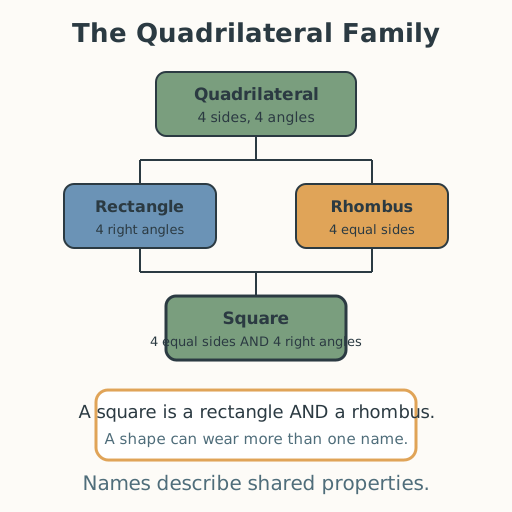
- A "quadrilateral family" poster sheet · 1 per pair A tree showing how a square is also a rectangle and a rhombus
- Geoboards and rubber bands · 1 per pair To stretch quadrilaterals and see their properties change
Works in different contexts
- large-group Build quadrilaterals with four learners holding a rope, changing them from square to rectangle to rhombus as the class names the shared properties
- self-directed A learner sorts quadrilateral cards, finds the shared properties, and draws the family tree
- outdoor-only Build quadrilaterals with sticks and string outdoors and test equal sides and square corners
- multi-age Older learners explain "a square is also a rectangle" while younger learners build each shape and count sides and corners
- level-grouped Learners who see the relationships draw the family tree and justify each link; others build and count sides with support
Lesson 13 — Shapes That Share Properties
Summary
Learners build and sort quadrilaterals and discover the properties they all share — four sides and four angles — then see how squares, rectangles, and rhombuses are nested: a square is both a rectangle and a rhombus. A shape can wear more than one name, because names describe shared properties, not separate boxes.
Objectives
- Sort shapes into categories by their attributes and recognize that shapes in a category share common properties. (D05.S3.03.02)
Connection
A square is a rectangle, and a square is also a rhombus — even though it has its own name too. It is like a person who is both a cousin and a sister and a friend, all at once: the names overlap because the properties overlap. Tile-makers and builders have long known this family of four-sided shapes, because fitting them together — in floors, walls, and cloth — depends on what they share. Today you meet the whole family and learn who is related to whom.
Materials
- Quadrilateral shape cards (squares, rectangles, rhombuses, trapezoids, plus a few non-quadrilaterals)
- String or sticks for making sides
- Paper or slate and a drawing tool
Preparation
- Give each pair a set of shape cards and building sticks or string.
- Clear space to build and sort.
- Plan a worked example (a square is a rectangle and a rhombus).
Facilitator note
This lesson is written to the learner (“you”). It deepens sorting by showing that categories nest — the new skill is seeing that a shape can belong to several categories at once because each name marks a shared property. Teach with a worked example (philosophy §13): build a square, ask “is it a rectangle? (four right angles — yes) is it a rhombus? (four equal sides — yes),” and conclude a square is both. The key move is hierarchical classification, which children grow into slowly — do not rush it (Van de Walle et al., 2019). A shape wearing many names is not “wrong”; it is precise. And no learner’s speed at naming shapes measures their smartness — some see the nesting quickly, some need to hold and turn each shape, and both are mathematical. Quadrilaterals appear in tiling and design across many cultures. Count in the home language. For learners who are Deaf or hard of hearing, sign each property and point to sides and corners; for learners who are blind or low-vision, feel the sides and corners of each shape and fold a paper square to test equal sides. Learners with limited movement direct a partner. Mastery arrives at its own pace.
Procedure
- Gather — the four-sided family (5 min). What do a square, a rectangle, a rhombus, and a trapezoid all have in common? Count their sides: four. Count their corners: four. They are all quadrilaterals.
- Worked example — a square wears many names (10 min). Build a square with sticks. Is it a rectangle? A rectangle has four right angles — yes, a square does. Is it a rhombus? A rhombus has four equal sides — yes, a square does. So a square is a rectangle and a rhombus — and a quadrilateral too.
- Sort the family (12 min). Sort your cards: which are rectangles (four right angles)? Which are rhombuses (four equal sides)? Which are both? Which are neither? Say each shape’s full name: “this square is also a rectangle and a rhombus.”
- Build and change (10 min). With string or sticks, make a rectangle. Push on it — can you make it a rhombus that is not a rectangle? Make a square. What does it keep, and what changes?
- Check with a friend (5 min). Trade cards and name each shape with all its names. Do you agree? Count sides and corners together, kindly.
- Close (3 min). Remember: quadrilaterals share four sides and four angles, and a shape can wear more than one name. A square is a rectangle and a rhombus.
Differentiation
- Support: Work only on “four sides and four angles = quadrilateral” today; add the square-is-a-rectangle idea another day.
- Support (blind/low-vision): Feel and fold paper shapes to test equal sides and square corners.
- Extension: Draw the quadrilateral family tree and write one sentence for each link (“every square is a rectangle because …”).
Assessment
- Formative (observation): Can the learner state the shared properties of quadrilaterals and explain that a square is both a rectangle and a rhombus?
- Self: Can the learner name one shape and list all the categories it belongs to?
Home connection
At home, find four-sided shapes (tiles, windows, doors, cloth patterns) and tell a grown-up whether each is a rectangle, a rhombus, or both.
Resources
- Van de Walle, J. A., Karp, K. S., & Bay-Williams, J. M. (2019). Elementary and Middle School Mathematics: Teaching Developmentally (10th ed.). Pearson. (Hierarchical classification of quadrilaterals — how a square is a rectangle and a rhombus.)