Lesson 14 — Measuring & Estimating Liquid Volume
Learners estimate and then measure how much liquid containers hold, using liters and milliliters, and discover that one liter equals one thousand milliliters. Estimating first, then measuring, makes the unit real.
Objectives
Objectives
- D05.S4.03.01 Measure and estimate liquid volume and mass using standard units and solve real problems with them.
Essential question
How do I measure and estimate liquid volume using liters and milliliters?
Key vocabulary
Materials
Standard materials
- A 1-liter container and smaller marked containers · 1 set per group A bottle or jug holding one liter, plus cups marked in milliliters
- Water and a large basin · 1 To pour, fill, and measure without spills
- Paper or slate and a drawing tool · per learner To record estimates and measurements
Low-tech / no-cost
- Found containers and water Use any bottle, gourd, or cup as a container; compare how many of the small fill the large
- Voice and body Estimate by eye, then pour and count aloud; use two hands to show "about this much"
Enriched / lab & device
- A graduated cylinder and measuring cups · 1 set per group Marked in milliliters for precise measurement
- A "capacity hunt" recording sheet · 1 per group To record the capacity of several real containers around the room
Works in different contexts
- large-group Measure and pour as a whole group, estimating together before each measure and reading the marks aloud
- self-directed A learner estimates the capacity of containers, then fills and measures each, recording both numbers
- outdoor-only Measure water with bottles, gourds, and cups outdoors, pouring into a basin and counting the fills
- multi-age Older learners read the milliliter marks while younger learners pour and count the fills
- level-grouped Learners who measure easily compare containers and order them by capacity; others fill and count with support
Lesson 14 — Measuring & Estimating Liquid Volume
Summary
Learners estimate and then measure how much liquid containers hold, using liters and milliliters, and discover that one liter equals one thousand milliliters. Estimating first, then measuring, makes the unit real and useful.
Objectives
- Measure and estimate liquid volume and mass using standard units and solve real problems with them. (D05.S4.03.01)
Connection
A cook measures a liter of water for soup; a nurse measures milliliters of medicine; a farmer knows how many liters the milk pail holds; a family measures how much rain fell in the night. Liquid volume is how much space a liquid takes up — and we measure it with units that people everywhere agreed on: the liter and the milliliter. A good measurer always estimates first, then measures to check — that is how you catch a mistake before it spills.
Materials
- A 1-liter container and smaller marked containers
- Water and a large basin
- Paper or slate and a drawing tool
Preparation
- Give each group a liter container, smaller marked cups, water, and a basin.
- Clear a splash-friendly space.
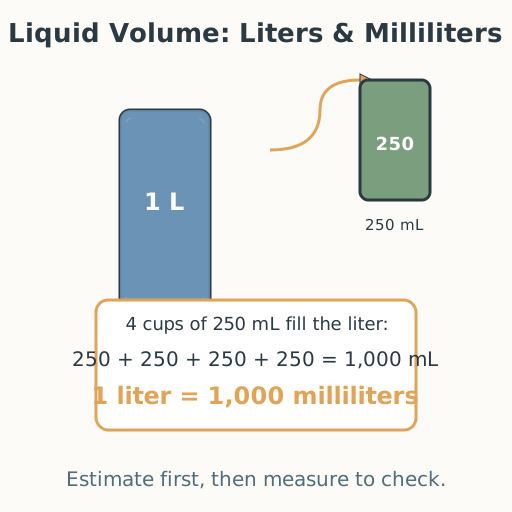
- Plan a worked example (fill the liter with a 250-mL cup four times).
Facilitator note
This lesson is written to the learner (“you”). It introduces liquid volume with the liter and milliliter — the new skill is estimating capacity before measuring it with standard units. Teach with a worked example (philosophy §13): fill a 250-mL cup four times to fill the liter bottle, counting aloud, and conclude 1 L = 1,000 mL. The estimation-before-measurement habit is the real lesson: a good estimate is a thinking tool, not a guess (Van de Walle et al., 2019). No one’s accuracy at pouring measures their smartness; estimation grows with practice, and “not yet” is information, never a verdict. The liter and milliliter are shared international units — one among several systems people have used, but the one most of the world agrees on today, which makes medicine and trade safer everywhere. Measure in the home language. For learners who are Deaf or hard of hearing, mark the water level with signs and count fills; for learners who are blind or low-vision, feel the water rise in the cup and pour to a finger-marked line. Learners with limited movement direct a partner to pour. Mastery arrives at its own pace.
Procedure
- Gather — how much does it hold? (5 min). Look at the liter bottle. How much water fits inside? Capacity is how much a container can hold, and volume is how much liquid is in it. We measure both in liters and milliliters.
- Worked example — fill the liter (10 min). Watch and help: fill a 250-mL cup, pour it into the bottle. Again — that is 500 mL. Again — 750. Again — one liter. Four cups of 250 mL make 1,000 mL. So 1 liter = 1,000 milliliters.
- Estimate, then measure (15 min). Choose containers. Estimate first: about how many milliliters does this cup hold? Write your estimate. Now measure by filling and reading the marks. How close were you? Record both numbers.
- Compare containers (8 min). Which container holds more? Order three containers from least to greatest capacity, then check by pouring from one into another.
- Check with a friend (5 min). Trade estimates and measurements. Do you agree? Measure again together, kindly, if you differ.
- Close (2 min). Remember: liquid volume is measured in liters and milliliters — 1,000 mL make a liter — and a good measurer estimates first, then checks.
Differentiation
- Support: Use only “full cup” and “half cup” today; add exact milliliter marks another day.
- Support (blind/low-vision): Pour to a finger-marked line and feel the water rise.
- Extension: Find a container whose capacity is about half a liter, and explain how you know.
Assessment
- Formative (observation): Can the learner estimate a container’s capacity, then measure it in liters or milliliters and read the result?
- Artifact (portfolio): The learner’s estimate-and-measure record, kept as a record of measurement.
Home connection
At home, estimate how many cups of water fill a family jug, then fill it and count — and tell a grown-up how close your estimate was.
Resources
- Van de Walle, J. A., Karp, K. S., & Bay-Williams, J. M. (2019). Elementary and Middle School Mathematics: Teaching Developmentally (10th ed.). Pearson. (Measuring and estimating capacity with liters and milliliters, developing benchmarks before precision.)