Lesson 06 — Telling a Story Without Words
Learners retell a short story or a feeling using only movement and gesture — no words — and explain why they chose each gesture. They discover that the body is a language of its own, and that people everywhere tell stories with hands, faces, and movement when words are not enough.
Objectives
Objectives
- D07.S3.03.02 Retell a story or feeling using only movement and gesture, and explain their choices.
Essential question
How do I retell a story or feeling using only movement and gesture, and explain my choices?
Key vocabulary
Materials
Standard materials
- A short story or feeling everyone knows · 1 A tiny tale — a seed growing, a storm passing, a balloon floating away — or a feeling to show
- Open space to move · per group Room to gesture and move safely
Low-tech / no-cost
- The body and face alone Movement and gesture need no equipment — only hands, face, and body
- No props needed If a prop helps, a found stick or cloth can stand for an object in the story
Enriched / lab & device
- A scarf or cloth per learner · 1 per learner Optional, to stand for the wind, the rain, or a growing plant
- A recording device · 1 per group Optional, to record the retelling and watch it back to notice the choices
Works in different contexts
- large-group Retell one shared story as a whole group — everyone moves the sun rising, the rain falling, the seed growing — then let individuals retell their own version
- multi-age Younger learners retell a simple part (the sun rises); older learners retell a whole story and explain their choices; pair them to share
- self-directed A learner retells a story or feeling with movement only, then says (or writes or records) why they chose each gesture
- level-grouped Some learners retell one moment with one clear gesture; others retell a whole story with a beginning, middle, and end and explain choices; match the challenge
- outdoor-only Retell the story of the day — the sun, the wind, the rain — with movement only, under the open sky
Lesson 6 — Telling a Story Without Words
Summary
Learners retell a short story or a feeling using only movement and gesture — no words — and explain why they chose each gesture. They discover that the body is a language of its own, and that people everywhere tell stories with hands, faces, and movement when words are not enough.
Objectives
- Retell a story or feeling using only movement and gesture, and explain their choices. (D07.S3.03.02)
Connection
Think of a wave hello, a shrug, a nod, a hand over the heart, a finger to the lips for “shh.” People everywhere use gesture — movement of the hands, face, and body — to say things without words. A mime, a dancer, a person using sign language, a child acting out “the big fish got away” — all tell stories with movement. Today you will tell a whole story or feeling using only your body, and explain your choices.
Materials
- A short story or feeling everyone knows (a seed growing, a storm passing, a balloon floating away)
- Open space to move
Preparation
- Choose a short story or feeling to retell, or let learners choose their own.
- Clear a safe space to move.
Facilitator note
This lesson is written to the learner (“you”) so it works in a classroom and for a self-directed learner. Retelling with movement and explaining choices is a skill, so model it once — “I grow slowly from a crouch to tall to show the seed growing; I chose slow because seeds grow slowly” — before learners try (Kirschner, Sweller & Clark, 2006). The heart is the explanation of choices, not the polish of the movement. Any story or feeling can be retold seated, with hands and face alone, or with the whole body. A learner with limited mobility retells fully with face, hands, and shoulders, or directs a partner’s movement and explains the choice — directing is retelling. A learner who does not speak explains by pointing to a “choice” word card (big, slow, small, fast) or by showing the gesture twice with contrast. There is no wrong retelling as long as the learner can say (or show) why they moved that way.
Procedure
- Gather (5 min). Choose a small story or feeling to retell — a seed growing, a storm passing, a balloon floating away, or a feeling like “joy” or “worry.” You will tell it with no words at all.
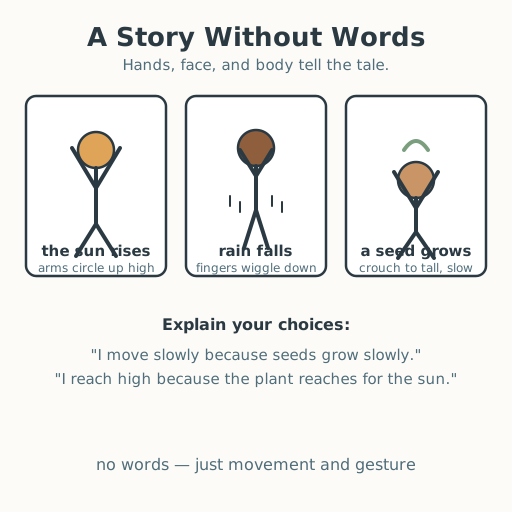
- Find the moments (10 min). Think of the story in three moments: the beginning, the middle, the end. For “a seed grows”: it is small and still, then it pushes up, then it stands tall in the sun.
- Make a gesture for each moment (10 min). Use your hands, face, and body — not your voice. Crouch small, push up slowly, stretch tall. Each moment needs one clear gesture.
- Perform and explain (15 min). Show your retelling to a partner or the group. Then explain your choices: “I moved slowly because seeds grow slowly; I reached high because the plant reaches for the sun.”
- Share and close (5 min). Remember: your body is a language. People everywhere tell stories with hands, faces, and movement — and your movement told a story with no words at all.
Differentiation
- Support: Retell one moment with one clear gesture (the sun rises: arms circle up) and say why, then build a second moment if ready.
- Support (limited mobility, seated): Retell with face, hands, and shoulders, or direct a partner’s movement and explain the choice — directing is retelling.
- Support (non-speaking): Point to a choice word card (big, slow, small, fast) or show the gesture twice with a contrast to explain.
- Extension: Invite learners to retell a whole story with a beginning, middle, and end and to explain two or three choices, then have a partner guess the story.
Assessment
- Formative (observation): Does the learner retell a story or feeling using only movement and gesture, and explain their choices?
- Performance: The learner’s movement-only retelling, performed live.
Resources
- No external resources required; the claims in this lesson are about the learner’s own movement, which they practice directly.
Home connection
Tell a grown-up a story with no words — only hands, face, and body — and let them guess. Then explain why you chose each movement.