Lesson 06 — From Farm and Garden to My Table
Learners follow food's journey from seed to table — plant, grow, harvest, transport, sell, cook — and meet the many workers who help it along the way. They learn that every meal is the work of many hands and that food travels far or near, with local food connecting people to the land around them.
Objectives
Objectives
- D03.S3.03.02 Identify where common foods come from, such as plants, animals, farms, and gardens, and how they reach a table.
Essential question
How does food travel from a farm or garden to my table, and who helps it along the way?
Key vocabulary
Materials
Standard materials
- Farm to table picture sequence cards · 1 set Cards in order — seed, growing plant, harvest, transport, market, kitchen table
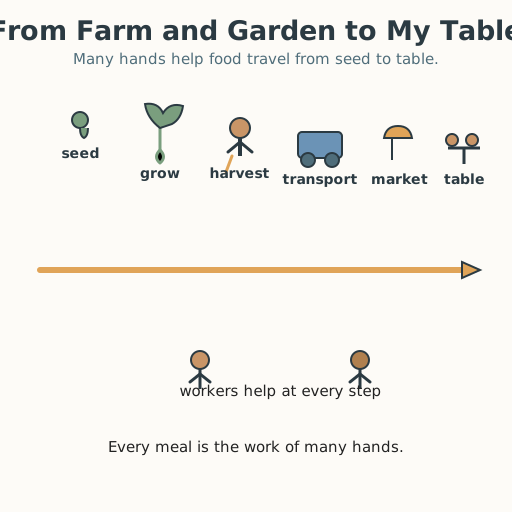
- A "food journey" chart · 1 A long arrow with the six steps to arrange the cards along
- Paper and crayons · per learner To draw the journey of one food from origin to table
Low-tech / no-cost
- Voice and body Act out the journey — planting, growing, harvesting, carrying, cooking — with no cards needed
- A remembered food Tell the story of one food's journey from where it grew to your table
Enriched / lab & device
- A real food to trace · 1 A safe food such as rice, bread, or a fruit, to trace from seed to table
- A "where food comes from" picture book or short video · 1 Showing planting, harvesting, transport, and markets around the world
Works in different contexts
- large-group Arrange the sequence cards on the chart together, then let pairs retell one food's journey to a partner
- self-directed A learner puts the cards in order, retells the journey, and draws one food traveling from origin to table
- outdoor-only Find a plant or garden nearby and trace a food's journey from seed to a pretend table, acting out each step
- multi-age Older learners read the step cards while younger learners act out planting, harvesting, and carrying; then all retell together
- level-grouped Learners who can retell the full journey do so; others put the picture cards in order with support
Lesson 6 — From Farm and Garden to My Table
Summary
Learners follow food’s journey from seed to table — plant, grow, harvest, transport, sell, cook — and meet the many workers who help it along the way. They learn that every meal is the work of many hands, and that food travels far or near, with local food connecting people to the land around them.
Objectives
- Identify where common foods come from, such as plants, animals, farms, and gardens, and how they reach a table. (D03.S3.03.02)
Connection
A seed goes into the soil. Sun and rain help it grow. Someone waters it, tends it, and later harvests it. Someone carries it to a market or a shop. Someone buys it and cooks it. Then it reaches your table. For other foods the journey starts differently — a fish is caught from a river or the sea, milk comes from herded animals, and wild fruit is gathered from a tree — but every food still reaches a table by many hands. Every meal is a long journey made by many hands — and today you will follow that journey from start to finish.
Materials
- “Farm to table” picture sequence cards (seed, growing plant, harvest, transport, market, table)
- A “food journey” chart (a long arrow with six steps)
- Paper and crayons
Preparation
- Prepare the sequence cards and the food journey chart.
- Think of one or two local examples of foods grown nearby, so learners can see that some food travels a short way and some a long way.
Facilitator note
This lesson is written to the learner (“you”). Every meal is many people’s work. Lift up the farmers, gardeners, harvesters, transporters, millers, market sellers, and cooks — often underpaid and too often invisible — so learners meet food with gratitude and a sense of justice, not guilt. Teach that food can travel far (by truck, ship, or plane) or near (from a nearby farm or garden), and that local food connects people to the land around them and often uses less fuel. Honor that food reaches tables in many ways — grown on farms and gardens, gathered from wild places, fished from water, or herded with animals — and that each journey is real and worthy, not only the planted-field story. This is where technology enters honestly: tools, irrigation, mills, trucks, and refrigeration help move food to many tables, and they also use energy and affect the Earth — a seed for later grades, held lightly here. A learner who is blind or has low vision arranges the cards by feel or retells the journey aloud; a learner who does not use a speaking voice points or arranges the cards in order; a learner who is deaf or hard of hearing follows the cards and the acted-out journey from the front. This lesson completes D03.S3.03.02 (how food reaches a table) and the food-journey chart is a unit portfolio artifact.
Procedure
- Gather (5 min). Last lesson you learned where food begins. Now follow one food all the way to your table.
- Meet the journey (15 min). Arrange the cards in order on the arrow. Seed — a tiny beginning in the soil. Grow — sun, water, and care help it rise. Harvest — people gather what grew. Transport — trucks, carts, boats, or trains carry it. Market — it is sold in a market or shop. Table — someone cooks it and you eat. Some foods start their journey differently — a fish is caught, milk is milked from herded animals, wild fruit is gathered from a tree — but each still travels to a table by many hands. Point to each step.
- Who helps along the way? (10 min). A farmer plants and tends. A harvester gathers. A driver or carrier moves it. A miller grinds grain into flour. A seller offers it. A cook prepares it. Every meal is the work of many hands — people who deserve our thanks and fair pay.
- Far or near (10 min). Some food travels a long way — across seas and mountains. Some comes from nearby — a local farm or garden, just down the road. Local food connects you to the land and people around you, and it often uses less fuel. Both kinds feed us.
- Draw one journey (5 min). Choose one food and draw its journey from origin to table, with the people who help.
- Close (5 min). Say it together: “My food travels by many hands, from seed to table. I thank the land and the people who feed me.”
Differentiation
- Support: Arrange just three steps (seed, grow, table) first; accept spoken, drawn, or gestured retellings.
- Support (non-speaking): Arrange the cards in order and point to each worker.
- Support (blind/low-vision): Retell the journey aloud as a story, with the learner naming each step in order.
- Extension: Trace a real food from your home through all six steps, and name one thing that would change if the food were grown nearby.
Assessment
- Formative (observation): Can the learner put the food journey in order and name at least one person who helps food reach a table?
- Portfolio: The “food journey” drawing becomes a unit portfolio artifact.
Home connection
At home, choose one food and ask a grown-up where it came from — a nearby farm or garden, or a faraway place. Trace its journey from origin to your table and thank the people who grew and carried it.
Resources
- Food and Agriculture Organization of the United Nations, “Sustainable food value chains” (how food moves from farm to table): https://www.fao.org/sustainable-food-value-chains/en/