Lesson 07 — First Aid for Minor Hurts
Learners learn a basic first-aid response for common minor injuries: for a cut or scrape, tell an adult, wash with clean water, and cover it; for a bruise, cool it and rest. They practice the steps on a doll or in the air — never on a real body — and learn that telling an adult always comes first, because some hurts need grown-up or medical help.
Objectives
Objectives
- D03.S4.03.01 Demonstrate a basic first-aid response for common minor injuries, such as telling an adult about a cut, scrape, or bruise.
Essential question
What should I do for a minor cut, scrape, or bruise, and when do I tell an adult?
Key vocabulary
Materials
Standard materials
- First-aid step cards · 1 set Cards for a cut, a scrape, and a bruise — tell an adult, wash with clean water, cover a cut, cool cloth for a bruise, rest
- A small first-aid kit to show · 1 Clean water, soap, a clean cloth or bandage, a cool cloth — shown, not applied to real bodies
- Paper and crayons · per learner To draw the steps for one minor hurt
Low-tech / no-cost
- Voice and body Act out the steps for a cut, scrape, and bruise with no kit — tell, wash, cover, cool, rest
- A clean cloth and water Practice the motions of washing and covering a hurt on a doll or on the air, never on a real wound
Enriched / lab & device
- A practice doll or stuffed animal · 1 To practice "washing" and "covering" a pretend cut on a toy, never on a real body
- A first-aid picture chart · 1 A wall chart showing the steps for minor cuts, scrapes, and bruises
Works in different contexts
- large-group Demonstrate each hurt once at the front, then send pairs to act out the steps with a doll while others draw the steps
- self-directed A learner reads or hears the steps, orders the cards, and practices the motions on a doll or in the air, then draws one hurt and its care
- outdoor-only Act out a real scenario on a walk — a scrape from a fall — and practice telling, washing with clean water, and resting
- multi-age Older learners model each step on a doll while younger learners retell it; then everyone orders the cards
- level-grouped Learners who can retell the steps teach them; others match each hurt to its care card with support
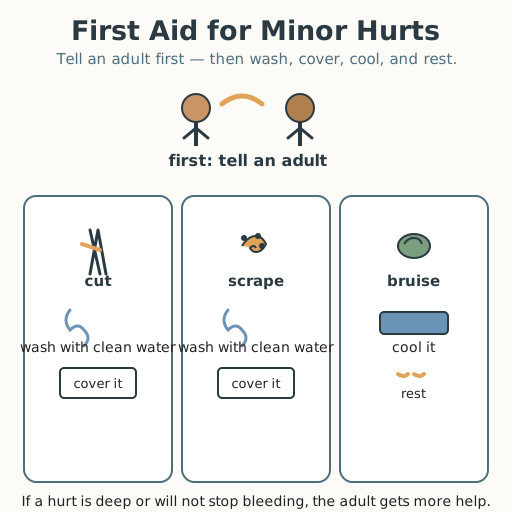
Lesson 7 — First Aid for Minor Hurts
Summary
Learners learn a basic first-aid response for common minor injuries: for a cut or scrape, tell an adult, wash with clean water, and cover it; for a bruise, cool it and rest. They practice the steps on a doll or in the air — never on a real body — and learn that telling an adult always comes first, because some hurts need grown-up or medical help.
Objectives
- Demonstrate a basic first-aid response for common minor injuries, such as telling an adult about a cut, scrape, or bruise. (D03.S4.03.01)
Connection
You are running and you fall. Your knee stings, and there is a small red scrape. Or you bump your arm and later a bruise appears. These small hurts happen to everyone, and there is a calm, careful way to respond: first aid. The very first step is always the same — tell an adult. Today you will learn what to do next.
Materials
- First-aid step cards (cut, scrape, bruise)
- A small first-aid kit to show (clean water, soap, a clean cloth or bandage, a cool cloth)
- Paper and crayons
Preparation
- Prepare the first-aid step cards and gather a small kit to show (not to use on real bodies).
- Read the facilitator note fully before teaching; keep the tone calm and reassuring, not frightening.
Facilitator note
This lesson is written to the learner (“you”). Reassure, never frighten. The lesson covers minor, everyday hurts only — cuts, scrapes, and bruises — and its core message is empowering: tell an adult, and let the adult help. Practice is done on a doll, a stuffed animal, or in the air, never on a real body or a real wound, so no learner is hurt or embarrassed. Teach the steps plainly: for a cut or scrape — tell an adult, wash with clean water (soap if available), cover with a clean cloth or bandage; for a bruise — tell an adult, cool it with a cool cloth, and rest. Always stress that if a hurt is deep, big, or will not stop bleeding, the adult will decide if more help is needed. A learner who is blind or has low vision practices the motions hand-over-hand and says the steps aloud; a learner who does not use a speaking voice signs or points to the step cards; a learner who is deaf or hard of hearing follows the cards and the demonstration from the front, since every step is shown, not only told. The first-aid facts follow the guidance of the International Federation of Red Cross and Red Crescent Societies (IFRC): clean a minor wound with clean water and cover it, and cool a bruise. This lesson opens the unit’s safety strand (D03.S4.03.01) and leads into the capstone on safe touch.
Procedure
- Gather (5 min). Small hurts — a cut, a scrape, a bruise — happen to everyone. The calm, careful response to a hurt is called first aid.
- The first step is always the same (5 min). For every hurt, the very first thing is to tell an adult. The adult looks, decides, and helps. You never have to handle a hurt all alone.
- A cut or a scrape (15 min). A cut is a break in the skin, like from something sharp. A scrape is skin rubbed off, like from a fall. For both: tell an adult, wash the hurt with clean water (soap if there is any), and cover it with a clean cloth or bandage to keep dirt out. Practice the motions in the air or on a doll, in order.
- A bruise (10 min). A bruise is a dark, tender spot under the skin, from a bump. For a bruise: tell an adult, cool it with a cool cloth, and rest the hurt part. Practice the motions.
- When a hurt is bigger (5 min). If a cut is deep or big, or will not stop bleeding, the adult decides and may get a nurse or doctor. That is why telling an adult always comes first.
- Close (5 min). Say it together: “For a cut, scrape, or bruise, I tell an adult. I wash, cover, cool, and rest. First aid keeps me safe.”
Differentiation
- Support: Practice one hurt at a time, with the adult modeling each step first; accept spoken, drawn, or gestured answers.
- Support (non-speaking): Order the step cards and point to each step for each hurt.
- Support (blind/low-vision): Say the steps aloud in order and practice the motions hand-over-hand with a doll.
- Extension: Teach the steps to someone younger, and name one hurt that would need a nurse or doctor instead of a bandage.
Assessment
- Formative (observation): Can the learner say, in order, the first-aid steps for one minor hurt — with “tell an adult” first — in their own way?
- Self: The learner names the hurt they practiced and the very first step for every hurt.
Home connection
With a grown-up, name what you would do for a small cut or scrape at home — tell, wash, cover — and where your family keeps clean water and a cloth.
Resources
- International Federation of Red Cross and Red Crescent Societies, “Basic first aid” (clean, cover, cool, and when to get more help): https://www.ifrc.org/our-work/health-and-care/first-aid