Lesson 08 — Having a Say — Power and Being Left Out
Learners explain what it means to have power or a say in a group — that your voice helps decide what happens — and what can happen when someone is left out, always ending in the possibility of noticing and inviting them in.
Objectives
Objectives
- D08.S4.03.02 Explain what it means to have power or a say in a group, and what can happen when some people are left out.
Essential question
What does it mean to have power or a say in a group, and what can happen when some people are left out?
Key vocabulary
Materials
Standard materials
- "A say for all" picture cards · 1 set Two scenes — a group where everyone speaks and is heard, and a group where one person sits outside with no voice — plus a card showing "invite them in"
- A two-column chart · 1 per learner or pair Columns for "everyone has a say" and "someone is left out," with a space to say what could change
- Pencils and crayons · per learner For drawing the scenes and the fix
Low-tech / no-cost
- A real circle and a spoken game Sit in a circle and decide something together; then act a version where one person is left out, and notice and fix it together
- Body and voice Act a talking circle where each person speaks, then act someone left out, and name how it feels and what to do
Enriched / lab & device
- A short, gentle story about a group decision · 1 A blame-free story, such as a class choosing a game where one voice is missed, ending in inviting everyone in
- A set of picture scenes of groups deciding together · 1 set Scenes of fair and unfair group decisions, for sorting and retelling
Works in different contexts
- large-group Hold a real class decision — everyone speaks in turn — then notice together what it would feel like if someone were left out
- self-directed The learner studies the cards, sorts the two scenes, and writes or draws one way to include someone, then shares with a grown-up or peer
- outdoor-only Form a talking circle outside and make a small real decision together, giving every voice a turn
- multi-age Older learners scribe the "what could change" sentence while younger learners act the scenes and the fix
- level-grouped Learners who grasp the idea quickly coach peers by asking "who is not being heard? how can we include them?" rather than telling
Lesson 8 — Having a Say: Power and Being Left Out
Summary
Learners explain what it means to have power or a say in a group — that your voice helps decide what happens — and what can happen when some people are left out. Grade 2 sorted fair and unfair rules; Grade 3 names the deeper idea behind fairness: power is the ability to help decide, a say is a voice that is heard, and a fair group makes room for every voice. The lesson always ends in the possibility of noticing and inviting someone in.
Objectives
- Explain what it means to have power or a say in a group, and what can happen when some people are left out. (D08.S4.03.02)
Connection
Every group decides things — your class, your games, your home, your town. When everyone gets to speak and is heard, the group has a fair say. That is what power in a group can mean: not bossing others, but having a voice that helps decide. When some people are left out — not asked, not listened to — the choice can be unfair, because their needs and ideas were never heard. Noticing who is left out, and inviting them in, is how groups become fair.
Materials
- “A say for all” picture cards (everyone speaks; someone left out; invite them in)
- A two-column chart (everyone has a say / someone is left out)
- Pencils and crayons
Preparation
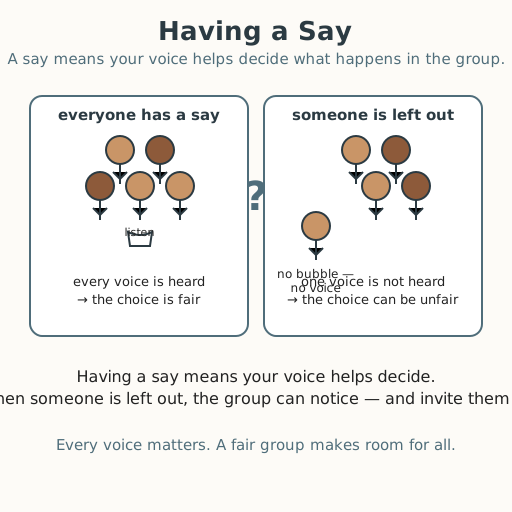
- Prepare the cards. Everyone has a say: five people in a circle, each with a speech bubble — every voice is heard. Someone is left out: four people speaking while one person sits outside the circle with no bubble. The fix: a card where the outside person is invited into the circle.
- Prepare the two-column chart, and be ready to model the words: “Having a say means your voice helps decide. When someone is left out, their voice is missing, and the choice can be unfair.”
Facilitator note
This lesson is written to the learner (“you”). Hold power as shared, not bossing. For this age, “power in a group” is best explained as the ability to help decide, and “a say” as a voice that is heard. This is a values commitment, held as such — not a factual claim — and it carries the curriculum’s egalitarian heart: power is meant to be shared, and a fair group makes room for every voice. Keep it concrete and blame-free: use a real classroom decision (what game to play, where to sit, how to share) and end with the fix — noticing who is left out and inviting them in. The unfairness is in the arrangement, never in a child. The idea connects outward to the wider world: the same noticing — who has a say, who is left out — is how fairness in the big human story begins to be studied in later grades. There is a real, citable anchor: the United Nations Convention on the Rights of the Child says children have the right to say what they think and to be listened to (see Resources). Honor every body: a learner who does not use a speaking voice points or signs; a learner who is blind or has low vision hears the scenes described clearly. Never require a learner to share a real experience of being left out — the given cards and circle are enough.
Procedure
- Gather (5 min). Think of a time your group decided something. Did everyone get to speak? How did it feel?
- Meet “a say” and “power” (10 min). A say means your voice is heard and helps decide. Power in a group can mean the ability to help decide — not bossing others. Say it together: “A say = my voice helps decide.”
- See fair and unfair (15 min). Look at the two cards. In the first, everyone speaks and is heard — the choice is fair. In the second, one person sits outside with no voice — the choice can be unfair, because their needs and ideas were never heard.
- Meet the fix (10 min). Look at the third card: the person is invited in. When a group notices someone is left out, it can ask them in, listen, and make the choice together. That is how a group becomes fair.
- Practice it (10 min). In a circle, make one small real decision together, giving every voice a turn. Then name it: “Everyone had a say, so the choice was fair.” Point, sign, or act.
- Close (5 min). Every voice matters. A fair group makes room for all — and anyone can be the one who notices and invites someone in.
Differentiation
- Support: Meet only “a say” and “left out,” and finish one sentence together — “When someone is left out, the group can…” — with picture support.
- Support (blind/low-vision): Sit in a real circle and notice each voice by sound; describe aloud what it means when a voice is missing.
- Support (non-speaking): Sort the cards onto the two columns and point to the “invite them in” card instead of speaking.
- Support (Deaf/HH): The cards are visual — read them with your eyes, and sign “say,” “left out,” and “include” as you go.
- Support (motor-difference): Direct a partner to move each card while you point, sign, or eye-gaze.
- Extension: Make up one new way a group could make sure no voice is missed — a talking stick, a turn list — and tell why it helps.
Assessment
- Formative (observation): Can the learner explain what it means to have a say and what happens when someone is left out?
- Formative (oral/performance): Does the learner name one way the group could include someone — in their own words, ending in fairness rather than blame?
Resources
- United Nations Convention on the Rights of the Child, Article 12 — states that children have the right to say what they think and to have their views taken into account, supporting the idea that every voice, including a child’s, deserves to be heard in the groups that affect them. https://www.ohchr.org/en/instruments-mechanisms/instruments/convention-rights-child
Home connection
With a grown-up, think of a decision your family makes. Does everyone get a say? What is one small way to make sure a quieter voice is heard?