Lesson 09 — Two Peoples, Two Places — A Comparison
Learners bring two skills together into one portfolio artifact: a "two peoples, two places" comparison that places the Arctic and the desert side by side and explains how each environment shaped food, shelter, clothing, and settlement — comparing with respect, never ranking.
Objectives
Objectives
- D08.S2.03.01 Compare how two peoples met basic needs for food, shelter, and clothing and explain how their environment shaped those choices.
- D08.S3.03.02 Explain how rivers, mountains, or climate shaped where people chose to settle and live.
Essential question
How can I put two peoples side by side — their place, food, shelter, and clothing — and explain how each place shaped how they lived?
Key vocabulary
Materials
Standard materials
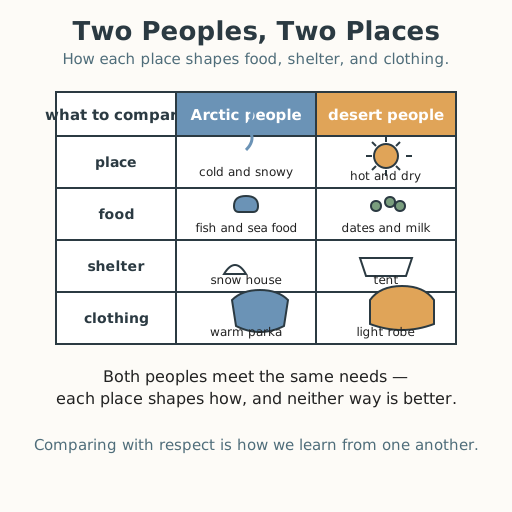
- A "two peoples, two places" comparison sheet · 1 per learner A sheet with two columns (Arctic people, desert people) and four rows (place, food, shelter, clothing), plus a line for "how the place shaped it"
- Crayons, pencils, paste · per learner For drawing each cell and writing the "shaped by" sentence
Low-tech / no-cost
- A drawn or laid-out comparison Draw the two columns in the sand or on paper, and lay found objects in each cell (a wrap, a cloth, a cup, a leaf)
- Body and voice Act each cell — bundling warm, draping light cloth, fishing, herding — and say how the place shaped it
Enriched / lab & device
- A photo set of Arctic and desert life · 1 set Real photographs of the two peoples' food, shelter, and clothing side by side
- A camera or tablet · 1 per group Optional — photograph the finished comparison as a portfolio record
Works in different contexts
- large-group Build one big class comparison sheet together, each learner adding one cell in turn, then the group reads the "shaped by" sentences aloud
- self-directed The learner completes the comparison sheet alone, then tells a grown-up or peer one "shaped by" sentence for each people
- outdoor-only Lay the comparison with found objects in two lines, one for each people, and say the "shaped by" sentence as you walk each line
- multi-age Older learners scribe the captions and read labels while younger learners draw the cells and place the objects
- level-grouped Learners who finish early coach peers by asking "what is this place like? how did it shape the food?" rather than telling
Lesson 9 — Two Peoples, Two Places: A Comparison
Summary
Learners bring two skills together into one portfolio artifact: a “two peoples, two places” comparison that places the Arctic and the desert side by side and explains how each environment shaped how people met their needs and where they settled. It becomes the unit’s recorded “two peoples, two places” comparison — comparing with respect, never ranking.
Objectives
- Compare how two peoples met basic needs for food, shelter, and clothing and explain how their environment shaped those choices. (D08.S2.03.01)
- Explain how rivers, mountains, or climate shaped where people chose to settle and live. (D08.S3.03.02)
Connection
You have learned two big things: how two peoples meet the same needs in different ways, and how the land and climate shape where and how people live. Today you will do both at once, on one page — an Arctic people and a desert people, side by side, with the place, food, shelter, and clothing of each, and a sentence for each that says how the place shaped it. That page is a small, careful history of two peoples, told with respect.
Materials
- A “two peoples, two places” comparison sheet
- Crayons, pencils, paste
Preparation
- Prepare the comparison sheet: two columns (Arctic people, desert people) and four rows (place, food, shelter, clothing), plus a line for “how the place shaped it” for each.
- Revisit the earlier lessons’ ideas — the two peoples’ needs (Lesson 3) and how the land shapes settlement (Lesson 6) — so the retrieval is fresh.
Facilitator note
This lesson is written to the learner (“you”). This is a retrieval-and-integration lesson and a portfolio artifact — practice, not a test. Learners are recalling two skills they already practiced (comparing two peoples’ needs; explaining how the land shaped settlement) and combining them — spaced retrieval across the unit (Dunlosky et al., 2013). Model one full column first (Kirschner, Sweller & Clark, 2006): fill the “Arctic people” column and say the “shaped by” sentence aloud — “The frozen sea and the cold shaped it: people fish and wear warm parkas and build snug homes.” Then guide the desert column. Honor both peoples, and never rank: each place asks something of its people, and each people answers with deep knowledge. A learner may choose a different pair of peoples or places if that is more meaningful to them — the structure matters, not the specific example. Honor every body: a learner who is blind or has low vision lays objects in two rows by touch and says or signs the comparison; a learner who does not use a speaking voice draws or points. The artifact is evidence of growth, never a ranking.
Procedure
- Gather and remember (10 min). You know two skills. Say them together:
- Two peoples meet the same needs — food, shelter, clothing — and the place shapes how.
- The land and climate shape where people settle and live.
- Watch one example (10 min). Look at the model sheet. The “Arctic people” column is filled: place — cold and snowy; food — fish; shelter — a snow house; clothing — a warm parka. The “shaped by” line reads: “The cold and the frozen sea shaped it — warm clothes, snug homes, and food from the sea.”
- Build your comparison (20 min). On your sheet, fill both columns — Arctic people and desert people — for place, food, shelter, and clothing. For each column, write or tell the “shaped by” sentence.
- Explain it (10 min). Point to each column and tell the comparison: “The Arctic is cold, so… the desert is hot and dry, so…” You may speak, sign, act, or show your sheet.
- Close (5 min). You just told the story of two peoples, side by side, with respect. Comparing carefully is how we learn from one another.
Differentiation
- Support: Fill just the “place” and “food” rows for both peoples with heavy support, and say one “shaped by” sentence together.
- Support (blind/low-vision): Lay objects in two rows by touch (a warm wrap, a light cloth, a cup, a leaf) and say the comparison aloud while a partner records it.
- Support (non-speaking): Draw the cells and point to the “shaped by” line, or act each people’s food, shelter, and clothing.
- Support (Deaf/HH): The sheet is visual — build it with pictures, and sign “cold,” “hot,” “food,” “shelter,” and “clothing” as you go.
- Support (motor-difference): Use a large, stable sheet and easy-grip crayons; a partner places the drawings while the learner points, signs, or eye-gazes.
- Extension: Add a third people or place, and write a “shaped by” sentence that names two ways the environment shaped their lives.
Assessment
- Formative (portfolio): Does the comparison show both peoples across place, food, shelter, and clothing, with at least one “shaped by” sentence that names how the environment shaped a choice?
- Formative (oral/performance): Does the learner explain the comparison in their own words, without ranking either people or place as better?
Home connection
Take your comparison sheet home and share it. Ask someone: which two peoples or places would you put side by side, and how did each place shape how they lived?