Lesson 01 — Reasons For and Against
Learners meet the habit at the heart of fairness: before deciding, weigh reasons *for* and reasons *against* a simple choice, then say what they would do and why. A good decision listens to both sides before choosing.
Objectives
Objectives
- D09.S1.03.01 Give reasons for and against a simple choice and say what they would do and why.
Essential question
How do I weigh reasons for and against a choice before I decide?
Key vocabulary
Materials
Standard materials
- A "reasons for and against" chart · 1 A two-column sheet or poster — one side "for," one side "against" — to sort reasons about a simple choice
- Choice situation cards · 1 set Pictures of simple everyday choices (sharing the last fruit, letting a friend go first, keeping or returning a found coin, taking a turn first)
- Crayons and paper · per learner
Low-tech / no-cost
- Voice and body Act out each choice and speak the reasons; no cards or chart needed
- A drawn two-column chart Draw a "for" side and an "against" side in the dirt, on cloth, or on a shared sheet
- Found objects Stones or seeds to place on the "for" or "against" side of a drawn line
Enriched / lab & device
- Laminated choice cards and a reusable "for/against" board · 1 set per pair Durable cards and a wipeable two-column board for repeated weighing of reasons
- A balance scale or simple pan scale · 1 To feel what "weighing" two sides means before moving to reasons in words
Works in different contexts
- large-group Hold each choice card up large; the whole group says reasons for and against, placing a stone on each side of a drawn line, then one learner says what they would do and why
- self-directed The learner sorts reasons into "for" and "against" for each choice, then writes or tells what they would do and why
- outdoor-only Find a real choice outdoors (which way to walk, who waters the plants first) and weigh reasons for and against on the spot with stones
- multi-age Older learners model saying a reason with "because"; younger learners add their own reason for or against
- level-grouped Learners who need more support weigh just two reasons (one for, one against); learners ready for more weigh several on each side before deciding
Lesson 1 — Reasons For and Against
Summary
Learners meet the habit at the heart of fair deciding: weighing reasons. Before choosing, they collect reasons for a choice and reasons against it, then say what they would do and why. A good decision listens to both sides before it decides — and the “why” matters as much as the “what.”
Objectives
- Give reasons for and against a simple choice and say what they would do and why. (D09.S1.03.01)
Connection
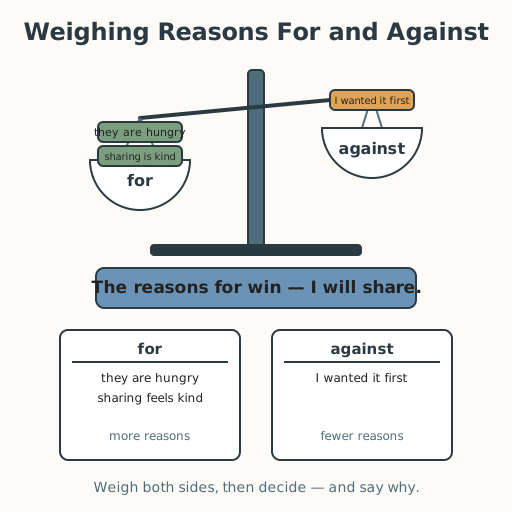
Think of a small choice you have faced: sharing the last piece of fruit, letting a friend go first, keeping or returning something you found. Before you choose, you can weigh the reasons — like a scale with two pans. On one side, the reasons for (“they are hungry too,” “sharing feels kind”). On the other, the reasons against (“I want it first,” “I might get less”). Then you decide, and you can say why. People everywhere weigh reasons before they decide — a family choosing who gets the last bowl of rice, fishers choosing where to cast the net, a class choosing a game. Today you will practice weighing reasons for and against.
Materials
- A “reasons for and against” chart (two columns: “for” and “against”)
- Choice situation cards (sharing the last fruit, letting a friend go first, keeping or returning a found coin, taking a turn first)
- Crayons and paper
Preparation
- Prepare the two-column “for / against” chart, or draw it on the ground, cloth, or a shared sheet.
- Prepare the choice situation cards; have stones or seeds ready to mark each reason.
Facilitator note
Written to the learner (“you”). This lesson teaches weighing reasons, the foundation of the unit’s moral reasoning. Model the move first as a worked example: pick one choice, say one reason for and one reason against, then state a decision and its “because.” Keep choices small, everyday, and blame-free — there is no single correct answer, and a learner may decide either way as long as they can give a reason. A reason is an honest “because,” and every honest reason is welcome; we do not rank reasons as “better” people, only notice which side has more or stronger reasons. The balance-scale idea is a picture, not a rule: sometimes one strong reason outweighs several small ones, and that is worth wondering about. Hold fairness as a question (“what does each choice do for others?”), never a command. A learner who does not speak aloud places a stone on the “for” or “against” side or points to a card; a learner who is deaf or hard of hearing follows each reason through the chart and sign; a learner who is blind or low-vision hears each choice and reason described and gives their reason aloud; a learner with a motor difference can direct a partner to place their stone. A learner may always pass. The goal is the learner’s own reasoning — “for… against… so I would…” — not a memorized answer.
Procedure
- Gather (5 min). Think of a choice you made this week. Did you stop to think of reasons for and against, or just act? What was the “why”?
- Meet “weighing reasons” (10 min). A reason is a “because.” For any choice you can name reasons for (why to do it) and reasons against (why not to do it). Weighing means listening to both sides before you decide.
- Weigh it together (15 min). Pick a choice card. Name reasons for and against, and place a stone on each side of the chart for each one. Say, sign, or point to what you would do — and why. Wonder together: which side has more reasons? Could one strong reason beat several small ones?
- Weigh your own choice (10 min). On your paper, draw or write a small choice, two reasons for, and two reasons against. Then write or tell your decision and its “because.” If drawing is not your way, build it with stones, act it out, or have a partner scribe while you direct.
- Close (5 min). Before you decide, weigh the reasons for and against. Then you can say what you would do — and why.
Differentiation
- Support: Use one choice and model two reasons aloud, one for and one against, with a gesture for each; a non-speaking learner places a stone on each side; a learner with limited movement directs a partner.
- Extension: Invite learners to weigh the same choice from two different points of view (their own and a friend’s) and wonder whether the reasons change.
Assessment
- Formative (observation): Can the learner give reasons for and against a simple choice and say what they would do and why?
- Artifact (portfolio): The learner’s own “my choice, reasons for and against, and my decision” page (or a built, acted, or partner-scribed version).
Home connection
Tonight, before a small home decision, stop and name one reason for and one reason against out loud. Then decide and tell a grown-up your “because.”
Resources
- CASEL SEL Framework (responsible decision-making): https://casel.org/fundamentals-of-sel/
- The balance-scale picture of weighing reasons is adapted from a long tradition of weighing arguments; a plain-language version appears in many “thinking skills” materials for children (see the Cambridge “philosophy for children” collections).