Lesson 02 — The Same Act, Different Situations
Learners discover that whether an act is good depends on the *situation*: the same act — shouting, running, pushing, taking — can protect in one situation and hurt in another. They practice explaining why the context changes the act's meaning.
Objectives
Objectives
- D09.S1.03.02 Explain why the same act can be good in one situation and not in another.
Essential question
Why can the same act be good in one situation and not in another?
Key vocabulary
Materials
Standard materials
- Same act two situations cards · 1 set Pairs of pictures showing the same act in two situations — shouting to warn vs. shouting to scare, running in a field vs. running near a baby, pushing to save vs. pushing to hurt, taking food when hungry vs. taking what is not yours
- Two puppets or soft toys · 2 For acting out the same act in two different situations
- Crayons and paper · per learner
Low-tech / no-cost
- Voice and body Act out the same act in two situations together; no cards or toys needed
- A drawn "same act" arrow Draw one act with an arrow to two different situations and what each one means
Enriched / lab & device
- Laminated "same act" cards · 1 set per pair Durable cards for repeated sorting of the same act into "helps" or "hurts" situations
- A short video or story showing one act in two situations · 1 Optional, for a group to watch and name why the meaning changed
Works in different contexts
- large-group Show each act card pair large; the whole group names the two situations and why the act changes from good to not good, then acts both out
- self-directed The learner sorts each act into its two situations and tells or writes why the same act changed meaning
- outdoor-only Find a real act outdoors (shouting, running, pushing a heavy branch) and name two situations where it is good and not good, and why
- multi-age Older learners model "the situation changed the act's meaning"; younger learners try with their own pair
- level-grouped Learners who need more support use two clear pairs (shout-to-warn vs. shout-to-scare); learners ready for more invent a third pair of their own
Lesson 2 — The Same Act, Different Situations
Summary
Learners discover that an act is not good or bad by itself — it depends on the situation. The same act — shouting, running, pushing, taking — can protect someone in one situation and hurt someone in another. They practice explaining why the context changes the act’s meaning, and hold it as a question rather than a fixed rule.
Objectives
- Explain why the same act can be good in one situation and not in another. (D09.S1.03.02)
Connection
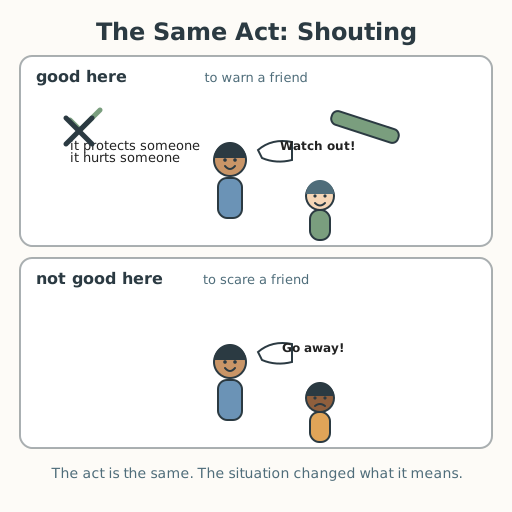
Think of shouting. If you shout “Watch out!” to warn a friend about a falling branch, the shout is good — it protects them. But if you shout at a friend to scare or shame them, the same shout is not good — it hurts them. The act did not change; the situation did. People everywhere reason this way: taking fruit from a shared tree when you are hungry is different from taking what is not yours; running is welcome on a field and dangerous beside a baby. Today you will practice seeing how the situation changes what an act means.
Materials
- “Same act, two situations” cards (shouting to warn vs. to scare, running in a field vs. near a baby, pushing to save vs. to hurt, taking food when hungry vs. taking what is not yours)
- Two puppets or soft toys
- Crayons and paper
Preparation
- Prepare the “same act, two situations” card pairs.
- Set up a small space for acting out the same act in two situations.
Facilitator note
Written to the learner (“you”). This lesson teaches context: an act’s meaning depends on the situation and its effect on others, not on a fixed label. It builds directly on Grade 2’s right-and-wrong with a reason, but complicates it honestly — the same act can sit on both sides of the line, and that is why we must think rather than follow a rule blindly. Use gentle, concrete pairs and wonder aloud rather than assert: “what does this act do in this situation?” Keep the framing blame-free; the point is never to excuse harm (“I was just warning them”) but to teach that meaning depends on effect and intent together, and that is a question to keep open. A learner who does not speak aloud points to the two situations or signs; a learner who is deaf or hard of hearing follows each pair through the cards and sign; a learner who is blind or low-vision hears each situation described and names why the act changed meaning; a learner with a motor difference can direct a partner to act the puppets. A learner may always pass. The goal is the learner’s own explanation — “the same act was good here and not good there because…” — not a memorized phrase.
Procedure
- Gather (5 min). Think of a time the same thing you did was fine in one place and a problem in another. What changed — you, or the situation?
- Meet “it depends on the situation” (10 min). An act is something you do. Whether it is good depends on the situation — where it happens, who it reaches, and what it does for them. The same act can be good in one situation and not good in another.
- Match the act to its two situations (15 min). Pick a card pair. Name the act, then name the two situations. Wonder together: why is the same act good here and not good there? What did it do for the other person each time?
- Act it out (10 min). With the puppets, show one act in two situations — shout to warn, then shout to scare. Say why it changed. A learner who does not move the puppets can point to each situation or direct a partner.
- Close (5 min). An act is not good or bad all by itself. The situation — and what it does to another person — changes what it means. That is why we stop and think.
Differentiation
- Support: Use two clear pairs (shout-to-warn vs. shout-to-scare) and model one sentence “It was good here because…, and not good there because…”; a non-speaking learner points to each situation; a learner with limited movement directs a partner.
- Extension: Invite learners to invent their own act with two situations and ask a partner to name why the meaning changed.
Assessment
- Formative (observation): Can the learner explain why the same act can be good in one situation and not in another?
- Performance: The acted-out “same act, two situations” pair, explained aloud.
Home connection
At home, notice one act today — a shout, a run, a push, a grab — and wonder with a grown-up: in what situation would it be good, and in what situation would it not? Why?
Resources
- This “context matters” idea is a cornerstone of ethics for children; see the “philosophy for children” tradition (Matthew Lipman, Harry Stottlemeier’s Discovery) for the same question asked with young learners.