Lesson 06 — Proposing a Rule With a Reason
Learners move from *explaining* rules to *proposing* one: they choose a shared space, draft a rule for it, and give the "so that…" reason. A fair rule is one whose reason everyone can hear — made *with* the group, not handed down to it.
Objectives
Objectives
- D09.S3.03.01 Explain how rules keep a group safe and fair and propose a rule for a shared space with a reason.
Essential question
How do I propose a rule for a shared space, with a reason?
Key vocabulary
Materials
Standard materials
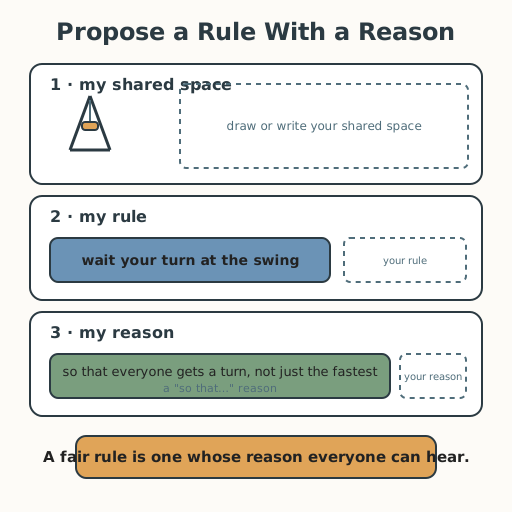
- A "propose a rule" page · per learner A page with three prompts — "my shared space," "my rule," and "my reason (so that…)" — for drafting a proposed rule
- A shared-space picture set · 1 set Pictures of shared spaces — a classroom, a playground, a library, a garden, a water pump, a bus stop — to spark ideas
- Crayons and drawing tools · per learner
Low-tech / no-cost
- Voice and body Speak or act out the proposed rule and its reason; no page needed
- A drawn "propose a rule" page Draw the three prompts on paper, cloth, or the ground and fill them together
- Found objects Stones, sticks, or leaves to mark the shared space, the rule, and the reason
Enriched / lab & device
- Laminated "propose a rule" boards · 1 per learner Wipeable boards so learners can draft, revise, and share their proposed rule
- A class "rules with reasons" gallery · 1 A wall or digital display gathering every proposed rule and its reason
Works in different contexts
- large-group Each learner proposes their rule aloud with its "so that…" reason, and the group listens; a few rules are tried on the spot
- self-directed The learner drafts a rule for a shared space and writes or tells its reason, then shares it with a grown-up or peer
- outdoor-only Choose a real shared outdoor space (a path, a water source, a play area), propose a rule for it, and state the reason right there
- multi-age Older learners scribe or help younger ones draft the rule and its reason; younger learners give the idea
- level-grouped Learners who need more support fill a sentence frame ("In the ___, the rule is ___, so that ___"); learners ready for more propose two rules and compare their reasons
Lesson 6 — Proposing a Rule With a Reason
Summary
Learners move from explaining rules to proposing one. They choose a shared space, draft a rule for it, and give the “so that…” reason. A fair rule is one whose reason everyone can hear — made with the group, not handed down to it.
Objectives
- Explain how rules keep a group safe and fair and propose a rule for a shared space with a reason. (D09.S3.03.01) — this lesson focuses on proposing a rule for a shared space with a reason; Lesson 5 focused on explaining how rules keep a group safe and fair.
Connection
Think of a shared space you use every day — a classroom, a playground, a library, a garden, a water pump, a bus stop. What is one problem there? Maybe everyone grabs at once, or someone is always left waiting. You can propose a rule to fix it: “At the swing, the rule is wait your turn, so that everyone gets a turn, not just the fastest.” The rule and its reason go together. People everywhere propose rules this way — a village agrees when to water the field, a class agrees how to share the books, a family agrees who clears the table. Today you will propose a rule of your own, with a reason.
Materials
- A “propose a rule” page (my shared space, my rule, my reason — “so that…”)
- A shared-space picture set (classroom, playground, library, garden, water pump, bus stop)
- Crayons and drawing tools
Preparation
- Prepare the “propose a rule” page with three prompts, or draw it on paper, cloth, or the ground.
- Prepare the shared-space pictures; arrange a circle for sharing proposals.
Facilitator note
Written to the learner (“you”). This lesson lets learners author rules rather than only receive them — an egalitarian, civic act. The structure is a simple worked example: (1) name the shared space, (2) name the rule, (3) give the “so that…” reason. Model it fully once, then let each learner draft their own. Emphasize that a rule gains its fairness from its reason — a reason that everyone, not just the proposer, can hear and accept. Hold open the question of whether the group would actually agree to the rule; a proposed rule is a suggestion to the group, not a command. A learner who does not speak aloud fills the page by pointing to a picture and to their rule and reason, or signs; a learner who is deaf or hard of hearing drafts through sign and pictures; a learner who is blind or low-vision states the space, rule, and reason aloud and has them written down; a learner with a motor difference can direct a partner to write or draw. A learner may always pass. The goal is a real proposal — “In the ___, my rule is ___, so that ___” — in the learner’s own words.
Procedure
- Gather (5 min). Think of a shared space you know and one small problem in it. What rule could help?
- Meet “propose a rule” (10 min). To propose a rule is to suggest it to the group. A strong proposal has three parts: the shared space, the rule, and the reason — a “so that…” that shows how it keeps everyone safe or fair.
- Hear a model (10 min). Listen to (or build) one model: “In the garden, the rule is water only your own row first, so that everyone’s plants get water before anyone takes extra.” Name the three parts.
- Propose your rule (15 min). On your page, choose a shared space, write or draw your rule, and write or tell the reason. Share your proposal with a partner — say the rule and its “so that…” and listen to theirs. A learner who does not write can point, sign, or have a partner scribe while they direct.
- Close (5 min). A fair rule is one whose reason everyone can hear. You can propose a rule — and explain why.
Differentiation
- Support: Use a sentence frame (“In the ___, the rule is ___, so that ___”) and model it once; a non-speaking learner points to a picture for each blank; a learner with limited movement directs a partner.
- Extension: Invite learners to propose two rules for the same space and wonder which the group would more likely accept, and why the reason matters.
Assessment
- Formative (observation): Can the learner propose a rule for a shared space and give a reason?
- Artifact (portfolio): The learner’s “propose a rule” page (or a built, acted, or partner-scribed version), kept as a portfolio artifact.
Home connection
At home, propose one rule for a shared family space (the table, the yard, the bathroom) and give its “so that…” reason. Ask your family if they would agree to it.
Resources
- CASEL SEL Framework (responsible decision-making): https://casel.org/fundamentals-of-sel/
- The idea that a rule’s fairness lives in its shareable reason is a plain-language form of “public reason,” adapted for children from civic thought.