Lesson 06 — Plants Make Their Own Food
Learners discover that green plants make their own food using sunlight (with water and air), and that because plants make the food every animal's energy starts with, all living things depend on plants — or on animals that eat them. A plant is a producer; every animal, including people, is a consumer that depends on producers.
Objectives
Objectives
- D10.S3.03.02 Explain that green plants make their own food using sunlight, and that all living things depend on plants or on animals that eat them.
Essential question
How do green plants make their own food, and why do all living things depend on plants?
Key vocabulary
Materials
Standard materials
- How a plant makes food — picture cards · 1 set Sun, a green leaf, water, and air (carbon dioxide) coming together so the plant makes its own food; plus cards of a plant-eater and an animal-eater that depend on plants
- Paper and crayons · per learner For drawing a plant making its own food from sunlight, and who depends on it
Low-tech / no-cost
- A real green leaf and sunlight Hold a real leaf in the sun and say what it is doing — making its own food; no printed cards needed
- Voice and body Act out a plant reaching for sunlight and "making food," then an animal eating the plant to get energy
Enriched / lab & device
- A live plant in the classroom to observe · 1 per group A real green plant to watch and care for as an example of a living thing that makes its own food
- A short video or picture set of plants growing in sunlight · 1 Optional — plants growing toward light, leaves in the sun, animals eating plants
Works in different contexts
- large-group Build the "plant makes food" story big — sun + water + air → food — and the whole group names who depends on the plant
- self-directed A learner draws a plant making its own food from sunlight and writes or says who depends on it
- outdoor-only Find a green plant in the sun and trace the story — the plant makes its own food, and an animal eats the plant to get energy
- multi-age Older learners write the "depends on plants" sentences; younger learners act the plant making food and the animal eating
- level-grouped Learners who finish early explain that an animal-eater also depends on plants (it eats an animal that ate plants); others draw the plant and one animal that eats it
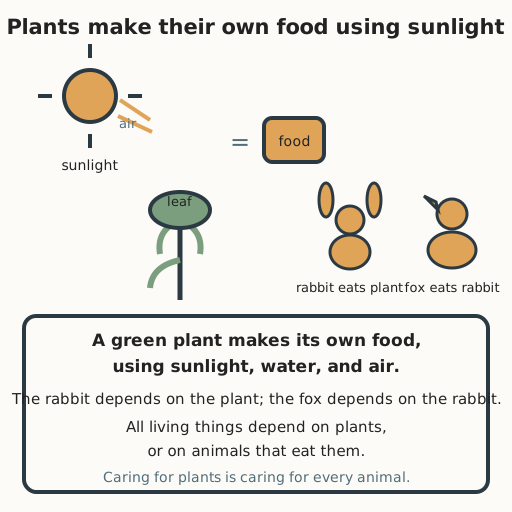
Lesson 6 — Plants Make Their Own Food
Summary
Learners discover that green plants make their own food using sunlight — with water and air — and that this makes plants the producers every animal depends on. Because a plant’s food is where every animal’s energy starts, all living things depend on plants, or on animals that eat them. A plant is a producer; every animal, including people, is a consumer that depends on producers.
Objectives
- Explain that green plants make their own food using sunlight, and that all living things depend on plants or on animals that eat them. (D10.S3.03.02)
Connection
Think of the last thing you ate. If it was bread or rice or fruit, it came from a plant. If it was meat or milk or an egg, it came from an animal — an animal that ate plants. However you trace it back, the food always begins with a green plant using sunlight to make its own food. Plants do something no animal can do: they make food out of sunlight, water, and air. That is why every living thing, deep down, depends on plants.
Materials
- “How a plant makes food” picture cards (sun, a green leaf, water, air, and who depends on the plant)
- Paper and crayons
Preparation
- Prepare the picture cards: the sun shining on a green leaf, water from the soil, air, and the words “the plant makes its own food”; plus a plant-eater (a rabbit) and an animal-eater (a fox) that depend on plants.
- Set out a real green leaf or plant to hold in the light.
- Set out paper and crayons.
Facilitator note
This lesson is written to the learner (“you”). This is a new foundational idea — the Grade 3 upgrade of Grade 2’s “animals get energy from eating” — so teach it with a worked example and guided practice before learners draw their own (Kirschner, Sweller & Clark, 2006). Keep the science simple and true: green plants use sunlight, water, and air to make their own food (this is photosynthesis, but at this age the words “plants make their own food using sunlight” are enough — do not demand the word photosynthesis). The big claim is that all living things depend on plants, or on animals that eat them: plant-eaters depend directly, animal-eaters depend indirectly (they eat an animal that ate a plant), and people depend on both. Use examples from many places and biomes — rice fields, grasslands, sea plants, forests — so no single place is the default; note that sea plants and tiny green plants in water make food the same way. Honor every body: describe each card in words for a learner who is blind or has low vision and let them feel a real leaf; a non-speaking learner points to sun, water, air, and leaf to tell the story; acting out a plant reaching for light and an animal eating works for learners who learn best by moving. Hold the ethics gently: plants feed the whole living world, so caring for plants is caring for every animal — this returns in Lessons 9–10.
Procedure
- Gather (5 min). Remember Lesson 5: animals get energy from eating. But where does a plant’s energy come from? Plants do not eat. Today you learn what they do instead.
- Meet the plant’s secret (10 min). A green plant makes its own food using sunlight. It takes in water from the soil and air from around it, and the sunlight helps it turn these into food. Watch or model it with the cards: sun + water + air → the plant’s own food.
- See who depends on plants (10 min). The rabbit eats the plant and gets energy. The fox eats the rabbit. Even the fox depends on plants — through the rabbit. Say it: “All living things depend on plants, or on animals that eat them.”
- Find plants in your own food (8 min). Think of a food you ate. Trace it back: bread → wheat (a plant); milk → a cow → grass (a plant). Say the chain: “This food depends on plants.”
- Draw it (10 min). Draw a green plant making its own food from sunlight (sun + water
- air → food), and one animal that depends on it. Label the plant “makes its own food.”
- Close (2 min). Plants make their own food using sunlight — the only food that does not start by eating something else. Every animal, including you, depends on plants. That is why green things matter everywhere on Earth.
Differentiation
- Support: Tell the story together aloud with the cards — sun + water + air → food — and name one animal that depends on the plant.
- Blind/low vision: Feel a real leaf and hear the story; say it back: “The plant makes its own food using sunlight, and the rabbit depends on it.”
- Deaf/hard of hearing / non-speaking: Point to sun, water, air, and leaf in order to tell the story, and point to the animal that depends on the plant.
- Motor differences: Direct a partner’s hands to arrange the cards and draw, while the learner says or points to sun, water, air, leaf, and the animal.
- Extension: Explain that an animal-eater (a fox) still depends on plants, by tracing the chain: fox → rabbit → plant.
Assessment
- Formative (observation): Can the learner explain that green plants make their own food using sunlight, and that all living things depend on plants or on animals that eat them?
- Artifact (portfolio): The drawing of a plant making its own food and an animal that depends on it.
Home connection
At home, look at one food on your table and trace it back to a green plant. Tell a grown-up: “Even the meat, milk, or eggs we eat begin with a plant making food from sunlight.”
Resources
- BBC Bitesize (KS2), “The structure of flowering plants” — plants use their leaves to make food, supporting the idea that green plants make their own food. https://www.bbc.co.uk/bitesize/topics/zy66fg8/articles/z2d4g7h
- NASA Space Place, “All About the Sun” — the Sun is the source of the light and warmth that plants use to make food. https://spaceplace.nasa.gov/all-about-the-sun/en/