Lesson 07 — Runs Out or Comes Back
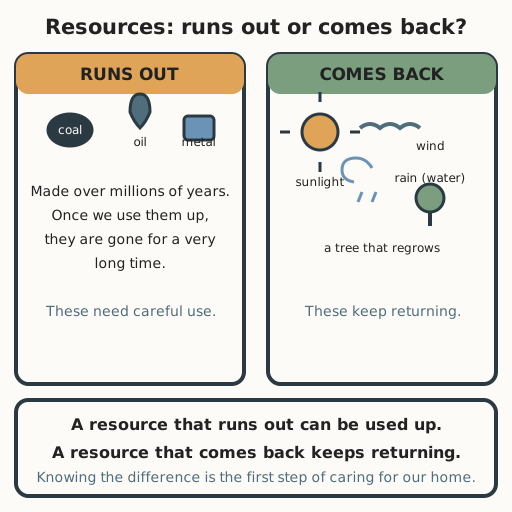
Learners tell a natural resource that can run out from one that comes back. Coal, oil, and metal are made over millions of years and can be used up; sunlight, wind, rain (water), and plants that regrow keep coming back. They sort resources into two columns and learn that what runs out needs careful use — a first step of stewardship.
Objectives
Objectives
- D10.S4.03.01 Tell the difference between a natural resource that can run out and one that comes back, such as sunlight, with an example of each.
Essential question
What is the difference between a natural resource that can run out and one that comes back?
Key vocabulary
Materials
Standard materials
- Resource cards to sort · 1 set Runs-out cards — coal, oil, metal — and comes-back cards — sunlight, wind, rain (water), a tree that regrows
- A two-column "runs out / comes back" chart · 1 Two labeled columns for sorting the resource cards
- Paper and crayons · per learner For drawing one resource that runs out and one that comes back
Low-tech / no-cost
- Found objects as resources A stone (metal/mineral), a seed (a plant that regrows), and sunlight and wind felt on the skin; no printed cards needed
- Voice and body Act out sunlight coming back every day and coal being used up; let a partner name which runs out and which comes back
Enriched / lab & device
- Real samples to feel · 1 set A piece of coal or metal (runs out) and a leaf or water in a cup (comes back), handled safely
- A device to look at one resource's story · 1 per group Optional — see how coal forms over millions of years, or how water cycles through rain
Works in different contexts
- large-group Hold each resource card up big; the whole group calls out "runs out!" or "comes back!" and one learner places it in the column
- self-directed A learner sorts the resource cards into the two columns alone and writes or says one example of each
- outdoor-only Feel sunlight and wind on your skin (comes back) and find a stone or piece of metal (runs out); name one of each
- multi-age Older learners read the resource labels and explain why a resource runs out or comes back; younger learners sort and act
- level-grouped Learners who finish early tell why we must be careful with a resource that runs out; others sort one of each
Lesson 7 — Runs Out or Comes Back
Summary
Learners tell a natural resource that can run out from one that comes back. Coal, oil, and metal are made over millions of years and can be used up; sunlight, wind, rain (water), and plants that regrow keep coming back. They sort resources into two columns and learn that what runs out needs careful use — a first step of stewardship.
Objectives
- Tell the difference between a natural resource that can run out and one that comes back, such as sunlight, with an example of each. (D10.S4.03.01)
Connection
Think of the things you use every day — water to drink, food to eat, things made of metal or plastic, light and warmth. Where do they come from? All of them come from the Earth. Some of the Earth’s gifts come back on their own: the sun rises every morning, the wind blows, the rain falls, and a tree can grow again. Others run out: coal, oil, and metal were made over millions of years, and once we use them up, they are gone for a very long time. Knowing the difference is the first step of caring for our home.
Materials
- Resource cards to sort (“runs out” and “comes back”)
- A two-column “runs out / comes back” chart
- Paper and crayons
Preparation
- Prepare resource cards: runs out — coal, oil, metal; comes back — sunlight, wind, rain (water), a tree that regrows.
- Prepare the two-column chart labeled “runs out” and “comes back.”
- Set out paper and crayons.
Facilitator note
This lesson is written to the learner (“you”). Keep the tone hopeful, not frightening: this is the first step of stewardship, not a warning of doom. The core idea is two kinds of natural resource: one that can run out (coal, oil, gas, metal — made over millions of years, not replaced in a human lifetime) and one that comes back (sunlight, wind, rain/water, plants that regrow). Use the standard’s own example — sunlight — as the anchor for “comes back.” Be careful and honest at the edges: some “comes back” resources (clean water, trees) only come back if we use them slowly enough — but at Grade 3 we keep the two kinds clear and add that gentle note, saving “use it so it lasts” for Grade 4. Model the sort once, then guide practice (Kirschner, Sweller & Clark, 2006). Use examples from many places — a sunny field, a windy coast, a forest, a mine — so no single place is the default, and never imply one place wastes while another saves. Distinguish evidence from values: “coal is made over millions of years” is a fact; “we should use less” is a value of care — both are welcome, and we name which is which. Honor every body: describe each resource for a learner who is blind or has low vision (feel a stone for metal, a leaf for a regrowing plant, sunlight and wind on the skin); a non-speaking learner points to the “runs out” or “comes back” column; acting out the sun rising and coal being used up works for learners who learn best by moving.
Procedure
- Gather (5 min). Everything you use comes from the Earth. Today you learn that some of the Earth’s gifts run out, and some come back.
- Meet the two kinds (10 min). A resource that comes back keeps returning: the sun rises every day, the wind blows, the rain falls, and a tree can grow again. A resource that runs out is used up and not replaced in a human lifetime: coal, oil, and metal were made over millions of years.
- Sort the resources (12 min). With the cards, place each resource in the “runs out” or “comes back” column. Say it in a sentence: “Sunlight comes back — it rises every morning.” “Coal runs out — it was made over millions of years.”
- Make the gentle note (5 min). Some things that come back — like clean water and trees — only come back if we use them slowly and carefully. We will practice that next lesson.
- Draw one of each (10 min). Draw one resource that runs out and one that comes back. Label each: runs out or comes back.
- Close (3 min). Knowing what runs out and what comes back is the first step of caring for our Earth home. What runs out needs our care most of all.
Differentiation
- Support: Sort two resources together aloud — one “runs out” and one “comes back” — using the frame “___ runs out because ___; ___ comes back because ___.”
- Blind/low vision: Feel real samples (a stone for metal, a leaf for a regrowing plant) and feel sunlight and wind on the skin; name which runs out and which comes back.
- Deaf/hard of hearing / non-speaking: Sort cards by pointing and sign or point to “runs out” or “comes back” for each resource.
- Motor differences: Direct a partner’s hands to sort and draw while the learner says or points to each resource and its column; use big, light cards.
- Extension: Explain why a resource that runs out needs careful use, and name one thing that comes back that we still must use slowly (water, trees).
Assessment
- Formative (observation): Can the learner tell a natural resource that can run out from one that comes back, and give an example of each (such as coal and sunlight)?
- Artifact (portfolio): The “runs out / comes back” drawing with labeled examples.
Home connection
At home, find one thing made of metal or plastic (a resource that runs out) and one thing that comes back (sunlight through a window, rain, a plant growing). Tell a grown-up which is which.
Resources
- EIA Energy Kids, “Coal” — coal is a nonrenewable energy source because it takes millions of years to form, supporting the lesson’s “runs out” examples (coal and oil). https://www.eia.gov/kids/energy-sources/coal/
- NASA Space Place, “All About the Sun” — the Sun’s light and warmth arrive every day, a clear example of a resource that comes back. https://spaceplace.nasa.gov/all-about-the-sun/en/