Lesson 07 — A Family or Cultural Tradition of Mine
Learners identify one family or cultural tradition of their own and describe when it happens and what it means to them. By hearing traditions from around the world — meals, festivals, songs, greetings — they see that every culture repeats meaningful practices, and that their own tradition is a real thread of belonging.
Objectives
Objectives
- D01.S2.04.02 Describe a family or cultural tradition and how it connects them to a larger community.
Essential question
What is a family or cultural tradition of mine, and what does it mean?
Key vocabulary
Materials
Standard materials
- Traditions example chart · 1 Pictures or drawings of several traditions from around the world — a shared meal, a festival, a song, a greeting — each with a one-line meaning
- My tradition page · 1 per learner A page with three lines — "My tradition:", "When we do it:", "What it means to me:" — to draw or write
- Pencils and crayons · per learner
Low-tech / no-cost
- A family object or photo from home Bring a small object or memory of a tradition to describe; if you have none, describe it with words
- Voice and body Act out your tradition (a dance step, a greeting, a dish being made) and explain its meaning; no page needed
Enriched / lab & device
- A 'traditions around the world' slide set · 1 A short set of images showing the same kinds of traditions (meals, festivals, songs) in many countries, to spark discussion
- A class traditions gallery · 1 A shared wall or digital space where each learner posts their tradition and its meaning
Works in different contexts
- large-group Show several tradition examples to the whole group first, then learners describe their own in small groups and add to a shared gallery
- multi-age Older learners help younger learners describe the "when" and "what it means" of their tradition with gentle questions
- self-directed A learner describes their own tradition alone, including when it happens and what it means to them, and checks that it is a real repeat
- level-grouped Learners ready to extend compare their tradition to another family's and name one thing the same and one thing different
- outdoor-only Tell your tradition outdoors as part of a circle, passing a natural object (a stick or stone) as a talking piece
Lesson 7 — A Family or Cultural Tradition of Mine
Summary
Learners identify one family or cultural tradition of their own and describe when it happens and what it means to them. By hearing traditions from around the world — meals, festivals, songs, greetings — they see that every culture repeats meaningful practices, and that their own tradition is a real thread of belonging.
Objectives
- Describe a family or cultural tradition and how it connects them to a larger community. (D01.S2.04.02)
Connection
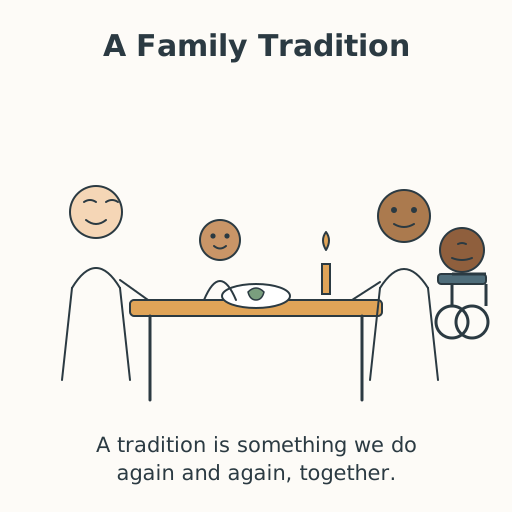
A tradition is something people do again and again because it means something. It might be the stew your family cooks every year at harvest, the song you sing before a journey, the lamps lit on a winter night, or the way you greet an elder. Traditions live in every culture on Earth — a wedding dance, a naming ceremony, a new-year meal, a prayer, a game. What makes something a tradition is not how grand it is; it is that it is repeated and that it means something to the people who do it. Your tradition is one small, real thread that ties you to your family and your people.
Materials
- Traditions example chart
- My tradition page
- Pencils and crayons
Preparation
- Print or draw the traditions example chart (several traditions, each with a meaning).
- Copy a “my tradition” page for each learner.
- Arrange space for sharing in a circle or small groups.
Facilitator note
This lesson is written to the learner (“you”). Traditions are deeply personal and
diverse — some learners may have several, some may feel they have none, and some may have
traditions tied to loss or migration. Hold all of it gently. The one requirement is a
repeat with meaning; it can be as small as “we eat together every Friday.” Do not rank
traditions or treat any as “exotic” — the goal is that every learner sees their own
practice as worthy of the same respect as any other. Model your own tradition first
(worked example). See docs/facilitation.md on holding difficult topics and cultural
power dynamics.
Procedure
- Gather (5 min). You have been drawing the map of who you are. Today you add one more thread: a tradition — something your family or culture does again and again because it means something.
- Meet traditions from around the world (10 min). Look at the chart. One family shares a big meal at harvest; another lights lamps on a winter night; another sings a song before a journey; another greets an elder in a special way. Different practices, one thing in common: each is repeated and each means something.
- Hear a worked example (10 min). “My tradition is that we cook a special bread on the new year. We do it every year, together. It means a fresh start, and it reminds me I belong to my family.” Notice the three parts: what we do, when we do it, and what it means.
- Describe your own tradition (15 min). On your page, draw or write your tradition: what you do, when you do it, and what it means to you. If you can think of more than one, choose the one that means the most to you.
- Close (5 min). Your tradition is a thread that ties you to your family and your culture. Next time, you will follow that thread out to see how it connects you to a much bigger community.
Differentiation
- Support: Offer tradition idea cards (a meal, a song, a festival, a greeting, a game, a story) and scribe the learner’s answers.
- Extension: Compare your tradition with a partner’s and name one thing the same and one thing different.
Assessment
- Formative (observation): Can the learner describe a family or cultural tradition, including when it happens and what it means to them?
- Self-check: The learner checks that their tradition is something really repeated and meaningful to them, not just a one-time event.
Home connection
Ask someone at home about the tradition you chose — where it came from and what it has meant to them — and add one new detail to your page.
Resources
- CASEL SEL Framework (social awareness and relationship skills competencies): https://casel.org/fundamentals-of-sel/