Lesson 07 — Compare and Contrast Within a Text
Learners learn to compare and contrast two characters, events, or ideas within one text, sorting what is the same and what is different, and using a simple chart to hold the comparison.
Objectives
Objectives
- D04.S2.04.02 Compare and contrast themes, characters, or ideas within and across two texts.
Essential question
How do I compare and contrast ideas within one text?
Key vocabulary
Materials
Standard materials
- A short text with two comparable things · 1 A story or passage where two characters, events, or ideas can be compared (for example, how two characters respond to the same problem)
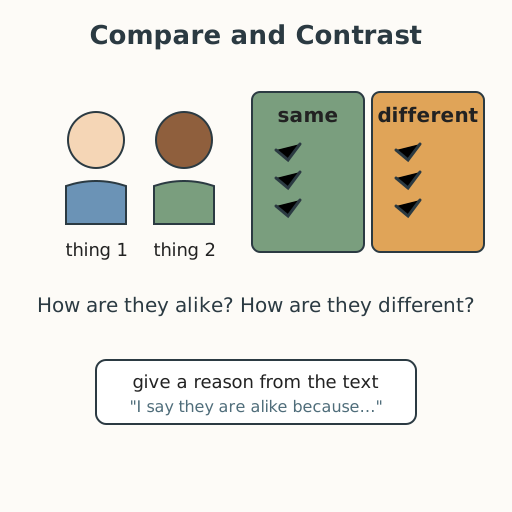
- A compare-and-contrast chart · 1 A two-column chart — "same" and "different" — or a simple Venn diagram
Low-tech / no-cost
- Two objects or people compared aloud Compare two real things in the room — two plants, two stones, two classmates' days — in words
- A chalk or sand diagram Draw two overlapping circles on the ground to sort "same" and "different"
Enriched / lab & device
- Two or more comparable passages · 2–3 Practice comparing characters or ideas across different kinds of text
- A printed Venn diagram · 1 per learner A reusable Venn diagram for sorting similarities and differences
Works in different contexts
- large-group Read one text together, then sort "same" and "different" details on a shared chart, with the group naming each
- self-directed A learner reads a text, chooses two things to compare, and fills a "same / different" chart, then checks it against the text
- multi-age Older learners read and model a comparison; younger learners add one "same" and one "different" detail
- level-grouped Each group compares two things in a text at its own level, then groups share what they noticed
- outdoor-only Compare two real things outdoors — two leaves, two insects, two clouds — and sort their "same" and "different" traits aloud
Lesson 7 — Compare and Contrast Within a Text
Summary
Learners learn to compare (find what is the same) and contrast (find what is different) between two characters, events, or ideas within one text. They use a simple chart or Venn diagram to sort their thinking.
Objectives
- Compare and contrast themes, characters, or ideas within and across two texts. (D04.S2.04.02)
Connection
Think of two friends. They are alike in some ways and different in others, and noticing both is how you understand them — and how you understand a story. When two characters meet the same problem, or two events echo each other, asking “how are they the same, and how are they different?” opens the story’s meaning. Comparing is a reader’s way of seeing clearly.
Materials
- A short text with two comparable things
- A compare-and-contrast chart (“same” / “different”, or a Venn diagram)
Preparation
- Choose a short text where two characters, events, or ideas can be compared.
- Prepare the chart or Venn diagram.
Facilitator note
This lesson is written to the learner (“you”) so it works in a classroom and for a self-directed learner. Comparing and contrasting is a taught skill: model it with a worked example — read a passage, then think aloud as you sort “same” and “different” details (Kirschner, Sweller & Clark, 2006). Keep the two moves distinct: compare = how they are alike; contrast = how they differ. Anchor every claim in the text: “I say they are alike because…” The goal is supported thinking, not right answers. This works in any language and writing system — the comparison is about meaning, not script. Honor comparisons made in the learner’s own language, and invite comparisons that are faithful to the text even when worded differently. A learner who is blind or has low vision compares from a text heard aloud or read in braille or large print.
Procedure
- Gather (5 min). Think of two people you know. Name one way they are the same and one way they are different. That is comparing and contrasting.
- Meet the two moves (5 min). Learn them: compare = how they are alike; contrast = how they differ. A reader asks both questions of the things a text holds.
- Watch a worked example (10 min). The facilitator reads a short passage with two characters facing the same problem, then thinks aloud: “They are alike because… they are different because…” Watch each detail land in the “same” or “different” column, with a reason from the text.
- Compare and contrast yourself (15 min). Read your text. Choose two things to compare — two characters, two events, or two ideas. Sort what is the same and what is different on your chart, and be ready to say why, pointing to the text.
- Share (5 min). Tell a partner one “same” and one “different,” each with a reason. Did your partner’s reasons come from the text?
- Close (5 min). Reading deeply is noticing both likeness and difference. Both open the meaning.
Differentiation
- Support: Compare two things with a prepared list of traits; the learner sorts each into “same” or “different.”
- Support (non-speaking): Sort picture cards into “same” and “different” columns, or sign the comparison.
- Support (blind/low vision): Compare from a text heard aloud, stating similarities and differences orally or in braille or large print.
- Extension: Compare three things in a text, and write one sentence for each pairing explaining how they are alike and different.
Assessment
- Formative (observation): Can the learner name at least one similarity and one difference between two things in a text, each supported by a detail from the text?
Home connection
At home, compare two things you notice — two foods, two songs, two days — and name one thing that is the same and one that is different.
Resources
- Kirschner, P. A., Sweller, J., & Clark, R. E. (2006). Why minimal guidance during instruction does not work. Educational Psychologist, 41(2), 75–86.
- National Reading Panel (2000). Report on comprehension (comparing and contrasting). (Widely used evidence base.)