Lesson 08 — Compare and Contrast Across Two Texts
Learners compare and contrast themes, characters, or ideas across two texts, holding both side by side, sorting similarities and differences, and supporting each with evidence from the texts.
Objectives
Objectives
- D04.S2.04.02 Compare and contrast themes, characters, or ideas within and across two texts.
Essential question
How do I compare and contrast themes or characters across two texts?
Key vocabulary
Materials
Standard materials
- Two short texts on a related theme · 2 Two stories or passages that can be compared — two folktales about kindness, or two informational texts about the same animal
- A two-text compare chart · 1 A chart with a column for each text plus a shared "same / different" space
Low-tech / no-cost
- Two remembered stories Compare two stories the group knows — their themes or characters — spoken aloud
- A chalk or sand chart Draw two columns in the soil, one per text, and a shared middle space for "same"
Enriched / lab & device
- A set of paired texts · 2–3 pairs Practice comparing themes and characters across several pairs of texts
- A digital side-by-side reader · 1 Display two texts together to mark matching and differing ideas
Works in different contexts
- large-group Read two texts aloud, then fill the shared chart together, each learner naming a similarity or difference with a reason
- self-directed A learner reads two texts, fills the chart, and writes one sentence stating a similarity and one a difference, each with evidence
- multi-age Older learners read one text each and model the comparison; younger learners add a "same" or "different" detail they heard
- level-grouped Each group compares a pair of texts at its own level, then groups share one similarity and one difference
- outdoor-only Compare two told stories or two real happenings nearby, sorting how their themes or characters are alike and different
Lesson 8 — Compare and Contrast Across Two Texts
Summary
Learners hold two texts side by side and compare and contrast their themes, characters, or ideas — finding what is alike and what differs, and supporting each finding with evidence from the texts. They work with paired stories or informational texts.
Objectives
- Compare and contrast themes, characters, or ideas within and across two texts. (D04.S2.04.02)
Connection
Two storytellers can tell about the same thing — kindness, courage, water, the moon — and each tells it their own way. Reading two texts about a related idea is like hearing two voices on one subject: you notice where they agree and where they go their own way. That is how a reader gathers more than any single book can give, and how the same idea grows richer in many tellings.
Materials
- Two short texts on a related theme
- A two-text compare chart
Preparation
- Choose two short texts that can be compared (two folktales about kindness, two informational texts about the same animal).
- Prepare the chart.
Facilitator note
This lesson is written to the learner (“you”) so it works in a classroom and for a self-directed learner. Comparing across texts is a taught skill: model it with a worked example — read two short passages, then think aloud as you sort “same” and “different” (Kirschner, Sweller & Clark, 2006). Anchor every claim in evidence: “I say their themes are alike because in this text… and in that text…” The goal is supported thinking, not a single right answer. This is a global moment too: paired texts can come from two cultures or two languages, and comparing them is how a reader hears more than one voice. Honor comparisons in the learner’s own language and honor differing interpretations that are faithful to the texts. A learner who is blind or has low vision compares from texts heard aloud or read in braille or large print.
Procedure
- Gather (5 min). Think of two stories you know that share an idea — courage, or kindness. What do they do alike, and what do they do differently?
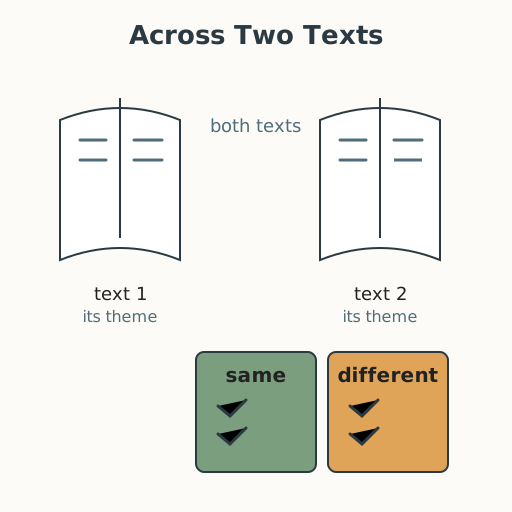
- Meet the two-text comparison (5 min). Learn to hold two texts side by side: compare their themes, characters, or ideas (how alike?) and contrast them (how different?), always pointing to the texts.
- Watch a worked example (10 min). The facilitator reads two short passages, then thinks aloud: “Both are about… (alike), but in the first… while in the second… (different).” Watch each claim carry its evidence.
- Compare across texts yourself (20 min). Read your two texts. Fill the chart: what is the same, and what is different, about their themes, characters, or ideas? Write one sentence for a similarity and one for a difference, each with evidence.
- Share (5 min). Tell a partner your similarity and difference, and your evidence. Did their evidence come from both texts?
- Close (5 min). Two voices, one idea, many tellings. Reading across texts is hearing the whole conversation.
Differentiation
- Support: Read two very short texts and give a prepared list of points; the learner sorts each as “same” or “different.”
- Support (non-speaking): Sort picture cards or sign the similarities and differences.
- Support (blind/low vision): Compare from texts heard aloud, stating similarities and differences orally or in braille or large print.
- Extension: Compare three texts on one theme and write a short paragraph explaining the idea the three share and how each differs.
Assessment
- Formative (observation): Can the learner name a similarity and a difference between two texts and support each with evidence from the texts?
Home connection
At home, read or hear two things on the same subject — two songs, two stories, two news items — and name one thing they share and one thing that differs.
Resources
- Kirschner, P. A., Sweller, J., & Clark, R. E. (2006). Why minimal guidance during instruction does not work. Educational Psychologist, 41(2), 75–86.
- National Reading Panel (2000). Report on comprehension (comparing across texts). (Widely used evidence base.)