Lesson 09 — Organizing Ideas into Paragraphs
Learners learn the clear structure of a paragraph — a topic sentence, supporting details, and a closing sentence — and practice building one so a single idea is easy to follow.
Objectives
Objectives
- D04.S3.04.01 Write a narrative, informative, or opinion piece organized into paragraphs with clear ideas.
Essential question
How is a paragraph built so its idea is clear?
Key vocabulary
Materials
Standard materials
- A paragraph model · 1 A clear example paragraph with a topic sentence, two or three details, and a closing sentence
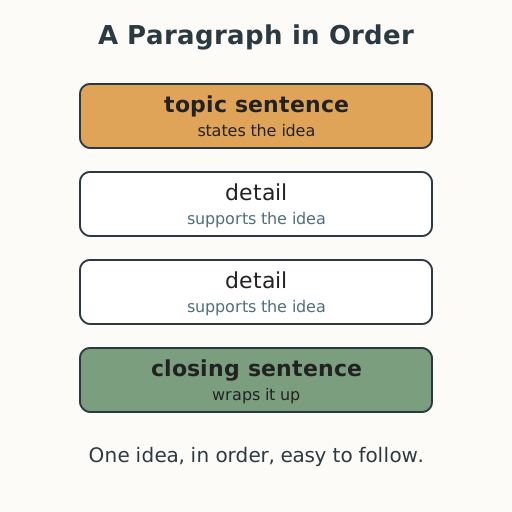
- A paragraph-building chart · 1 A chart showing the paragraph as a stack — topic sentence, details, closing sentence
Low-tech / no-cost
- A paragraph said aloud Say a paragraph together — topic, details, closing — with no writing tools
- Blocks or stones as parts Use a stack of blocks or stones, one per part of the paragraph, to feel the order
Enriched / lab & device
- A paragraph puzzle · 1 set Sentence strips to order into a correct paragraph, then compare
- A writing app with paragraph view · 1 Compose a paragraph on a device and see its parts as one block
Works in different contexts
- large-group Build a paragraph together on the board, the group naming each part and its job
- self-directed A learner reads a model paragraph, names its three parts, then writes their own and checks it has all three
- multi-age Older learners model a paragraph; younger learners point to the topic sentence and closing sentence
- level-grouped Each group builds a paragraph on a topic at its own level, then groups read theirs and name the parts
- outdoor-only Build a paragraph about something outdoors — a plant, a path, a sound — saying each part aloud in order
Lesson 9 — Organizing Ideas into Paragraphs
Summary
Learners learn the clear structure of a paragraph: a topic sentence that states the idea, two or three details that support it, and a closing sentence that wraps it up. They practice building a paragraph so a single idea is easy to follow.
Objectives
- Write a narrative, informative, or opinion piece organized into paragraphs with clear ideas. (D04.S3.04.01)
Connection
Think of a paragraph as a small house for one idea. The topic sentence is the front door — it tells you what is inside. The details are the rooms — they hold the idea up. The closing sentence is the back step — it lets you leave knowing what you saw. When each paragraph holds just one idea, in order, your reader walks through your thinking without getting lost. That is what makes writing clear.
Materials
- A paragraph model
- A paragraph-building chart
Preparation
- Choose or write a clear model paragraph.
- Prepare the paragraph-building chart.
Facilitator note
This lesson is written to the learner (“you”) so it works in a classroom and for a self-directed learner. Paragraph structure is a foundational writing skill, so use explicit instruction and a worked example: name the three parts, show a model, then build one together before independent work (Kirschner, Sweller & Clark, 2006). Keep the three jobs clear — topic sentence (states the idea), details (support it), closing sentence (wraps it). This structure transfers across languages and writing systems, though the conventions may differ; honor the learner’s home writing system. The goal is clarity for a reader, not a rigid formula — a learner who can explain why each part is there has the skill. Celebrate every attempt; writing is thinking made visible.
Procedure
- Gather (5 min). Think of one thing you could explain to a friend in three sentences. That is a paragraph waiting to be built.
- Meet the three parts (5 min). Learn a paragraph’s three jobs: the topic sentence (states the idea), the details (support it), and the closing sentence (wraps it up).
- Watch a worked example (10 min). Read a model paragraph. Name its topic sentence, its details, and its closing sentence, and see how each does its job in order.
- Build a paragraph (15 min). Choose an idea and write a paragraph with all three parts. Read it back and check: is the idea clear? do the details support it? does the closing wrap it?
- Share (5 min). Read your paragraph to a partner and ask: can you find my topic sentence, my details, and my closing sentence?
- Close (5 min). A clear paragraph is a clear idea, in order. Build it well, and your reader will follow.
Differentiation
- Support: Order a prepared set of sentence strips into a paragraph, then name each part.
- Support (non-speaking): Build a paragraph by arranging picture-plus-sentence cards in order, or sign the parts.
- Support (blind/low vision): Compose the paragraph orally or in braille or large print, naming the three parts as you go.
- Extension: Write two paragraphs on one topic, each with its own topic sentence and details, and explain where one idea ends and the next begins.
Assessment
- Formative (observation): Can the learner write a paragraph with a topic sentence, supporting details, and a closing sentence, so one idea is clear?
Home connection
At home, tell someone one thing in a “mini-paragraph”: a topic sentence, two details, and a closing sentence — and see if they can name the three parts.
Resources
- Kirschner, P. A., Sweller, J., & Clark, R. E. (2006). Why minimal guidance during instruction does not work. Educational Psychologist, 41(2), 75–86.
- Graham, S., & Perin, D. (2007). Writing Next — explicit teaching of paragraph structure supports writing quality. (Widely used evidence base.)