Lesson 13 — Editing and Publishing
Learners edit their revised draft for spelling, capitalization, and punctuation, then make a clean final copy and publish it by sharing with a real audience — completing the writing process: plan, draft, revise, edit, publish.
Objectives
Objectives
- D04.S3.04.02 Use a simple writing process — plan, draft, revise, edit, and publish — on their own.
Essential question
How do I edit and publish my writing?
Key vocabulary
Materials
Standard materials
- The revised draft · 1 The draft from the previous lesson
- An editing checklist · 1 Prompts — spelling, capitals, end marks, spaces between words, clear sentences
- Clean paper for the final copy · per learner Paper for the published piece
Low-tech / no-cost
- The draft and careful eyes Edit by hand with the checklist, then copy the final piece onto clean paper
- A shared read-aloud Read the final piece aloud to a small group as its "publication"
Enriched / lab & device
- A word processor with spell check · 1 Edit on a device, using spell check as a helper, then format a clean final copy
- A class publishing display or digital gallery · 1 Post finished pieces on a wall or shared space so the audience is real
Works in different contexts
- large-group Edit a shared paragraph together on the board, then learners edit their own; finished pieces go into a class collection
- self-directed A learner edits with the checklist, makes a clean final copy, and "publishes" by sharing it with at least one reader
- multi-age Older learners model the editing pass; younger learners check capitals and end marks with support
- level-grouped Pairs edit each other's pieces with the checklist before making final copies, then read the finished work aloud
- outdoor-only Edit and copy the final piece outdoors, then read it aloud as a small gathering under the open sky
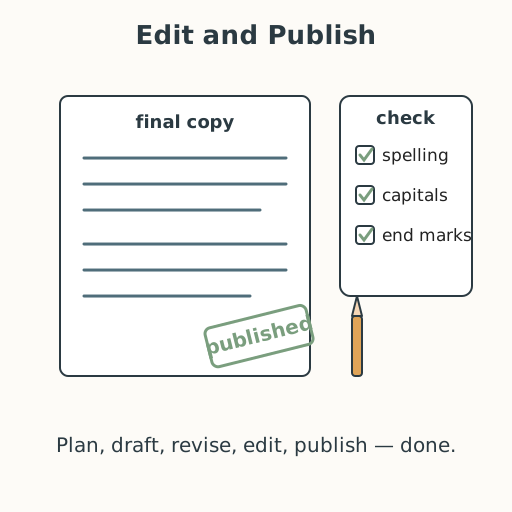
Lesson 13 — Editing and Publishing
Summary
Learners edit their revised draft for spelling, capitalization, and punctuation, then make a clean final copy and publish it by sharing with a real audience. This completes the writing process — plan, draft, revise, edit, publish — carried through on their own.
Objectives
- Use a simple writing process — plan, draft, revise, edit, and publish — on their own. (D04.S3.04.02)
Connection
A piece of writing is finished when it is ready to meet its reader. Editing is the last tidying — making sure the words are spelled right, the sentences begin and end properly — so nothing distracts from the idea. Publishing is the moment of giving: your thinking leaves your hands and reaches another person. Every written thing you have ever loved was once edited and published, just like this.
Materials
- The revised draft
- An editing checklist
- Clean paper for the final copy
Preparation
- Have each learner’s revised draft ready.
- Prepare the editing checklist and final copy paper.
Facilitator note
This lesson is written to the learner (“you”) so it works in a classroom and for a self-directed learner. Editing is a taught step: model it on a shared paragraph with a worked example — checking spelling, capitals, and end marks one by one (Kirschner, Sweller & Clark, 2006). Remind learners of the difference: revision (last lesson) fixed the ideas; editing fixes the mechanics. A spell checker or dictionary is a helper, not a replacement for the learner’s own careful eye — and a tool cannot decide for the writer what to say. Honor editing in the learner’s home language and writing system, and honor editing by dictation, braille, or assistive technology. Publishing is the celebration: give the piece a real audience — a partner, a group, a class collection, a home reader — and honor every finished piece as a real accomplishment, never ranked against others. This piece is the unit’s portfolio centerpiece: plan, draft, revision, and final copy together show the whole journey.
Procedure
- Gather (5 min). Your ideas are now clear. Today you will tidy the words so nothing distracts your reader, then share your work.
- Meet editing (5 min). Learn what editing checks: spelling, capitalization, and punctuation (end marks, spaces). It is the mechanics — the last tidy before publishing.
- Watch a worked example (10 min). The facilitator edits a shared paragraph, thinking aloud: “Does this word look right? Does this sentence start with a capital? Does it end with the right mark?” Watch each check and fix.
- Edit your piece (15 min). Use the checklist on your draft. Fix spelling, capitals, and end marks, one kind at a time.
- Make the final copy and publish (10 min). Write or type your final copy neatly. Then publish it: read it aloud (or sign it) to a partner or group, or add it to the class collection. Your work now has a reader.
- Close (5 min). You carried one idea all the way from a plan to a published piece. That is what writers do — and now you are one.
Differentiation
- Support: Edit one check at a time (spelling first, then capitals, then end marks), with a partner reading along.
- Support (non-speaking): Edit by dictation, sign, or assistive technology, and publish by sharing through the learner’s preferred mode.
- Support (blind/low vision): Edit from a draft in braille or large print, or by dictation, and publish by reading aloud or sharing a braille/large-print copy.
- Extension: Edit for sentence variety too — combine two short sentences or split one long one — and explain how the change helps the reader.
Assessment
- Summative (portfolio/performance): Can the learner produce a final copy that completes the writing process — plan, draft, revise, edit, publish — with editing for spelling, capitalization, and punctuation, shared with a real audience?
Home connection
At home, publish your piece to someone you love — read it aloud or give them a copy — and tell them about the journey it took from plan to published work.
Resources
- Kirschner, P. A., Sweller, J., & Clark, R. E. (2006). Why minimal guidance during instruction does not work. Educational Psychologist, 41(2), 75–86.
- Graham, S., & Perin, D. (2007). Writing Next — explicit teaching of editing and the writing process supports writing quality. (Widely used evidence base.)