Lesson 07 — Patterns That Follow a Rule
Learners generate number and shape patterns that follow a given rule — a repeating pattern, a growing pattern like "add 3," and a square-number pattern — and state each rule in words. A pattern becomes a rule you can carry, so you can predict the next term without counting everything.
Objectives
Objectives
- D05.S2.04.01 Generate and analyze a number or shape pattern that follows a given rule and describe its features.
Essential question
How do I generate a number or shape pattern that follows a given rule?
Key vocabulary
Materials
Standard materials
- Small counters or shape pieces · a handful per learner To build growing and repeating shape patterns
- Paper or slate and a drawing tool · per learner To record number sequences and their rules
Low-tech / no-cost
- Stones, sticks, or leaves on the ground Lay out a pattern of real objects and grow it step by step
- Voice and body Count the pattern aloud; clap on each new step or shape
Enriched / lab & device
- Pattern blocks or linking cubes · 1 set per pair To build and extend shape patterns with precision
- A number-line or pattern app · 1 per pair To generate and extend sequences and check the rule
Works in different contexts
- large-group Build one growing pattern together on the floor, naming each new term in one voice
- self-directed A learner picks a rule, generates a sequence of terms, and checks that each step follows the rule
- multi-age Older learners state the rule in symbols; younger learners build and read the terms aloud
- level-grouped Learners who generalize easily write the rule in words and symbols; others extend a given pattern with support
- outdoor-only Build a growing pattern of stones and leaves outdoors and grow it by one step each time
Lesson 7 — Patterns That Follow a Rule
Summary
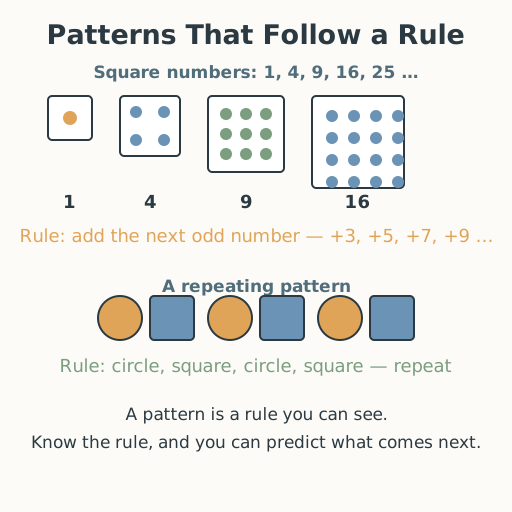
Learners generate number and shape patterns that follow a given rule: a repeating pattern (circle, square, circle, square), a growing pattern (“add 3”: 2, 5, 8, 11 …), and a square-number pattern (1, 4, 9, 16 …). They state each rule in words, so a pattern becomes a rule they can carry and use to predict the next term.
Objectives
- Generate and analyze a number or shape pattern that follows a given rule and describe its features. (D05.S2.04.01)
Connection
Patterns are everywhere, and they all have a rule: the tiles on a floor, the stripes on a cloth, the stairs you climb, the way a fern adds a new leaf, the way a chant or a drumbeat repeats. Weavers and beadworkers across many traditions have built repeating and growing patterns into cloth and jewelry for thousands of years — a pattern is a rule you can see (Zaslavsky, 1999). When you know the rule, you can predict what comes next without building every step. That is the power of a pattern.
Materials
- A handful of small counters or shape pieces (per learner)
- Paper or slate and a drawing tool
Preparation
- Give each learner counters or shape pieces.
- Prepare (or plan to draw) the worked example: the “add 3” pattern and the square-number pattern.
- Clear space to build and count aloud.
Facilitator note
This lesson is written to the learner (“you”). It opens the Patterns & Relationships strand for Grade 4 — the new skill is generating a pattern from a rule and stating the rule in words. Teach with a worked example (philosophy §13): build 2, 5, 8, 11 with counters and say “add three each time”; then build the squares 1, 4, 9, 16 and notice the rule “add the next odd number: +3, +5, +7.” The key move is generalizing — saying what the pattern always does, not just what it did (Clements & Sarama, 2014). Seeing a pattern quickly is not a measure of smartness; a pattern is a fact about numbers or shapes, never about a person. Patterns are a human and cross-cultural treasure — weaving, beading, lattice grids, and architecture carry patterns in many traditions (Zaslavsky, 1999). Count in the home language. For learners who are Deaf or hard of hearing, tap each term; for learners who are blind or have low vision, build with tactile pieces and read the pattern by touch. Learners with limited movement direct a partner to build. Mastery arrives at its own pace.
Procedure
- Gather — patterns around you (5 min). Name a pattern you have seen — stripes, steps, beads. What repeats or grows? A pattern has a rule.
- Worked example — add three (8 min). Build with counters: 2, then 5 (add 3), then 8 (add 3), then 11 (add 3). Say the rule: add three each time. Now predict: what comes after 11? 14. Build it to check.
- Build a repeating pattern (8 min). Make a repeating pattern with two or three shapes, like circle, square, circle, square. State its rule: “circle, square, repeat.” Predict the tenth shape without building all ten — how did the rule help?
- The square pattern (12 min). Build 1 dot, then a 2-by-2 square (4), then a 3-by-3 square (9), then a 4-by-4 square (16). Write the numbers 1, 4, 9, 16. What is the rule? Each step adds the next odd number: +3, +5, +7. Predict the next one: 25. Build the 5-by-5 square to check.
- Check with a partner (5 min). Trade a pattern. Can your partner state your rule and predict your next term? Count it together, kindly.
- Close (2 min). Remember: a pattern is a rule you can see. Find the rule, and you can predict the future of the pattern.
Differentiation
- Support: Extend a given “add 2” pattern today; make your own rule another day.
- Support (blind/low-vision): Build patterns with tactile pieces and read each step by touch.
- Extension: Generate the triangular numbers (1, 3, 6, 10 …) and state their rule in words (“add 2, then 3, then 4 …”).
Assessment
- Formative (observation): Can the learner generate a sequence that follows a given rule and state the rule in words?
- Self: Can the learner predict the next term of a pattern they made and tell how they know?
Home connection
At home, find a growing or repeating pattern (a staircase, a braid, a tiled wall) and name its rule, then predict the next step. Tell a grown-up the rule.
Resources
- Clements, D. H., & Sarama, J. (2014). Learning and Teaching Early Math: The Learning Trajectories Approach (2nd ed.). Routledge. (Generalizing a pattern by stating its rule.)
- Zaslavsky, C. (1999). Africa Counts: Number and Pattern in African Cultures (3rd ed.). Lawrence Hill Books. (Arithmetic patterns embedded in weaving, beading, and other cultural designs.)