Lesson 08 — Analyzing Pattern Features
Learners analyze number and shape patterns by naming their features: what stays the same, what changes, how much it increases, and where it repeats. They use those features to predict a later term, turning a pattern from a picture into a description they can reason with.
Objectives
Objectives
- D05.S2.04.01 Generate and analyze a number or shape pattern that follows a given rule and describe its features.
Essential question
How do I analyze a pattern and describe its features?
Key vocabulary
Materials
Standard materials
- A set of pattern cards (number and shape) · 1 set per pair Patterns to analyze: some growing, some repeating, with different steps
- Paper or slate and a drawing tool · per learner To record features and predictions
Low-tech / no-cost
- Patterns made of stones and sticks on the ground Build two patterns and describe what stays the same and what changes
- Voice and body Say the features aloud; clap the constant part and step the changing part
Enriched / lab & device
- Pattern blocks or linking cubes · 1 set per pair To build and compare two patterns feature by feature
- A table-making tool or grid paper · per learner To record each pattern's terms and the change from one term to the next
Works in different contexts
- large-group Analyze one pattern together, naming each feature aloud before learners analyze their own
- self-directed A learner picks two patterns, lists what stays the same and what changes, and predicts a later term
- multi-age Older learners describe the change in symbols; younger learners say "same" or "changes" for each feature
- level-grouped Learners who analyze easily compare a growing and a repeating pattern; others describe one pattern's features with support
- outdoor-only Compare two natural patterns (leaf veins, shell spirals) and name what stays the same and what changes
Lesson 8 — Analyzing Pattern Features
Summary
Learners analyze number and shape patterns by naming their features: what stays the same, what changes, how much a growing pattern increases, and where a repeating pattern repeats. They use those features to predict a later term, turning a pattern from a picture into a description they can reason with.
Objectives
- Generate and analyze a number or shape pattern that follows a given rule and describe its features. (D05.S2.04.01)
Connection
When you learn a song, a game, or a weaving, you notice what repeats and what changes — the chorus stays the same, the verses change; the game’s turn order repeats, the score grows. That noticing is analysis. A pattern has parts that are constant and parts that change, and naming them is how you understand any rhythm — in music, in cloth, in a staircase, in a row of numbers. Describe the features, and the pattern stops being mysterious and becomes predictable.
Materials
- A set of pattern cards (number and shape) (per pair)
- Paper or slate and a drawing tool
Preparation
- Prepare the pattern cards: growing patterns (add 2, add 5, multiply by 2) and repeating patterns (AB, ABC).
- Prepare (or plan to draw) the worked example: the “add 3” pattern analyzed.
- Clear space to compare and describe aloud.
Facilitator note
This lesson is written to the learner (“you”). It deepens Lesson 7: now the learner analyzes — names what stays the same, what changes, and how. Teach the features with a worked example (philosophy §13): in 2, 5, 8, 11 the terms change, the step (+3) stays the same, so it is a growing pattern that increases by 3. The key move is describing invariance and change, the heart of generalizing a pattern (Clements & Sarama, 2014). How quickly a learner spots a feature is not a measure of their worth; a pattern is a fact about numbers or shapes, never about a person. Patterns and their analysis are human and cross-cultural — musicians, weavers, and builders have named “what repeats and what changes” for millennia (Zaslavsky, 1999). Count in the home language. For learners who are Deaf or hard of hearing, sign the constant and changing parts; for learners who are blind or have low vision, feel the pattern’s parts and name each by touch. Learners with limited movement direct a partner to build. Mastery arrives at its own pace.
Procedure
- Gather — what repeats, what changes (5 min). Think of a song or game. Which part repeats, and which part changes? That is analysis.
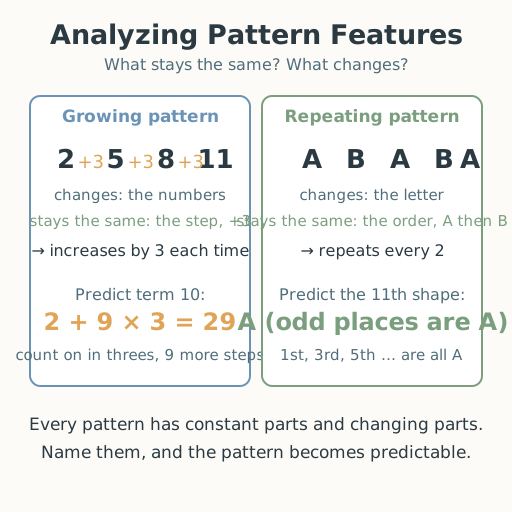
- Worked example — the features of “add 3” (8 min). Look at 2, 5, 8, 11. What changes? The numbers (2, 5, 8, 11). What stays the same? The step — it is always +3. So: a growing pattern that increases by 3. Name the features, then predict term 10 by counting on in threes.
- Analyze a repeating pattern (8 min). Look at circle, square, circle, square, circle. What changes? The shape. What stays the same? The order — always circle then square. It repeats every 2. Predict the 11th shape: odd places are circles, so it is a circle. Explain how you know.
- Analyze on your own (15 min). Take the pattern cards. For each, write: growing or repeating? What stays the same? What changes? By how much? Then predict a later term and check by building or counting.
- Compare with a partner (5 min). Trade two cards. Do you agree on each pattern’s features and its predicted term? Talk it through, kindly.
- Close (4 min). Remember: every pattern has constant parts and changing parts. Name them, and the pattern becomes a description you can reason with.
Differentiation
- Support: Analyze one “add 2” pattern today; add repeating and harder patterns another day.
- Support (blind/low-vision): Analyze patterns of tactile pieces, naming what stays the same and what changes by touch.
- Extension: Compare a growing pattern (“add 2”) and a doubling pattern (“multiply by 2”) and describe how their features differ.
Assessment
- Formative (observation): Can the learner name what stays the same and what changes in a pattern, and predict a later term from those features?
- Self: Can the learner explain why a predicted term is correct using the pattern’s features?
Home connection
At home, analyze a real pattern — a fence, a song, a braid — and name what repeats and what changes. Predict the next part and tell a grown-up how you knew.
Resources
- Clements, D. H., & Sarama, J. (2014). Learning and Teaching Early Math: The Learning Trajectories Approach (2nd ed.). Routledge. (Generalizing by describing what is invariant and what changes.)
- Zaslavsky, C. (1999). Africa Counts: Number and Pattern in African Cultures (3rd ed.). Lawrence Hill Books. (Pattern and its analysis across many traditions.)