Lesson 09 — Unknown Numbers & Simple Equations
Learners use a letter or symbol to stand for an unknown number in a simple equation and find its value by balancing both sides — with counters, by counting on, or by using an inverse operation — then check by putting the value back in. An equation becomes a balance that must stay equal.
Objectives
Objectives
- D05.S2.04.02 Use a letter or symbol to stand for an unknown number in a simple equation and find its value.
Essential question
How do I use a letter or symbol for an unknown number and find its value?
Key vocabulary
Materials
Standard materials
- A simple balance or a drawn balance scale · 1 per pair To show that both sides of an equation must stay equal
- Small counters · a handful per learner To stand for the known and unknown amounts
- Paper or slate and a drawing tool · per learner To write equations with a letter for the unknown
Low-tech / no-cost
- A seesaw, stick, or drawn balance on the ground Show both sides equal by placing counters; find the missing amount that balances
- Voice and body Hold up fingers for the known side, then ask "how many more make it equal?"
Enriched / lab & device
- A pan balance with weights · 1 per pair To physically balance an equation and find the unknown weight
- A number-line or equation app · 1 per pair To model an equation as a jump on the line and check the solution
Works in different contexts
- large-group Balance a big equation together, adding counters to one side while the group names how many more are needed
- self-directed A learner writes an equation with a letter, solves it with counters or inverse operations, and checks by substituting the value back
- multi-age Older learners use inverse operations to solve; younger learners count on with counters to find the unknown
- level-grouped Learners who solve easily write their own equations; others solve with counters and support
- outdoor-only Balance sticks and stones on a board or log to find the unknown amount that makes both sides level
Lesson 9 — Unknown Numbers & Simple Equations
Summary
Learners use a letter (or any symbol) to stand for an unknown number in a simple equation, and find its value by keeping both sides balanced — with counters, by counting on, or by using an inverse operation. For example, in n + 3 = 7, the unknown n is 4. They check by putting the value back in.
Objectives
- Use a letter or symbol to stand for an unknown number in a simple equation and find its value. (D05.S2.04.02)
Connection
A mystery number hides in many real situations: “If I had three more, I would have seven — how many do I have now?”; “If I save this much each week, how many weeks until I have enough?”; “How many more seeds until the field is full?” Instead of saying “the mystery number” over and over, mathematicians use a letter, like n, to stand for it. An equation is a balance: whatever you do to one side, you do to the other, and the mystery number is what makes both sides equal.
Materials
- A simple balance or a drawn balance scale (per pair)
- A handful of small counters (per learner)
- Paper or slate and a drawing tool
Preparation
- Give each pair a balance (or draw one) and counters.
- Prepare (or plan to draw) the worked example: n + 3 = 7.
- Clear space to balance and count aloud.
Facilitator note
This lesson is written to the learner (“you”). This is the learner’s first formal meeting with a variable — a letter standing for an unknown. Teach it concretely as a balance (philosophy §13): both sides of an equation are equal, and the unknown is what makes them so (Van de Walle, Karp & Bay-Williams, 2019). Model n + 3 = 7 with a worked example, find n = 4 by counting on or subtracting, then check by substitution. Build on Grade 3’s missing-number problems (Carpenter, Fennema, Franke, Levi & Empson, 2015). A letter is a tool for a job, not a scary symbol; and the pace at which a learner meets variables is not a measure of their worth. An equation is a fact about numbers, never about a person. The idea of an unknown and of balancing quantities is found across mathematical traditions; the letters we use are one convention among many (Ifrah, 2000). Count in the home language. For learners who are Deaf or hard of hearing, sign the balance and the unknown; for learners who are blind or have low vision, feel a real balance and find the missing amount by touch. Learners with limited movement direct a partner to place counters. Mastery arrives at its own pace.
Procedure
- Gather — the mystery number (5 min). “If I had three more, I would have seven.” How many do I have now? That hidden number is the unknown.
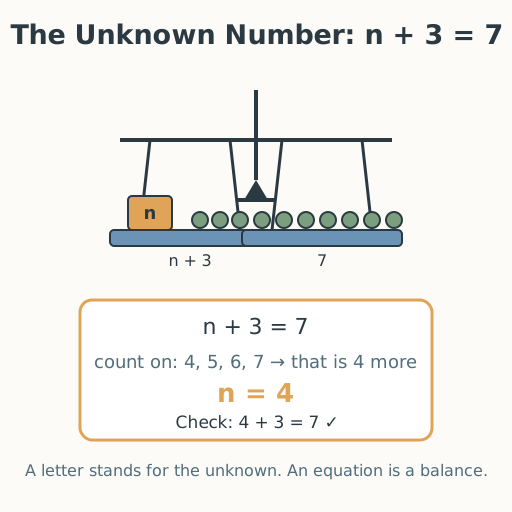
- Meet the letter (5 min). Instead of “the mystery number,” write n. Then the sentence becomes n + 3 = 7. The equals sign is a balance: the two sides weigh the same.
- Worked example — solve n + 3 = 7 (10 min). Put 3 counters on one side and 7 on the other. How many more make 3 into 7? Count on: 4, 5, 6, 7 — that is 4. So n = 4. Check: 4 + 3 = 7. ✓. Or subtract: 7 − 3 = 4. Both ways agree.
- Guided practice — balance and solve (15 min). Solve these with counters and record each: n + 5 = 12; 4 × n = 20; n − 2 = 6. For each, say how you know, and check by putting your value back in.
- Write your own (5 min). Write an equation with a letter whose answer is 9. Give it to a partner.
- Check with a partner (3 min). Solve your partner’s equation and compare. Do you both get 9? Talk it through, kindly.
- Close (2 min). Remember: a letter stands for the unknown, and an equation is a balance. Find the value that makes both sides equal, then check it.
Differentiation
- Support: Solve addition equations with counters first; add multiplication and subtraction another day.
- Support (blind/low-vision): Use a real balance and tactile counters to find the unknown by feel.
- Extension: Solve a two-step equation like 2 × n + 1 = 9 and explain each step in words.
Assessment
- Formative (observation): Can the learner use a letter for an unknown, find its value with counters or an inverse operation, and check by substitution?
- Self: Can the learner explain, in words, what the letter stands for in a real story?
Home connection
At home, make a mystery-number sentence for a grown-up (“if I had two more I would have ten”) and solve it together with a letter. Check your answer by putting it back in.
Resources
- Carpenter, T. P., Fennema, E., Franke, M. L., Levi, L., & Empson, S. B. (2015). Children’s Mathematics: Cognitively Guided Instruction (2nd ed.). Heinemann. (Missing-number problems as the base for equations with unknowns.)
- Van de Walle, J. A., Karp, K. S., & Bay-Williams, J. M. (2019). Elementary and Middle School Mathematics: Teaching Developmentally (10th ed.). Pearson. (The balance model and variables in early algebra.)
- Ifrah, G. (2000). The Universal History of Numbers. John Wiley & Sons. (Symbols for unknowns as one convention among many.)