Lesson 10 — Points, Lines, Segments, Rays & Angles
Learners draw and identify the basic building blocks of geometry — a point, a line, a line segment, a ray, and an angle — and name their parts (endpoint, vertex, and the three kinds of angle: right, acute, obtuse). Geometry begins with a few simple figures you can see and point to.
Objectives
Objectives
- D05.S3.04.01 Draw and identify points, lines, line segments, rays, and angles, and classify shapes by their lines and angles.
Essential question
How do I draw and identify points, lines, line segments, rays, and angles?
Key vocabulary
Materials
Standard materials
- A straightedge (ruler or straight stick) · 1 per learner To draw straight lines, segments, and rays
- Paper or slate and a drawing tool · per learner To draw and label the figures
Low-tech / no-cost
- Sticks, string, and stones on the ground A string held tight is a line; a stick between two stones is a segment; a stick from one stone outward is a ray
- Voice and body Point with a finger (point), stretch both arms (line), hold a fist to an elbow (segment), stretch one arm from a fist (ray), and bend the elbow to make an angle
Enriched / lab & device
- Geoboards and rubber bands · 1 per pair To build segments, rays, and angles and change them quickly
- A drawing or geometry app · 1 per pair To draw figures and measure angles
Works in different contexts
- large-group Draw each figure large on the board and have the whole group act it out with their bodies
- self-directed A learner draws and labels each figure, then checks by finding one of each in the room or outdoors
- multi-age Older learners label angles as acute, right, or obtuse; younger learners identify points and segments
- level-grouped Learners who are ready classify angles by size; others draw and name the basic figures first
- outdoor-only Find lines (the horizon, a road), segments (a fence post to post), rays (a sunbeam), and angles (a branch fork) outside
Lesson 10 — Points, Lines, Segments, Rays & Angles
Summary
Learners draw and identify the basic building blocks of geometry: a point, a line, a line segment, a ray, and an angle, and name their parts — an endpoint, a vertex — and the three kinds of angle: right, acute, and obtuse. Geometry begins with a few simple figures you can see, point to, and make with your own body.
Objectives
- Draw and identify points, lines, line segments, rays, and angles, and classify shapes by their lines and angles. (D05.S3.04.01)
Connection
Look around: the horizon is a line, the edge of a book is a line segment, a sunbeam or the beam of a flashlight is a ray, and the corner where two walls meet is an angle. Geometry is not something invented in a textbook — it is the shapes of the world, named. People in many places and times have measured fields, built roofs, and mapped stars with these same figures; the words we use today come from a long human conversation about shape and space.
Materials
- A straightedge (ruler or straight stick) (per learner)
- Paper or slate and a drawing tool
Preparation
- Give each learner a straightedge.
- Prepare (or plan to draw) the five figures as a worked example.
- Clear space to move and act out the figures.
Facilitator note
This lesson is written to the learner (“you”). It opens the Geometry strand for Grade 4 — the new skill is the precise vocabulary of points, lines, segments, rays, and angles, and the three angle sizes. Teach each figure with a worked example (philosophy §13) and let learners act it out with their bodies (Van de Walle, Karp & Bay-Williams, 2019). The key distinctions are finite vs infinite (a segment has two endpoints; a ray has one; a line has none) and angle size (right is a square corner, acute is smaller, obtuse is larger). Geometry vocabulary is learned at each learner’s own pace; naming a figure quickly is not a measure of smartness, and a shape is a fact about the world, never about a person. Geometry is a human and cross-cultural achievement — land-measuring, building, and star-mapping appear across many traditions, not one. Use the home language’s words for these figures; all are correct. For learners who are Deaf or hard of hearing, sign each figure; for learners who are blind or have low vision, feel string and sticks and trace each figure by touch. Learners with limited movement direct a partner to draw. Mastery arrives at its own pace.
Procedure
- Gather — shapes everywhere (5 min). Point to something straight in the room. Point to a corner. Geometry is the study of shapes like these.
- Meet the five figures (12 min). Learn and draw each, one at a time:
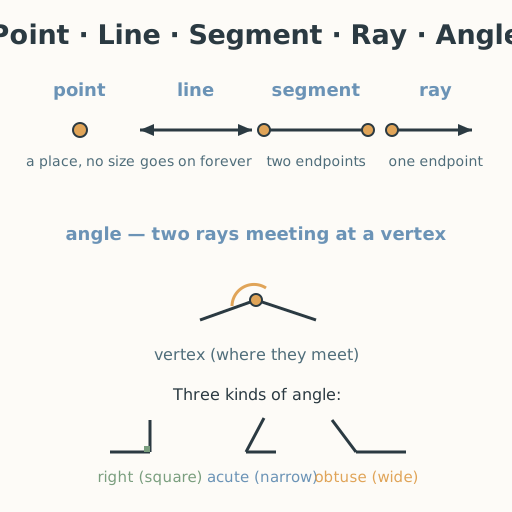
- A point is an exact spot — no size, just a place.
- A line is straight and goes on forever in both directions (draw arrows on both ends).
- A line segment is part of a line with two endpoints.
- A ray starts at one endpoint and goes on forever in one direction.
- An angle is two rays that meet at a point called the vertex.
- Act it out (8 min). Make each figure with your body: a point is a fingertip; a line is both arms stretched wide; a segment is a fist to an elbow; a ray is one arm from a fist pointing outward; an angle is a bent elbow.
- The three angles (10 min). Make an angle with your elbow. A right angle is a perfect square corner; an acute angle is smaller (narrower); an obtuse angle is bigger (wider). Find one of each in the room.
- Check with a partner (5 min). Trade drawings. Can your partner name each figure and its parts? Point to the vertex and endpoints together, kindly.
- Close (5 min). Remember: a point is a place, a line goes on forever, a segment stops, a ray starts and keeps going, and an angle is two rays meeting. These five are the alphabet of shapes.
Differentiation
- Support: Learn point, segment, and angle today; add line and ray another day.
- Support (blind/low-vision): Feel string and sticks to trace each figure and its endpoints.
- Extension: Find and classify five angles in the room or outdoors as right, acute, or obtuse, and justify each.
Assessment
- Formative (observation): Can the learner draw and name a point, line, segment, ray, and angle, and identify endpoints and the vertex?
- Self: Can the learner classify an angle as right, acute, or obtuse and tell how they know?
Home connection
At home, find one of each figure — a point, a line, a segment, a ray, and an angle — in your house or street, and tell a grown-up which is which and how you know.
Resources
- Van de Walle, J. A., Karp, K. S., & Bay-Williams, J. M. (2019). Elementary and Middle School Mathematics: Teaching Developmentally (10th ed.). Pearson. (The geometry vocabulary of points, lines, segments, rays, and angles.)