Lesson 14 — Converting Length & Distance
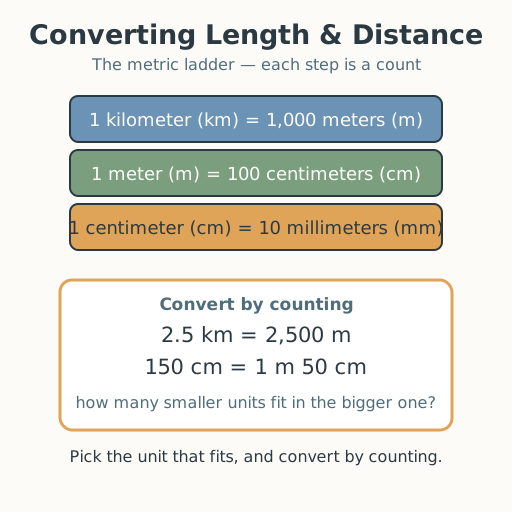
Learners convert measurements of length and distance within a system — mostly the metric system, which most of the world uses — by counting how many smaller units fit in a bigger one (10 mm = 1 cm, 100 cm = 1 m, 1,000 m = 1 km). They solve distance problems by choosing the unit that fits and converting when needed.
Objectives
Objectives
- D05.S4.04.01 Convert measurements within a system and solve problems involving distance, time, volume, and money.
Essential question
How do I convert measurements of length and distance within a system?
Key vocabulary
Materials
Standard materials
- A meter stick or a measured strip · 1 per pair To see and count centimeters and millimeters
- Paper or slate and a drawing tool · per learner To record conversions
Low-tech / no-cost
- A stick marked in hand-widths or strides Count the smaller units in the bigger unit and convert by counting
- Voice and body Step out a meter, then count the centimeters in it aloud in tens
Enriched / lab & device
- A metric ruler, meter tape, and a measuring wheel · 1 set per pair To measure real lengths and convert among units
- A conversion chart or app · 1 per pair To check conversions and solve distance problems
Works in different contexts
- large-group Lay out a meter on the floor and count its centimeters together, then convert as a group
- self-directed A learner measures objects, records in one unit, and converts to another, checking by counting
- multi-age Older learners convert kilometers to meters for journeys; younger learners count centimeters in a meter
- level-grouped Learners who convert easily work with large distances; others convert within a meter first
- outdoor-only Measure a real distance outdoors in strides and convert among units by counting
Lesson 14 — Converting Length & Distance
Summary
Learners convert measurements of length and distance within a system — mostly the metric system, which most of the world uses — by counting how many smaller units fit in a bigger one: 10 millimeters (mm) = 1 centimeter (cm), 100 cm = 1 meter (m), and 1,000 m = 1 kilometer (km). They solve distance problems by choosing the unit that fits and converting when needed.
Objectives
- Convert measurements within a system and solve problems involving distance, time, volume, and money. (D05.S4.04.01)
Connection
“About how far?” needs the right-sized unit. You would not measure a journey in centimeters or a pencil in kilometers. Most of the world measures with meters and kilometers, where each unit is ten or a thousand of the next — a system built to make converting easy (Van de Walle, Karp & Bay-Williams, 2019). Some places also use older units like inches, feet, and miles; knowing how to convert within a system is what lets you move between “about this long” and “exactly this long.” Whether you pace a field or read a road sign, converting is just counting smaller units inside bigger ones.
Materials
- A meter stick or a measured strip (per pair)
- Paper or slate and a drawing tool
Preparation
- Give each pair a meter stick or measured strip.
- Prepare (or plan to draw) the conversion ladder as a worked example.
- Clear space to measure and count.
Facilitator note
This lesson is written to the learner (“you”). Conversion is counting within a system: teach it concretely — count 100 centimeters in a meter, then generalize the metric ladder (10 mm = 1 cm, 100 cm = 1 m, 1,000 m = 1 km) (Van de Walle, Karp & Bay-Williams, 2019). Model once as a worked example (philosophy §13), then guide practice. The metric system is the global default and is egalitarian in spirit — one coherent system for everyone, not a patchwork of region-specific units; where customary units (inches, feet, miles) are in local use, treat them respectfully as one system among several, never ranked. A learner’s pace at memorizing conversion facts is not a measure of their worth; a conversion is a fact about units, never about a person. Count in the home language. For learners who are Deaf or hard of hearing, sign each conversion; for learners who are blind or have low vision, feel a meter stick and count the centimeter marks by touch. Learners with limited movement direct a partner to measure. Mastery arrives at its own pace.
Procedure
- Gather — the right-sized unit (5 min). Would you measure a road in hand-widths or a pencil in kilometers? You pick the unit that fits, then convert when you need to change units.
- Worked example — the metric ladder (10 min). Look at a meter stick: count 100 centimeters in it. Learn the ladder: 10 mm = 1 cm, 100 cm = 1 m, 1,000 m = 1 km. Convert together: 3 m = 300 cm (count three hundreds). 2 km = 2,000 m.
- Guided practice — convert both ways (15 min). Convert by counting: 5 cm = ___ mm; 400 cm = ___ m; 2.5 km = ___ m; 7,000 m = ___ km. For each, say how many smaller units fit in the bigger unit.
- Distance problems (10 min). Solve: a race is 3 km — how many meters? A table is 150 cm — how many meters and centimeters? A runner goes 2 km then 500 m more — how many meters in all?
- Check with a partner (3 min). Trade a conversion. Do you agree? Count it together, kindly.
- Close (2 min). Remember: converting is counting how many smaller units fit in a bigger one. Pick the unit that fits, and convert by counting.
Differentiation
- Support: Convert cm to mm and cm to m today; add km another day.
- Support (blind/low-vision): Feel the centimeter marks on a meter stick and count by touch.
- Extension: Convert a decimal distance (2.5 km) and explain the decimal’s meaning in meters.
Assessment
- Formative (observation): Can the learner convert among mm, cm, m, and km by counting, and solve a distance problem with the right unit?
- Self: Can the learner explain why they chose a particular unit for a given distance?
Home connection
At home, measure something in one unit (a room in meters, a pencil in centimeters) and convert it to a smaller or bigger unit. Tell a grown-up how you counted.
Resources
- Van de Walle, J. A., Karp, K. S., & Bay-Williams, J. M. (2019). Elementary and Middle School Mathematics: Teaching Developmentally (10th ed.). Pearson. (Measurement and unit conversion within the metric system.)