Lesson 15 — Converting Time, Volume & Money
Learners convert within three systems — time (60 seconds = 1 minute, 60 minutes = 1 hour), volume (1,000 milliliters = 1 liter), and money (100 smaller units = 1 larger unit in most currencies) — and solve problems like how long a journey takes, how much water is in a jug, and how much change to give. Conversion becomes counting within a system.
Objectives
Objectives
- D05.S4.04.01 Convert measurements within a system and solve problems involving distance, time, volume, and money.
Essential question
How do I convert time, volume, and money within a system and solve problems with them?
Key vocabulary
Materials
Standard materials
- A clock face or timer · 1 per pair To see and count seconds, minutes, and hours
- A liter bottle and a small cup · 1 per pair To see milliliters in a liter
- Play money or real coins and small bills · a set per pair To convert and make change
- Paper or slate and a drawing tool · per learner To record conversions
Low-tech / no-cost
- Counting aloud, a water container, and found objects as "coins" Count 60 seconds in a minute, pour a cup into a liter, and trade found objects to make change
- Voice and body Tap 60 beats in a minute; count coins in the home currency by ones, tens, and hundreds
Enriched / lab & device
- A stopwatch, a marked measuring jug, and a cash-register or counting tray · 1 set per pair To measure time, volume, and money precisely and check conversions
- A shopping game or app · 1 per pair To practice giving change and converting amounts
Works in different contexts
- large-group Count a minute together aloud, pour a liter into cups as a group, and make change on a large tray
- self-directed A learner converts time, volume, and money amounts and checks each by counting
- multi-age Older learners solve multi-step money problems; younger learners count seconds in a minute and coins by ones
- level-grouped Learners who convert easily solve mixed problems; others convert one kind of unit at a time
- outdoor-only Measure the time of a walk, pour water between containers, and use found objects as currency to practice making change
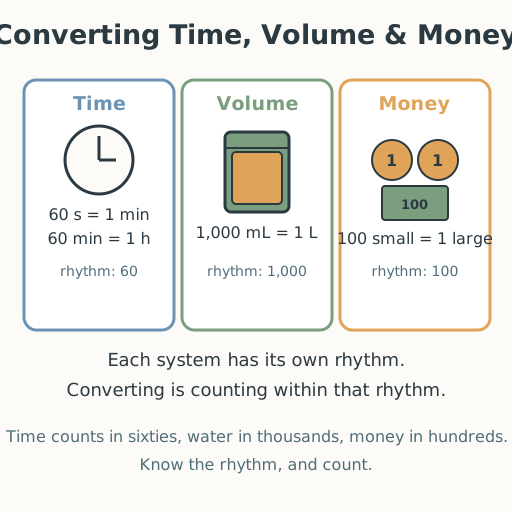
Lesson 15 — Converting Time, Volume & Money
Summary
Learners convert within three systems — time (60 seconds = 1 minute, 60 minutes = 1 hour), volume (1,000 milliliters = 1 liter), and money (in most currencies, 100 smaller units = 1 larger unit) — and solve problems like how long a journey takes, how much water a jug holds, and how much change to give. Conversion becomes counting within a system.
Objectives
- Convert measurements within a system and solve problems involving distance, time, volume, and money. (D05.S4.04.01)
Connection
“How long until dinner?” “How much water is left in the jug?” “How much change should I get back?” These everyday questions are conversions. Time counts in sixties, water in thousands, and money in hundreds — and each system has its own rhythm you must count carefully. Money is especially human: people have used cowrie shells, beads, salt, and many other things before coins and bills (Davies, 2002), and today most currencies split into 100 smaller units, which makes change a matter of counting in tens and hundreds.
Materials
- A clock face or timer (per pair)
- A liter bottle and a small cup (per pair)
- Play money or real coins and small bills (per pair)
- Paper or slate and a drawing tool
Preparation
- Gather the clock, the liter bottle, and the money for each pair.
- Prepare (or plan to draw) the three conversion tables as a worked example.
- Clear space to count, pour, and trade.
Facilitator note
This lesson is written to the learner (“you”). These three systems have different bases — 60 for time, 1,000 for liters, 100 for money — so teach each with its own concrete anchor (a minute of tapping, a liter of pours, a tray of coins) (Van de Walle, Karp & Bay-Williams, 2019). Model each as a worked example (philosophy §13), then guide practice. For money, use the home currency and its real subunits; in most currencies 100 smaller units make one larger unit, but honor local exceptions. Money’s history is global and varied — cowries, beads, salt, and metals all served as exchange before and alongside coins (Davies, 2002; Zaslavsky, 1999) — and no currency is “better” than another. A learner’s pace at conversion is not a measure of their worth; a conversion is a fact about units, never about a person. Count in the home language. For learners who are Deaf or hard of hearing, sign each conversion; for learners who are blind or have low vision, feel the coins and pour the water by touch. Learners with limited movement direct a partner. Mastery arrives at its own pace.
Procedure
- Gather — three rhythms (5 min). Time counts in sixties, water in thousands, money in hundreds. Each system has its own rhythm — you just have to count it carefully.
- Worked example — time (8 min). Tap one beat each second for a full minute — 60 beats. Learn: 60 seconds = 1 minute, 60 minutes = 1 hour. Convert: 2 hours = 120 minutes; 90 minutes = 1 hour 30 minutes.
- Worked example — volume (7 min). Pour the small cup into the liter bottle: it takes many cups — 1,000 milliliters make 1 liter. Convert: 2 L = 2,000 mL; 500 mL = half a liter.
- Worked example — money (10 min). Count the coins: 100 smaller units make one larger unit in most currencies. Convert: 250 of the small unit = 2 large units and 50 small. Now practice making change: the price is 1 large unit and 25 small; you pay 2 large units — how much change?
- Guided practice (10 min). Solve mixed problems: a journey is 2 hours 15 minutes — how many minutes? A jug holds 3 L — how many mL? You buy two items and pay with a larger bill — how much change? For each, say how you counted.
- Check with a partner (3 min). Trade a problem. Do you agree? Count it together, kindly.
- Close (2 min). Remember: converting is counting within a system — know its rhythm (60, 1,000, 100) and count.
Differentiation
- Support: Convert time only today; add volume and money another day.
- Support (blind/low-vision): Count real coins by feel and pour water to feel the volume.
- Extension: Solve a two-step money problem (buy two items, give change from a larger bill) and explain each step.
Assessment
- Formative (observation): Can the learner convert within time, volume, and money systems and solve a real problem in each?
- Self: Can the learner explain which “rhythm” (60, 1,000, or 100) belongs to which system and why?
Home connection
At home, convert a real amount — the minutes in a task, the milliliters in a bottle, or the change from a purchase — and tell a grown-up how you counted.
Resources
- Van de Walle, J. A., Karp, K. S., & Bay-Williams, J. M. (2019). Elementary and Middle School Mathematics: Teaching Developmentally (10th ed.). Pearson. (Measurement conversion for time, volume, and money.)
- Davies, G. (2002). A History of Money: From Ancient Times to the Present Day (3rd ed.). University of Wales Press. (The variety of money — shells, beads, salt, metal — across history.)
- Zaslavsky, C. (1999). Africa Counts: Number and Pattern in African Cultures (3rd ed.). Lawrence Hill Books. (Cowrie shells and other pre-coin exchange.)