Lesson 08 — The Environment Gives, People Change It
Learners see how the environment shapes how people meet needs for food, water, and shelter in cold, desert, river-valley, and coastal places — and how people in turn change the environment: terracing slopes, digging irrigation canals, and sinking wells. Both directions of the relationship matter, and both are held with respect.
Objectives
Objectives
- D08.S3.04.02 Explain how the environment affects how people get food, water, and shelter in different regions, and how people change the environment to meet their needs.
Essential question
How does the environment affect how people get food, water, and shelter, and how do people change the environment to meet their needs?
Key vocabulary
Materials
Standard materials
- "Environment and needs" picture cards · 1 set Cards for cold (parka, warm home, fish), desert (light robe, tent, dates), river valley (irrigated field, brick home, grain), coast (boat, fish) — food, water, shelter for each
- "People change the environment" cards · 1 set A terraced hillside, an irrigation canal, a dug well, a floating garden (chinampa) — each labeled with what it does
- Pencils and crayons · per learner For drawing one change people made
Low-tech / no-cost
- Found objects A warm wrap and a light cloth, a bowl (well), a groove in sand (canal), a step of earth (terrace) — match each to a need or a change
- Body and voice Act needing food, water, and shelter in a cold and a hot place, then act digging a canal or building a terrace
Enriched / lab & device
- Photos of terraces, canals, and wells around the world · 1 set Optional — Andean terraces, Nile or Mesopotamian canals, desert qanats, Tenochtitlan's chinampas
- A tablet or projector · 1 per group Optional — short clips of terraced farming or irrigation in use today
Works in different contexts
- large-group Sort the needs and changes together on a big board, the whole group calling out "food!" "water!" "shelter!" and "people changed it!"
- self-directed The learner matches each environment to its needs and draws one change people made, then explains it to a grown-up or peer
- outdoor-only Find or feel real earth and water and act building a terrace, digging a canal, or drawing from a well
- multi-age Older learners read the labels and scribe, while younger learners sort the cards and act each need and change
- level-grouped Learners who finish early coach peers by asking "what does this place give, and what did people change to get more?" rather than telling
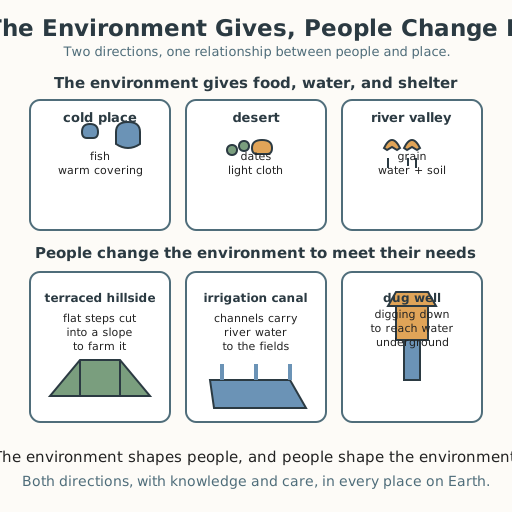
Lesson 8 — The Environment Gives, People Change It
Summary
Learners see the relationship between people and place as a two-way street: the environment shapes how people get food, water, and shelter in cold, desert, river-valley, and coastal places — and people in turn change the environment to meet their needs, terracing slopes, digging irrigation canals, and sinking wells. Both directions matter, and every people’s answer is held with respect.
Objectives
- Explain how the environment affects how people get food, water, and shelter in different regions, and how people change the environment to meet their needs. (D08.S3.04.02)
Connection
Think of where you get your food, water, and shelter today. Some of it comes straight from the environment around you — soil, rain, rivers, sunlight. And some of it comes because people changed the environment to get more: fields were flattened, canals were dug, wells were sunk, homes were built. Every place asks something of its people, and every people answers by adapting — and by reshaping the land to live well.
Materials
- “Environment and needs” picture cards (cold, desert, river valley, coast)
- “People change the environment” cards (terrace, canal, well, floating garden)
- Pencils and crayons
Preparation
- Prepare the needs cards. Cold place: fish and sea food, warm parka, snug home. Desert: dates and herded milk, light robe, airy tent. River valley: grain and garden food, irrigated fields, brick home. Coast: fish and shellfish, boats, home by the shore.
- Prepare the change cards: a terraced hillside (flattened steps to farm slopes), an irrigation canal (channels to carry river water to fields), a dug well (a shaft to reach water underground), a floating garden (chinampa — reed beds for crops on a lake).
Facilitator note
This lesson is written to the learner (“you”). Model the two directions with a worked example first (Kirschner, Sweller & Clark, 2006): “The environment gives — a river valley gives water and rich soil, so people farm grain; people change — they dig an irrigation canal to carry that water farther.” Then guide the other places and changes. Keep the framing respectful and non-ranking: terracing, canals, wells, and chinampas are all ingenious human answers — the Andes terraces, the Nile and Mesopotamian canals, desert qanats, and Tenochtitlan’s floating gardens — never “primitive” and never “less advanced” than today. Both directions matter: the environment shapes people, and people shape the environment, with care and with consequences. Honor every body: describe the cards in words for a learner who cannot see them; a learner who does not use a speaking voice points or acts. If learners can name how their own place has been changed (a field, a well, a road, a garden), welcome it.
Procedure
- Gather (5 min). Name three things you need every day — food, water, and shelter. Where do yours come from?
- The environment gives (15 min). Sort the needs cards by place:
- Cold place: fish, warm parka, snug home.
- Desert: dates, light robe, airy tent.
- River valley: grain, irrigated fields, brick home.
- Coast: fish, boats, home by the shore. For each, say how the environment shaped the answer.
- People change (15 min). Meet the change cards and say what each does:
- Terraced hillside: people cut steps into a slope to farm it.
- Irrigation canal: people dig channels to carry river water to fields.
- Dug well: people dig down to reach water beneath the ground.
- Floating garden: people build reed beds on a lake to grow crops. For each, say which need it helps and which place it fits.
- Draw one change (10 min). Choose one way people changed the environment and draw or write it, with the need it served.
- Close (5 min). The environment gives, and people change it — with knowledge and care, in every place on Earth.
Differentiation
- Support: Match one environment to its food, water, and shelter with heavy picture support and one shared sentence said together.
- Support (blind/low-vision): Feel a warm wrap and a light cloth, and model a terrace or canal in clay or sand, describing each aloud.
- Support (non-speaking): Sort the cards into “environment gives” and “people change” and point, instead of speaking.
- Support (Deaf/HH): The cards are visual — sort them and sign “food,” “water,” “shelter,” and “change” as you go.
- Support (motor-difference): Use larger cards and a stable board; point or eye-gaze while a partner moves each card.
- Extension: Choose a place you know and name one way its environment shapes life today and one way people have changed it.
Assessment
- Formative (observation): Can the learner match each environment to how people get food, water, and shelter there?
- Formative (oral/performance): Does the learner explain one way people change the environment to meet a need — by speaking, signing, writing, or acting?
Resources
- Food and Agriculture Organization of the United Nations, “Soil conservation” — terracing and other ways people shape slopes to farm them, practiced from the Andes to Asia. https://www.fao.org/soils-portal/soil-management/soil-conservation/en/
- International Potato Center (CIP), “Potato” — the potato was first domesticated in the Andes, where terracing supported its farming. https://cipotato.org/potato/
- National Geographic Education, “Irrigation” — carrying water to crops through canals, from the Nile and Tigris–Euphrates to today. https://education.nationalgeographic.org/resource/irrigation/
Home connection
Walk around your home or neighborhood and find one way people changed the environment to meet a need — a well, a pipe, a field, a garden, a roof. Draw or describe it and say which need it serves.