Lesson 07 — Do Our Shared Project
Learners carry out the project they planned, **checking in and listening** as they work, and close by reflecting on what each person did, how they listened to one another, and what they would do better next time. The product matters less than the *team* that made it.
Objectives
Objectives
- D09.S3.04.02 Work with classmates on a small shared project, dividing tasks fairly and listening to each person.
Essential question
How do we carry out our shared project together — checking in, listening, and finishing as a team?
Key vocabulary
Materials
Standard materials
- The project plan from Lesson 6 · 1 per group The completed plan with tasks and names, brought forward to guide the work
- Project supplies · as needed Paper, markers, tape, or found objects for the chosen project
- A "how did we work together?" reflection sheet · per learner Three lines — "what I did," "how we listened to each other," "what I would do better next time"
Low-tech / no-cost
- Voice, body, and found objects Carry out the project with whatever is at hand — a wall, a path, a garden, and hands
- A spoken reflection circle Pass the talking stone and answer the three reflection questions aloud; no sheet needed
Enriched / lab & device
- A camera or tablet · 1 per group To photograph the finished project and the group at work for a portfolio record
- A class display space · 1 A wall or shelf where the finished project is shared with the whole community
Works in different contexts
- large-group Groups work in parallel on their own small projects, then gather for a shared show-and-tell where each group names how they listened and divided the work
- self-directed The learner carries out their planned project, checking in with any partners, and completes the reflection sheet alone
- outdoor-only Carry out the outdoor project (planting, tidying, building) and reflect in a circle where the project now stands
- multi-age Older learners hold the plan and read out the next step; younger learners do their task and are praised by name
- level-grouped Learners who need more support do their task beside a partner; learners ready for more act as checkers who ask "is anyone stuck? can I help?"
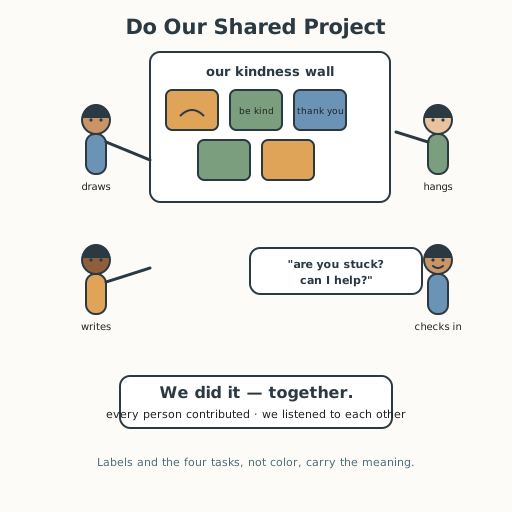
Lesson 7 — Do Our Shared Project
Summary
Learners carry out the project they planned in Lesson 6, checking in and listening as they work, and close by reflecting on what each person did, how they listened to one another, and what they would do better next time. The product matters less than the team that made it.
Objectives
- Work with classmates on a small shared project, dividing tasks fairly and listening to each person. (D09.S3.04.02)
Connection
A plan is only a promise until the team makes it real. Carrying out a shared project — the kindness wall, the tidy path, the planted seeds — is where fair division becomes visible: each person doing their task, and everyone checking in so no one is stuck or left out. A good team does not just split the work and walk away; it watches for the person who needs a hand and asks “are you stuck? can I help?” Farmers harvest in teams this way, fishers pull a net together, and builders pass bricks down a line. Today you will carry out your plan and finish as a team.
Materials
- The project plan from Lesson 6
- Project supplies (paper, markers, tape, or found objects)
- A “how did we work together?” reflection sheet per learner
Preparation
- Return each group’s completed plan and gather the supplies for each project.
- Prepare the reflection sheet (what I did; how we listened; what I would do better).
Facilitator note
Written to the learner (“you”). This is the doing half of the shared-project standard. Keep the emphasis on the team process, not the product: praise the check-in (“you noticed they were stuck and helped”) as much as the finished work. Rotate among groups and model the check-in question aloud (“are you stuck? can I help?”) so it becomes the group’s habit. Watch for the quiet or slower worker and make sure they are neither left out nor silently overloaded — a checker role helps. The reflection is the assessment: it asks what each person did (so no one’s contribution is invisible) and how the group listened. Never rank projects against one another; every finished project is a win for its team. A learner who does not speak aloud reflects by pointing to a picture or a task on the plan; a learner who is deaf or hard of hearing reflects through sign and the sheet; a learner who is blind or low-vision reflects aloud while the sheet is read back; a learner with a motor difference can describe their contribution while a partner scribes. A learner may always pass or reflect privately. The aim is a team that can say, in its own way, “we did it together — every person contributed, and we listened to each other.”
Procedure
- Gather and remember (5 min). Look at your plan from last time. What project did you choose, and who does what? That was your fair plan — now make it real.
- Do the work (25 min). Each person does their task. As you work, check in: ask “are you stuck? can I help?” and listen to the answer. If a task is too big or too small, pause and re-share the load so it stays fair.
- Finish and share (5 min). Step back and look at what you made together. Name one thing each person did — so no one’s work is invisible.
- Reflect (5 min). On your sheet, finish the three lines: “what I did,” “how we listened to each other,” and “what I would do better next time.” Share one line with the group.
- Close (5 min). You did it — together. A fair team shares the work and checks in on each other.
Differentiation
- Support: Do the task beside a partner; reflect with a spoken sentence frame (“I did ___; we listened by ___”); a non-speaking learner points to their task on the plan; a learner with limited movement directs a partner.
- Extension: Invite learners to plan one improvement for next time — a task that was unfair or a person who was not heard — and say how they would fix it.
Assessment
- Formative (observation): Did each person carry out their task, and did the group check in and listen to one another while working?
- Performance / portfolio: The finished project (photographed or drawn) plus the reflection sheet, kept as a portfolio record of fair teamwork.
Home connection
Finish one shared family job this week, checking in on each other as you go. Then ask together: “what did each of us do, and how did we listen to each other?”
Resources
- CASEL SEL Framework (relationship skills — teamwork and listening): https://casel.org/fundamentals-of-sel/
- Cooperative learning (working together toward a shared goal) is a well-evidenced practice; see Slavin’s cooperative-learning research and the Escuela Nueva self-organized group tradition.