Lesson 01 — The Me I'm Becoming
Learners open the year-end unit by mapping who they are becoming: they name interests, abilities, and experiences and explain how each shapes their sense of self, then begin their portfolio with a "me" map page.
Objectives
Objectives
- D01.S2.04.01 Explain how their interests, abilities, and experiences shape their sense of self.
Essential question
How do my interests, abilities, and experiences shape who I am and who I am becoming?
Key vocabulary
Materials
Standard materials
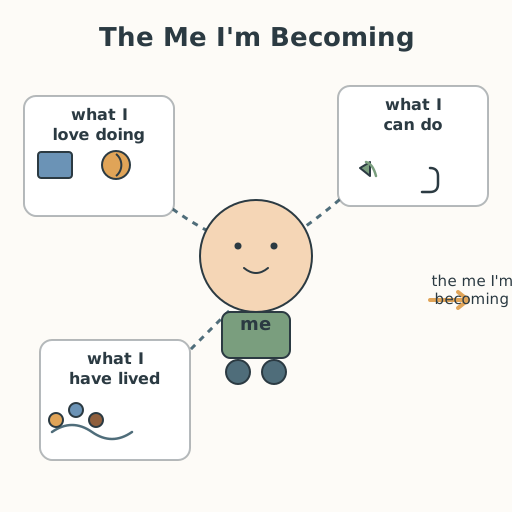
- A 'me' map page · 1 per learner Three branches labeled "what I love doing," "what I can do," and "what I have lived" leading to a center "me"
- Crayons or colored pencils · per learner
- A personal portfolio folder · 1 per learner To keep this year's reflection pages together for the celebration
Low-tech / no-cost
- A plain sheet of paper Draw the three branches by hand; no printed page needed
- Voice and memory Tell your three branches aloud to a partner instead of drawing them
Enriched / lab & device
- Camera or tablet · 1 per group Photograph each learner's "me" map to include in a digital portfolio
- A printed "all about me" template with sentence frames · 1 per learner Supports writing a short reflection paragraph
Works in different contexts
- large-group Do the three-branch brainstorm as a whole-class chart first, then learners fill in their own maps
- self-directed A learner completes the map alone, then shares one branch with a trusted person
- outdoor-only Gather three small found objects to stand for the three branches and lay out the map on the ground before drawing it
- multi-age Older learners model their own completed map and coach younger learners through each branch
- level-grouped Learners ready to extend write a short paragraph explaining how one experience changed how they see themselves
Lesson 1 — The Me I’m Becoming
Summary
The year ends by looking at the person each learner is becoming. Learners build a “me” map with three branches — what I love doing (interests), what I can do (abilities), and what I have lived (experiences) — and explain, in their own words, how those three things shape their sense of self. The page joins their portfolio and becomes the foundation for the closing celebration.
Objectives
- Explain how their interests, abilities, and experiences shape their sense of self. (D01.S2.04.01)
Connection
Think of a favorite food you learned to love because someone in your family made it — that is an experience. Think of a game or subject you can’t stop wanting to do — that is an interest. Think of something you can do now that you could not do last year, like swim farther, read harder books, or keep your temper a little longer — that is an ability. All three mix together to make you you. Today you map the recipe of yourself and notice the person it is making.
Materials
- A “me” map page (three branches to a center “me”)
- Crayons or colored pencils
- A personal portfolio folder
Preparation
- Prepare the “me” map page: three labeled branches (“what I love doing,” “what I can do,” “what I have lived”) that meet at a center circle labeled “me.”
- Set out crayons or colored pencils.
- Have each learner’s portfolio folder ready to receive the page.
Facilitator note
This lesson is written to the learner (“you”). It is the unit’s opening reflection, and it sets the tone for the whole closing: every child is becoming someone, and no one is finished. Two commitments matter most. First, keep the reflection descriptive, not ranked — there are no “best” interests or abilities; a love of caring for a pet is as real as a love of numbers. Second, hold every life story gently: a learner may have moved homes, changed caregivers, or lost someone, so “what I have lived” must always be the child’s own choosing, never a demand to disclose. Give the sentence frame “I have lived through ___ , and it taught me ___” only as an option, and honor a pass. The phrase “sense of self” is the abstraction to unpack — model it aloud: “my sense of self is the story I tell myself about who I am.” For a learner who is blind or has low vision, make the map in words or tactually (three folded corners or three raised dots). For a learner who does not use a speaking voice, accept pointing, drawing, signing, or a partner voicing. Keep the tone warm: this is wonder at a growing person, not a test.
Procedure
- Gather (5 min). You have grown a whole year. Today you notice who you are becoming. Everyone is becoming someone, and no one is finished.
- Meet the three branches (10 min). Look at your “me” map. It has three branches and a center. Interest = what you love doing. Ability = what you can do. Experience = what you have lived. Talk about one example of each, together, so the words are clear.
- Fill your map (15 min). On each branch, write or draw two or three true things. What do you love doing? What can you do — now, this year? What have you lived that shaped you? These are yours; share only what you choose.
- Explain how it shapes you (10 min). Now the center. Read your three branches and ask: How do these make me who I am? Write or draw one sentence in the center, or tell it to a partner. Example: “Because I love drawing and I practiced, I see myself as an artist.”
- Look ahead (5 min). Draw or imagine a small arrow past your map that says “the me I’m becoming.” You are not finished. This map is a snapshot of right now.
- Close (5 min). Put your map in your portfolio. It is the first page of the story of who you are becoming.
Differentiation
- Support: Offer a menu of example interests, abilities, and experiences to choose from; scribe the center sentence a learner says.
- Support (non-speaking): Point, sign, or draw each branch; a partner voices the center sentence.
- Support (blind/low-vision): Build the map in words or tactually; the three branches live in memory and speech, not pictures.
- Support (experienced loss or change): Honor a pass on “what I have lived”; the learner may write “I am still learning to say it.”
- Extension: Write a short paragraph explaining how one experience changed how you see yourself, and what you predict you will become next.
Assessment
- Formative (self + portfolio + observation): Can the learner name at least one interest, one ability, and one experience, and connect them to a sense of self — by word, drawing, sign, or a partner voicing?
- Observation: Does the learner speak of themselves with a “becoming,” not-finished frame (e.g., “I am getting better at…”)?
Home connection
Take your “me” map to someone who cares for you and tell them one thing from each branch — one thing you love doing, one thing you can do, and one thing you have lived that shaped you.
Resources
- CASEL SEL Framework (self-awareness): https://casel.org/fundamentals-of-sel/
- Erikson, E. H. (1950). Childhood and Society — identity as a developing, lifelong process (for facilitator background).