Lesson 06 — Living by a Value I Care About
Learners move from naming values to living them. They watch a worked example of a value turned into a real action, then write or draw a real (or imagined) moment when they lived by fairness, honesty, or kindness — and set a small "next time I will" commitment. They learn that a value is proven by what a person *does*, not just what they say.
Objectives
Objectives
- D01.S2.05.01 Name values they care about, such as fairness, honesty, and kindness, and give an example of living by one.
Essential question
What does it look like to actually live by one of my values?
Key vocabulary
Materials
Standard materials
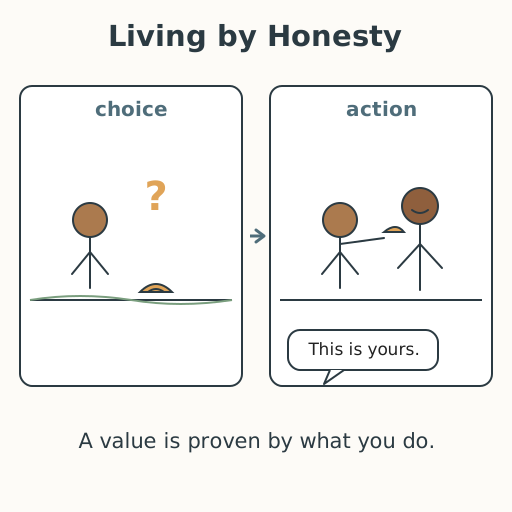
- Living-by-a-value poster · 1 A poster showing one value and a real scene of a person acting on it (returning a dropped item, sharing fairly, helping a newcomer)
- Blank 'living by a value' page · 1 per learner A page with space for the learner's value, a drawn or written example, and a 'next time I will' line
- Pencils and crayons · per learner
Low-tech / no-cost
- Role-play a value in action In pairs, act out a small scene of living by fairness, honesty, or kindness; no poster needed
- Spoken examples in a circle Each learner tells one real or imagined moment of living by a value, using only their voice
Enriched / lab & device
- Laminated 'value in action' photo cards · 1 set per pair Durable scenes for sorting under value headings (fairness / honesty / kindness) and for writing matching captions
- A class 'living our values' journal · 1 A shared journal where learners record small acts of living by their values over the week
Works in different contexts
- large-group Model one worked example together on the board, then have learners write their own and share in small groups before a few share out
- multi-age Younger learners draw the action; older learners write the value, the action, and a sentence about why it matters
- self-directed A learner chooses one value, writes a real or imagined example, and records a 'next time I will' commitment for themselves
- level-grouped Learners ready to extend write two examples — one easy and one hard — and compare what made the hard one hard
- outdoor-only In a circle, each learner names a value and a small real way they could live it before the day ends; no paper needed
Lesson 6 — Living by a Value I Care About
Summary
Learners move from naming values to living them. They study a worked example of a value turned into a real action, then write or draw a real (or imagined) moment when they lived by fairness, honesty, or kindness — and set a small “next time I will” commitment. The central idea: a value is proven by what a person does, not just what they say.
Objectives
- Name values they care about, such as fairness, honesty, and kindness, and give an example of living by one. (D01.S2.05.01)
Connection
A value you only say is like a seed you never plant. A value you live by is the seed growing — the fair share you give, the true word you speak, the help you offer. Whether you return a dropped coin purse, tell the truth about a broken cup, or sit with a lonely newcomer, the small deed is the value made real. All over the world, a person’s values are read not from their words but from their choices and actions.
Materials
- Living-by-a-value poster
- Blank “living by a value” page
- Pencils and crayons
Preparation
- Print or draw the living-by-a-value poster (a value paired with a real scene of acting on it).
- Copy a “living by a value” page for each learner.
- Arrange a circle and space for paired role-play.
Facilitator note
This lesson is written to the learner (“you”). The idea to land is that a value is
shown in action, and that even a small deed counts — this protects learners from the
perfectionism of “I must do something big to matter.” Model the worked example first
(Kirschner, Sweller & Clark, 2006): value → choice → action. Let learners write an
imagined example if a real one is hard to recall — the skill is connecting value to
deed, not confessing a deed. Never grade whose example is “more virtuous”; celebrate each
value lived, however small. See docs/philosophy.md §8 on mastery, not ranking.
Procedure
- Gather (5 min). Last time you named the values you care about. Today the harder, truer question: what does it look like to live by one?
- Watch a value turn into action (10 min). Look at the poster. Here is a worked example. Value: honesty. Choice: a child finds a dropped coin purse on the path. Action: the child runs it back to the person who dropped it, saying, “This is yours.” The value was never said out loud — it was done. That is living by a value.
- Practice matching (10 min). In pairs, act out a tiny scene of living by one value — fairness, honesty, or kindness. Let your partner guess which value you showed. Notice: the value shows up in the doing.
- Your own example (15 min). On your page, write or draw the value you chose, and one real (or imagined) moment you lived by it. Then finish this line: “Next time I will…” — one small, doable way to live that value again soon.
- Close (5 min). A value is not a poster on a wall; it is a choice you make again and again. Each small deed is you, becoming the person you mean to be.
Differentiation
- Support: Offer three illustrated “value in action” scenes to choose from and label; use a sentence starter for the commitment (“Next time I will ___”).
- Extension: Write two examples — one easy and one hard — and name what made the hard one hard, and what helped you still do it.
Assessment
- Formative (observation): Can the learner connect a value to a concrete example of acting on it, and state one small next step?
- Self-check: The learner checks that their example is a real action, not only a word, and that their “next time” step is small enough to actually do.
Home connection
Choose one value and do one small, real deed today — then tell someone at home what you did and which value it lived.
Resources
- Explicit modeling before independent practice supports novice learners (Kirschner, Sweller & Clark, 2006). Values-in-action connect to CASEL’s responsible-decision-making competency: https://casel.org/fundamentals-of-sel/