Lesson 07 — What Shapes Me: Family, Culture, Place, and History
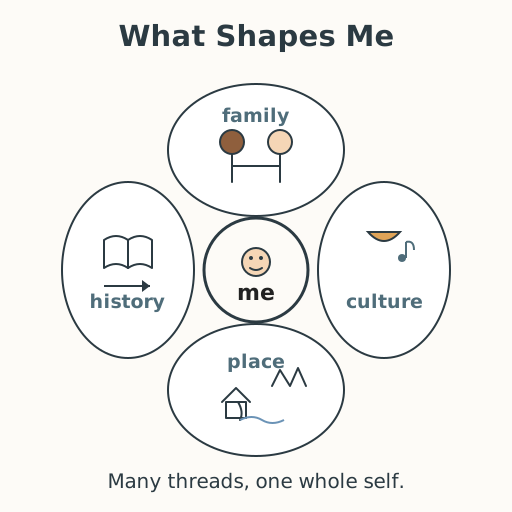
Learners learn that identity is not one thing but is shaped by four forces: family, culture, place, and history. Using a four-petal diagram, they fill in what each shaper contributes to who they are, and explain how one of them has shaped them. They hold each learner's family shape, place, and history — including adoption, loss, and moving — as equally worthy of honor.
Objectives
Objectives
- D01.S2.05.02 Explain how a person's identity is shaped by family, culture, place, and history.
Essential question
How am I shaped by family, culture, place, and history?
Key vocabulary
Materials
Standard materials
- Four-shapers-of-me poster · 1 A poster with a central "me" and four petals — family, culture, place, history
- Blank four-petal 'what shapes me' page · 1 per learner A page with a center "me" and four petals to fill in with drawings or words
- Pencils and crayons · per learner
Low-tech / no-cost
- A four-square drawn in the dirt or sand Draw a center circle and four petals on the ground; step into each and say one thing about that shaper of you
- Voice and memory Tell one thing from each of the four shapers aloud; no page needed
Enriched / lab & device
- Laminated four-petal identity frame · 1 per learner A reusable frame with dry-erase markers to revisit and update as identity grows over the year
- A class 'our many shapes' gallery · 1 A shared wall of four-petal pages showing the many families, cultures, places, and histories in the room
Works in different contexts
- large-group Build one shared example together on the board, then have learners fill their own petals in small groups and read aloud a single petal each
- multi-age Younger learners draw one thing in each petal; older learners write a sentence per petal and share one with a partner
- self-directed A learner fills all four petals and writes one sentence explaining how one shaper changed who they are
- level-grouped Learners ready to extend add a fifth petal (language, faith, ability, or a chosen community) and explain why it belongs
- outdoor-only Draw the four-petal shape in the ground and step into each petal to name one thing that shapes you; no paper needed
Lesson 7 — What Shapes Me: Family, Culture, Place, and History
Summary
Learners learn that identity is not one thing but is shaped by four forces: family, culture, place, and history. Using a four-petal diagram, they fill in what each shaper contributes to who they are, then explain in a sentence how one of them has shaped them. Throughout, they hold each learner’s family shape, place, and history — including adoption, loss, and moving — as equally worthy of honor.
Objectives
- Explain how a person’s identity is shaped by family, culture, place, and history. (D01.S2.05.02)
Connection
Who are you? Not one answer, but many threads woven together: the family that raised you (in whatever shape it takes), the culture you share (its foods, words, music, ways of belonging), the place you live or come from (a city block, a river valley, a coast), and the history behind you (stories, moves, and people who came before). Pull any one thread and you change the cloth. Knowing your threads — and honoring that every person’s cloth is different — is how you understand yourself and make room for others.
Materials
- Four-shapers-of-me poster
- Blank four-petal “what shapes me” page
- Pencils and crayons
Preparation
- Print or draw the four-shapers-of-me poster (center “me,” four petals: family, culture, place, history).
- Copy a four-petal page for each learner.
- Arrange a circle and a quiet space for individual work.
Facilitator note
This lesson is written to the learner (“you”). The idea to land is that identity has
four shapers — family, culture, place, history — and that every form of each is
worthy. Handle family with care: family means “the people who care for you” and may
include two parents, one parent, grandparents, adoptive or foster parents, siblings, or a
chosen community. Handle history gently: some histories include adoption, loss, or
leaving a home. Never require a learner to share a painful detail; let them fill a
petal with what feels safe and leave what does not. Celebrate the many shapes in the
room as a strength. See docs/facilitation.md on holding difficult topics safely.
Procedure
- Gather (5 min). You know how feelings are shaped — by thoughts, memories, and your body. Now a bigger question: what shapes you? The answer has four parts.
- Meet the four shapers (10 min). Look at the poster: a center me with four petals. Family — the people who care for you, whatever shape that takes. Culture — shared foods, words, music, and ways of belonging. Place — where you live or come from. History — the stories and people and moves that came before you. Worked example: a child named Kofi says — family: my aunt and cousin; culture: the songs and food of our home; place: a city by the sea; history: we moved here two years ago. Four threads, one self.
- Fill your petals (20 min). On your page, fill each petal with a drawing or a few words — as much as feels safe to share. There is no “right” family shape, no “better” place. Your threads are yours.
- Explain one shaper (10 min). Choose one petal and write one sentence: “___ has shaped me because ___.” Share your sentence with a partner if you wish.
- Close (5 min). You are many threads woven together — and every thread, and every person’s cloth, deserves honor. Next time, you will draw your full identity map.
Differentiation
- Support: Offer picture prompts for each petal (a house, a bowl of food, a map, an old photo) and a sentence starter; scribe as needed.
- Extension: Add a fifth petal (language, faith, ability, or a chosen community) and write why it belongs on your flower.
Assessment
- Formative (observation): Can the learner name all four shapers and give at least one real detail for each?
- Portfolio: The four-petal page, kept as an artifact of the learner’s growing identity.
Home connection
Ask a family member or caregiver to help you add one detail to a petal — a family story, a food, a place name, or a person who came before you.
Resources
- Identity as shaped by family, culture, place, and history is a core idea in developmental psychology (Erik Erikson’s identity stage) and in CASEL’s self-awareness competency: https://casel.org/fundamentals-of-sel/