Lesson 01 — My Mind and My Body Are Connected
Learners discover the mind–body connection with a simple, relatable example: a worry in the mind can show up as a tight feeling in the stomach. They learn that thoughts and feelings are not "just in the head" — they send signals to the body. Each learner traces one safe feeling of their own and marks where it shows up in their body.
Objectives
Objectives
- D03.S1.05.01 Explain the mind-body connection with a simple example, such as how worry can make a stomach feel tight.
Essential question
How can a worry in my mind show up in my body?
Key vocabulary
Materials
Standard materials
- Mind–body connection poster · 1 A poster showing a worried thought flowing into a body outline with a tight, shaded stomach
- Blank body outline page · 1 per learner A simple body outline with space to color where a feeling shows up and write the feeling name
- Pencils and crayons · per learner
Low-tech / no-cost
- Your own body and voice Name a feeling aloud and point to where it shows up in your body; no poster or page needed
- Chalk or a stick drawn on the ground Draw a simple body outline in the dirt or sand and mark the spot where a feeling lives
Enriched / lab & device
- A class 'body signal' chart · 1 A shared chart where learners post a feeling and the body spot where it shows up, building a class map of mind–body connections
- A tablet or camera · 1 per group To record a short 'this feeling lives here in my body' clip for a class gallery
Works in different contexts
- large-group Work one big example on the board together — worry to tight stomach — then have learners mark their own body outline in small groups
- multi-age Younger learners point to a body part and say the feeling; older learners explain the connection between the thought and the body signal
- self-directed A learner recalls one safe feeling, colors the body spot where it showed up, writes the feeling name, and reads it back to check it makes sense
- level-grouped Learners ready to extend trace two different feelings and compare where each shows up in the body
- outdoor-only Draw a body outline on the ground and step to the spot where a named feeling lives, saying the feeling aloud
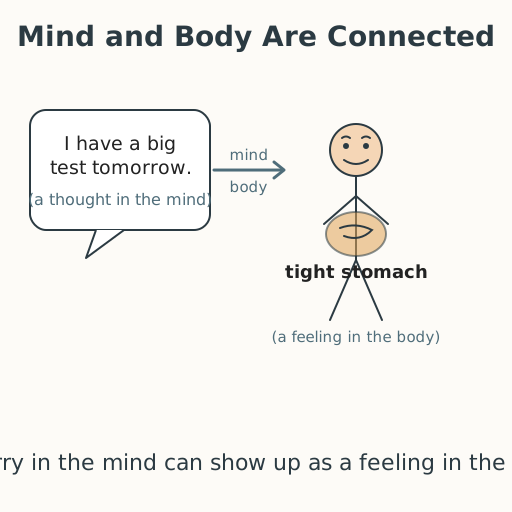
Lesson 1 — My Mind and My Body Are Connected
Summary
Learners meet the mind–body connection: a thought or feeling in the mind can show up as a sensation in the body. They work with a simple, relatable example — worry making a stomach feel tight — and then trace one safe feeling of their own, marking where it shows up in their own body on a body outline. This is the first step of a unit about knowing the body with precision, dignity, and joy.
Objectives
- Explain the mind–body connection with a simple example, such as how worry can make a stomach feel tight. (D03.S1.05.01)
Connection
Think of a time you had to speak in front of people, or wait for a result that mattered. Maybe your stomach felt tight, or your hands felt shaky, even though your mind was just thinking. That is the mind–body connection: what happens in your mind — a worry, a hope, an excitement — sends a signal to your body. Whether you live in a busy city or on a mountain farm, and whether the feeling is a flutter or a knot, your mind and your body are always talking to each other.
Materials
- Mind–body connection poster
- Blank body outline page
- Pencils and crayons
Preparation
- Print or draw the mind–body connection poster (a worried thought flowing into a body outline with a shaded, tight stomach).
- Copy a blank body outline page for each learner.
- Arrange a circle for gathering and a quiet space for individual work.
Facilitator note
This lesson is written to the learner (“you”). The one idea to land is that the mind and
body are connected — a thought or feeling can show up as a body sensation. Keep the
examples ordinary and safe; a learner may live with real stress or illness, so do not
push anyone to reveal more than they choose. The skill is noticing the signal with
curiosity, never judging it as good or bad. If a learner names something heavy, honor it
calmly and move gently. See docs/facilitation.md on holding difficult topics safely.
Procedure
- Gather (5 min). Last year you learned that your body changes with activity and rest — your heartbeat, your breathing, your warmth. Today you learn something new and powerful: your mind and your body are connected. A thought or feeling can show up in your body before you even put it into words.
- Meet the connection (10 min). Look at the poster. It shows a worked example: a thought — “I have a big test tomorrow” — flows down into a body, and the stomach feels tight. That tight feeling is the body answering the mind. This is what “mind and body are connected” means. It works the other way too: a deep breath can calm a racing mind. The two always talk.
- Scan your body (10 min). Think of one safe, ordinary feeling you had this week — excitement, worry, tiredness, joy. Soften your gaze. Where does it show up in your body? A flutter in the chest? Warm hands? Heavy shoulders? A tight tummy? Name the spot without judging it.
- Trace your own (15 min). On your body outline page, color the spot where that feeling lives for you, and write the feeling’s name beside it. Check with a partner: does your friend’s feeling show up in the same place or a different one? There is no wrong answer — every body speaks in its own way.
- Close (5 min). Your body is not separate from your feelings; it is where they live. Noticing the signal is the first step to understanding yourself — and to taking care of yourself.
Differentiation
- Support: Offer a word bank of feelings and a pre-labeled body outline to color instead of writing; scribe the feeling name.
- Extension: Trace two feelings and compare where each lives, then name one way the body signal helped them know what they felt sooner.
Assessment
- Formative (observation): Can the learner name a feeling and point to a body spot where it shows up, explaining the mind–body connection in their own words?
- Self-check: The learner points to their marked spot and asks, “Is this truly where and how that feeling shows up for me?”
Home connection
Ask someone at home: “Where in your body do you feel worry or joy?” and share one body signal you noticed in yourself today.
Resources
- The idea that thoughts and feelings are connected to body sensations is central to embodied emotion and to cognitive-behavioral approaches (see the work of Aaron Beck). For an accessible classroom framing of self-awareness, see CASEL’s self-awareness competency: https://casel.org/fundamentals-of-sel/