Lesson 02 — More Mind–Body Signals
Learners expand the mind–body connection met in Lesson 1 to a small set of common body signals — butterflies, heavy eyes, a warm chest, quick breath — and learn to match each signal to a feeling and a helpful response. They build a personal signal chart for three real signals of their own.
Objectives
Objectives
- D03.S1.05.01 Explain the mind-body connection with a simple example, such as how worry can make a stomach feel tight.
Essential question
What other signals does my mind send to my body, and what do they mean?
Key vocabulary
Materials
Standard materials
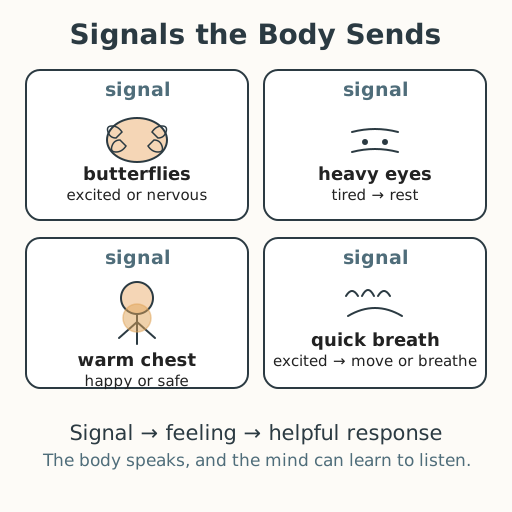
- Body signals poster · 1 A poster with four signal cards — butterflies, heavy eyes, warm chest, quick breath — each matched to a feeling and a helpful response
- Blank signal chart page · 1 per learner A page with rows for signal, feeling, and helpful response for the learner to complete
- Pencils · per learner
Low-tech / no-cost
- Voice and body Act out each signal — flutter, droop, warm smile, quick breath — and say the feeling and response aloud; no page needed
- A shared signal guessing game One learner acts out a body signal silently while others guess the feeling; no materials needed
Enriched / lab & device
- A class 'signal–feeling–response' board · 1 A shared board where learners pin signal cards to feelings and helpful responses, building a growing class chart
- Tablet or camera · 1 per group To record short 'guess my signal' clips for a class signals gallery
Works in different contexts
- large-group Go through the four worked examples together, then have pairs act out and guess signals before completing their own chart
- multi-age Younger learners act out and guess signals; older learners match each signal to a feeling and a helpful response
- self-directed A learner recalls three real signals of their own, names the feeling each carries, and writes one helpful response to each
- level-grouped Learners ready to extend distinguish two feelings that share one signal (butterflies can mean excited or nervous) and name the clue that tells them apart
- outdoor-only Act out signals in a circle and match them to feelings and responses aloud; use body and voice, no paper
Lesson 2 — More Mind–Body Signals
Summary
Learners build on Lesson 1 by meeting a small set of common body signals — butterflies, heavy eyes, a warm chest, quick breath — and learning to match each to a feeling and a helpful response. They then build a personal signal chart for three real signals of their own, strengthening the skill of reading the body’s messages with care.
Objectives
- Explain the mind–body connection with a simple example, such as how worry can make a stomach feel tight. (D03.S1.05.01)
Connection
Your body is always sending you messages — a flutter of butterflies before a performance, heavy eyes when you are tired, a warm chest when you feel safe, a quick breath when you are excited. These signals are the same in a busy market, a quiet village, or a high mountain school: the body speaks, and the mind can learn to listen. Noticing the signal — and what it is asking for — is a skill anyone can grow.
Materials
- Body signals poster
- Blank signal chart page
- Pencils
Preparation
- Print or draw the body signals poster (four signal cards, each with a signal, a feeling, and a helpful response).
- Copy a blank signal chart page for each learner.
- Arrange a circle and space for a signal guessing game.
Facilitator note
This lesson is written to the learner (“you”). The idea to land is that body signals carry
meaning, and each signal points to a helpful response. Present the responses as choices
the learner can make, never as rules — “you could rest” rather than “you must rest.”
Some learners live with bodies that signal differently (pain, fatigue, sensory differences);
honor that every body speaks its own language. Keep examples ordinary and let each learner
choose safe, real signals to share. See docs/facilitation.md on holding difficult topics
safely.
Procedure
- Gather (5 min). Last time you learned that your mind and body are connected — a worry can show up as a tight stomach. Today you meet more of the body’s language, and you learn to read it: signal → feeling → helpful response.
- Meet the signals (10 min). Look at the poster. Four worked examples. Signal: butterflies in the stomach. Feeling: excited or nervous. Helpful response: take a slow breath and name what is coming. Signal: heavy eyes. Feeling: tired. Response: rest. Signal: warm chest. Feeling: happy or safe. Response: enjoy it. Signal: quick breath. Feeling: excited. Response: move your body or take a breath. The body tells, and you can choose what to do.
- Play a guessing game (10 min). With a partner, act out one signal silently — flutter, droop, warm smile, quick breath. Let your partner guess the feeling and suggest one helpful response. Trade roles.
- Build your own chart (15 min). On your page, write three real signals your body has sent you this week. For each, name the feeling it carried and one helpful response you could choose. Share one with a partner: does the same signal ever mean different things for different people?
- Close (5 min). Your body speaks to you every day. The more you listen — signal, feeling, response — the better you can care for yourself and understand others.
Differentiation
- Support: Offer signal picture cards and a word bank to arrange into signal–feeling– response rows; scribe the learner’s responses.
- Extension: Find two feelings that share one signal (butterflies for excited and nervous) and name the clue that tells them apart — the thought, the situation, or another body cue.
Assessment
- Formative (observation): Can the learner match a signal to a feeling and name one helpful response, in the game and on their chart?
- Self-check: The learner rereads their chart and asks, “Is this really the signal my body sent, and is my response one I can actually do?”
Home connection
Notice one body signal at home tonight — hunger, tiredness, excitement — and share the signal, the feeling, and one helpful response with someone there.
Resources
- Reading the body’s signals is part of “interoception,” the sensing of the body’s inner state. For a classroom-friendly framing of self-awareness, see CASEL’s self-awareness competency: https://casel.org/fundamentals-of-sel/