Lesson 04 — Every Pace Is Normal
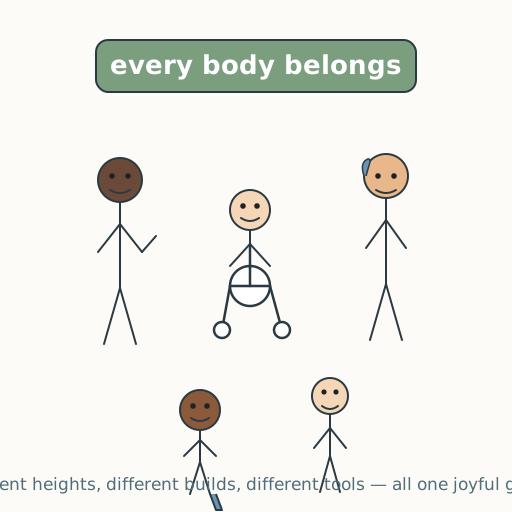
Learners honor the wide range of human bodies and abilities with dignity and joy. They meet a picture of diverse bodies — different heights and builds, a wheelchair user, a hearing aid, a prosthetic — all playing together, and learn that every pace, size, and ability is welcome. They complete an 'every body belongs' drawing and an honor statement of their own.
Objectives
Objectives
- D03.S1.05.02 Describe how bodies grow and change at different rates and that every pace is normal.
Essential question
How do I honor my own body's pace and every other body's pace with dignity and joy?
Key vocabulary
Materials
Standard materials
- Diverse bodies poster · 1 A poster showing children with diverse bodies and abilities — different heights, a wheelchair user, a hearing aid, a prosthetic — all playing together joyfully
- Blank 'every body' page · 1 per learner A page with a frame for a drawing of a welcoming scene and a sentence starter: 'Every body is honored when we ___'
- Pencils and crayons · per learner
Low-tech / no-cost
- A circle of 'every body' affirmations Take turns finishing the sentence 'Every body is honored when we ___' aloud; no page needed
- A found-object figure Build a simple figure from stones, sticks, or clay and describe one thing every body deserves; no poster needed
Enriched / lab & device
- A class 'every body belongs' mural · 1 A shared mural where each learner draws a different body — of many sizes, abilities, and aides — all part of one joyful scene
- A short video about inclusive sport or play · 1 A clip showing adapted games and assistive tools that let every body play, to discuss together
Works in different contexts
- large-group Build a shared 'every body belongs' scene on the board, then have small groups each add one diverse figure and one honor statement
- multi-age Younger learners name one thing every body deserves; older learners write how a rule or game can be changed so every body can join
- self-directed A learner draws a welcoming scene and completes the sentence 'Every body is honored when we ___', then reads it back to check
- level-grouped Learners ready to extend design one change to a game or space so a specific body — a wheelchair user, a slower runner — can fully join
- outdoor-only In a circle, take turns finishing 'Every body is honored when we ___' and name one way the group's play could welcome every body
Lesson 4 — Every Pace Is Normal
Summary
Learners take the truth from Lesson 3 — bodies grow at different rates — one step further and learn to honor the wide range of human bodies and abilities with dignity and joy. They meet a picture of diverse bodies — different heights and builds, a wheelchair user, a hearing aid, a prosthetic — all playing together, and complete an “every body belongs” drawing and an honor statement of their own. Shame has no place here; belonging does.
Objectives
- Describe how bodies grow and change at different rates and that every pace is normal. (D03.S1.05.02)
Connection
In a playground, a classroom, or a family, every body is different — some grow tall early, some later; some walk, some roll in a wheelchair; some hear with the help of a device, some move with a prosthetic. None of these is “less”; each is a real, complete way to be a person. A group that makes room for every body is not just kinder — it is stronger and more interesting. Honoring every pace and every ability is something you can practice every single day.
Materials
- Diverse bodies poster
- Blank “every body” page
- Pencils and crayons
Preparation
- Print or draw the diverse bodies poster (children of different heights and builds, a wheelchair user, a hearing aid, a prosthetic, all playing joyfully).
- Copy a blank “every body” page for each learner.
- Arrange a circle and a space for drawing.
Facilitator note
This lesson is written to the learner (“you”). The idea to land is dignity for every body:
different sizes, paces, and abilities are all normal, and every body belongs. Model
person-first, non-shaming language — “a child who uses a wheelchair,” never labels that
reduce a person to a condition. Guard against any teasing about bodies; interrupt it gently
and turn it toward honor. Some learners in the room may have bodies that are different or
disabilities; never make them the “example,” and never put them on the spot. See
docs/facilitation.md on assessing without ranking and holding difficult topics safely.
Procedure
- Gather (5 min). Last time you learned that bodies grow at different rates, and every pace is normal. Today you learn the heart of that truth: how to honor every body — your own and everyone else’s.
- Meet diverse bodies (10 min). Look at the poster. Different heights. Different builds. A child who rolls in a wheelchair. A child who hears with a hearing aid. A child who moves with a prosthetic leg. All of them are playing together, joyfully. None is missing something the others have and is “less”; each is a full person. A wheelchair, a hearing aid, a prosthetic are tools that help a body do what it wants — just like glasses help eyes see.
- Talk honor (10 min). With a partner, finish this sentence in two ways: “Every body is honored when we ___.” (Ideas: wait for a slower runner, make room for a wheelchair, speak so a friend with a hearing aid can see your face, never tease about size.) Share one aloud.
- Draw belonging (15 min). On your page, draw a scene where every body belongs — a game, a meal, a walk, a classroom — with many kinds of bodies in it. Under it, write your honor statement: “Every body is honored when we ___.”
- Close (5 min). Different is not less. A group that honors every body honors every person. You can build that group wherever you are.
Differentiation
- Support: Provide a pre-drawn scene to add diverse figures into, and a sentence starter to complete; scribe as needed.
- Extension: Design one concrete change to a game or space — a ramp, a wider gate, a slower pace, a spoken signal — so a specific body can fully join.
Assessment
- Formative (observation): Can the learner describe at least two different bodies or abilities as normal and give one concrete way every body can be honored?
- Self-check: The learner reads their honor statement and checks that it names a real action, not just a feeling.
Home connection
With someone at home, name one way your home or neighborhood could make room for a body different from your own — and one way you already do.
Resources
- Treating every body and ability with dignity reflects the social model of disability, which asks what a community can change to include everyone rather than what a person “lacks.” For accessible classroom framing, see the United Nations Convention on the Rights of Persons with Disabilities (CRPD): https://www.un.org/development/desa/disabilities/convention-on-the-rights-of-persons-with-disabilities.html